

Case Name: M/s ASP Traders vs. State of Uttar Pradesh & Ors.
Court: Supreme Court of India
Petition No.: Civil Appeal No. 9764 of 2025 [Arising out of SLP(C) No. 17995 of 2022]
Category of Dispute: Detention of Goods in Transit / Adjudication under Section 129
Date of Judgment: 24 July 2025
Relevant Sections:
-
Section 129(1), 129(3), 129(4), 129(5) of the CGST Act, 2017
-
Rule 142(3) and 142(5) of CGST Rules, 2017
-
Article 265 of the Constitution of India
Facts of the Case
-
Para 3.1–3.4: M/s ASP Traders consigned 17,850 kg of Red Arecanut worth ₹51,72,930 to Delhi. During transhipment, 7 bags were missing, triggering detention under Section 129 by GST Mobile Squad, Jhansi.
-
Para 3.5–3.6: Though ASP Traders submitted a reply to the GST MOV-07 notice, they paid ₹7,20,440 (IGST and penalty) under protest to secure release of goods, without waiver of objections.
-
Para 3.7–3.9: The Mobile Squad did not pass any final order in GST MOV-09. ASP made repeated requests and then filed a writ before Allahabad HC, seeking a direction for issuance of a final speaking order.
-
Para 3.10: The High Court held the proceedings as concluded under Section 129(5) and declined to issue a mandamus.
Question(s) in Consideration
-
Para 8: Whether payment of tax and penalty within the time stipulated under Section 129(1), even if under protest, absolves the officer from passing a reasoned order under Section 129(3) of the CGST Act?
Observations of the Court
-
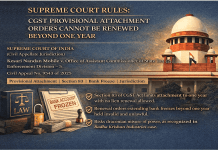
Para 14–15: Payment under protest does not waive the statutory right to appeal. Issuance of a reasoned order under Section 129(3) is mandatory, especially when objections are on record.
-
Para 16: Oral withdrawal of objections is insufficient. Written objections take precedence, and payment through DRC-03 (voluntary mode) lacks provision to indicate “under protest”.
-
Para 16.1–16.2: No tax can be levied or collected without authority of law under Article 265. The taxpayer cannot be deemed to have acquiesced to illegal levy by making payment under business compulsion.
-
Para 18: Absence of a speaking order violates principles of natural justice and renders appellate remedies under Section 107 illusory.
-
Para 19–20: Officer is duty-bound to issue GST MOV-09 and upload summary in DRC-07 as per Rule 142(5) and CBIC Circular No. 41/15/2018-GST.
Judgment of the Court
-
Para 21–22: Supreme Court set aside the High Court’s order. Directed Respondent No. 3 to pass a reasoned final order under Section 129(3) (Form GST MOV-09) and upload the summary in Form GST DRC-07 within one month after giving a hearing.
-
Appeal allowed. No costs.
Between Fine Lines
-
Even if goods are released after payment of tax and penalty, GST officer must pass a speaking order under Section 129(3).
-
Voluntary payment does not negate taxpayer’s right to appeal under Section 107.
-
Written objections submitted earlier cannot be overridden by alleged oral withdrawal.
-
Failure to pass an order defeats constitutional safeguards under Article 265.
-
Officers must adhere to CBIC Circulars and procedural mandates.
Summary of Referred Cases
| Name | Citation | Summary | Verdict/Use |
|---|---|---|---|
| Commissioner of Customs v. Dilip Kumar & Co. | (2018) 9 SCC 1 | Literal interpretation of taxing statutes preferred. | Respondent cited; SC held it inapplicable to procedural issue. |
| Sha Mulchand & Co. Ltd. v. Jawahar Mills Ltd. | AIR 1953 SC 98 | Mere waiver or laches does not amount to abandonment of statutory rights. | Cited to uphold protest payment doesn’t waive rights. |
| Bhau Ram v. Baij Nath Singh | AIR 1961 SC 1327 | Statutory right of appeal cannot be waived by receiving money under compulsion. | Used to reinforce right of appeal is independent and preserved. |
| M/s Kranti Associates Pvt. Ltd. v. Masood Ahmed Khan | (2010) 9 SCC 496 | All quasi-judicial orders must be reasoned; non-speaking orders are void. | Used to reinforce need for reasoned adjudication. |
Disclaimer – “The above summary is for academic purpose only; not formal legal opinion. Seek professional opinion before application. Author or publisher or website shall not be responsible for any usage in any form.”

 even after payment of penalty for detained goods. A landmark case reinforcing procedural fairness and taxpayer rights.)