
Case Summary
Case Title: Marcowagon Retail Pvt. Ltd. & Anr. v. Union of India & Ors.
Court: High Court of Gujarat, Ahmedabad
Petition No.: R/Special Civil Application No. 2234 of 2025 with 2236 of 2025
Date of Judgment: 24.04.2025
Bench: Justice Bhargav D. Karia & Justice D.N. Ray
Category: Penalty on expired e-way bill in case of zero-rated exports (Section 129)
Relevant Sections: Section 129 CGST Act, Section 16 IGST Act, Rule 138 CGST Rules
Facts (Paras 4–14)
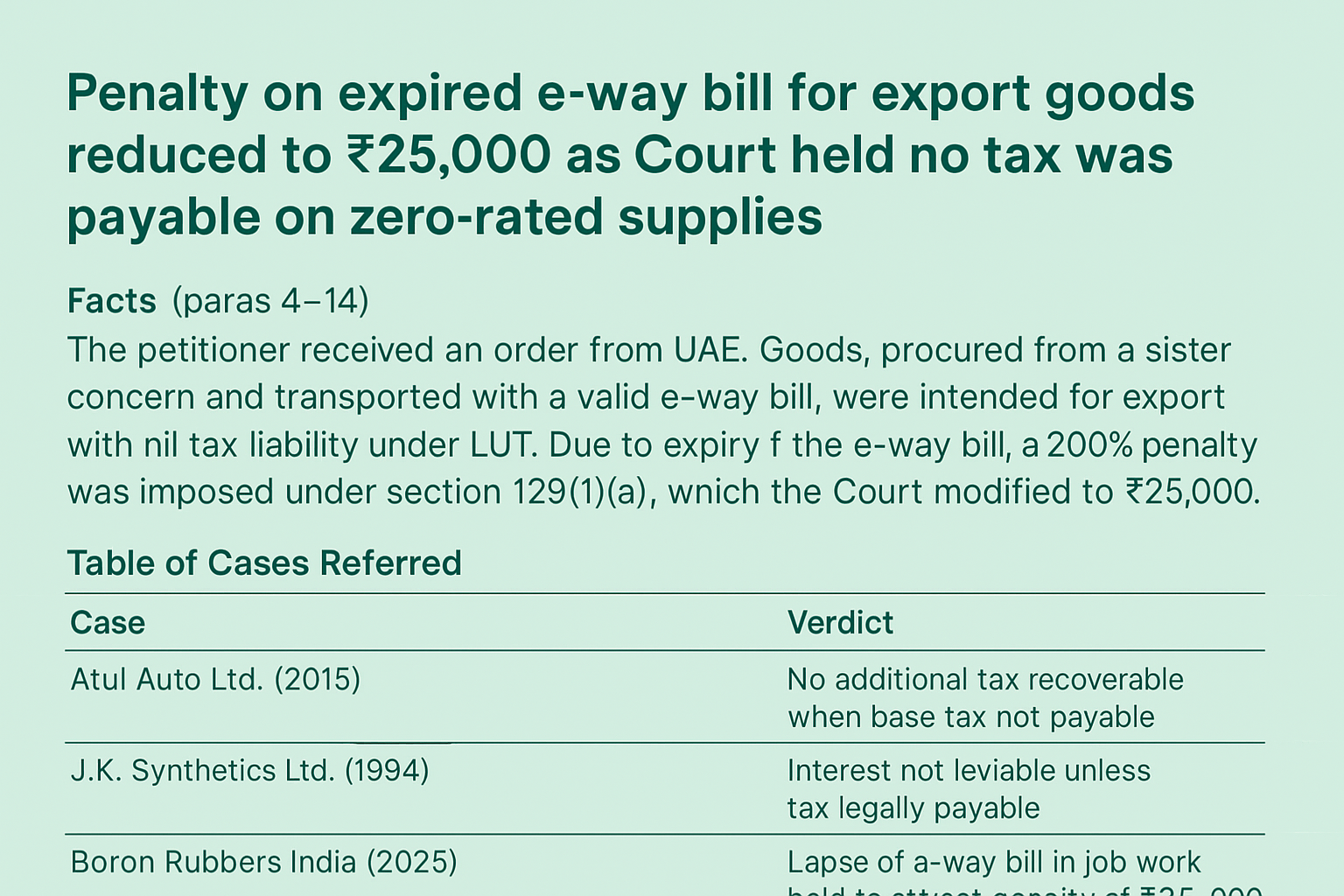
The petitioner, an exporter, received an order from UAE for sports apparel. Goods were procured from Gurugram through a sister concern and transported to Mundra Port with valid invoices, e-invoice, and e-way bill. However, due to vehicle breakdown and Diwali holidays, the e-way bill (valid up to 04.11.2024) expired. On 08.11.2024, the vehicle was intercepted, and proceedings under Section 129 were initiated. Despite submitting that the supply was zero-rated (export under LUT) with nil tax liability, the authority imposed 200% penalty of the tax leviable. Petitioners furnished a bank guarantee for release of goods and challenged the penalty.
Questions Before the Court
-
Whether penalty under Section 129(1)(a) can be levied when goods were zero-rated exports with nil tax payable?
-
Whether expired e-way bill for export goods amounts to contravention warranting penalty equal to 200% of tax not payable?
Observations (Paras 26–33)
The Court noted that zero-rated supplies under Section 16 IGST Act are distinct from exempt supplies. While tax is leviable on exports, no tax is payable if exported under LUT. Penalty computation under Section 129(1)(a) depends on “tax payable.” Since exports under LUT attract no tax, 200% penalty was without jurisdiction. The contravention of Rule 138 (expiry of e-way bill) is procedural. Court relied on Atul Auto Ltd. (2015), J.K. Synthetics (1994), and Boron Rubbers India (2025) to hold that penalty cannot be on notional tax but limited to ₹25,000 as applicable to exempted goods.
Judgment (Paras 34–37)
The Court modified the impugned penalty order, reducing penalty to ₹25,000. It directed release of bank guarantee furnished by the petitioner. However, costs of ₹10,000 per petition were imposed on the petitioner for initially suppressing facts about its sister concern transactions.
Table of Cases Referred
| Case | Court & Year | Verdict |
|---|---|---|
| Atul Auto Ltd. v. State of Gujarat | Gujarat HC, 2015 | No additional tax recoverable when base tax not payable. |
| J.K. Synthetics Ltd. v. CTO | SC, 1994 | “Tax payable” ≠ “tax due”; interest not leviable unless tax legally payable. |
| Boron Rubbers India v. Union of India | Gujarat HC, 2025 | Penalty for e-way bill lapse in job work supply restricted to ₹25,000 treating supply as exempt. |
| Rayzon Solar Pvt. Ltd. v. State of Gujarat | Gujarat HC, 2024 | Petition not entertained due to availability of appellate remedy under Section 107. |
Between Fine Lines
This judgment makes it clear that while expired e-way bills can invite penalty under Section 129, the computation must be tied to actual tax payable. For zero-rated exports under LUT, no tax is payable, hence penalty cannot be based on a notional tax. In such cases, maximum penalty exposure is ₹25,000. However, businesses must maintain accurate disclosures as suppression of facts may still attract costs.
Disclaimer – “The above summary is for academic purpose only; not formal legal opinion. Seek professional opinion before application. Author or publisher or website shall not be responsible for any usage in any form.”