

Case Reference
M/s Sohan Singh Meet Singh and Sons v. Union of India & Ors.
High Court of Himachal Pradesh, Shimla
CWP No. 3750 of 2024
Judgment dated: 5th November, 2024
Category: Classification / Levy of GST on Royalty
Relevant Sections: Section 9 CGST Act, 2017; Notifications No. 1/2017 & 11/2017 CT (Rate) dated 28.06.2017; Notification No. 27/2018 CT (Rate) dated 31.12.2018
Facts (Paras 1–4)
The petitioner, a mining concession holder, approached the High Court seeking quashing of GST levy on royalty paid to the State for mining rights. They challenged multiple Central and State notifications imposing GST on royalty (Annexures P-1 to P-6) and further sought refund of amounts already collected. The basis of their claim was the Supreme Court’s earlier seven-judge bench ruling in India Cement Ltd. v. State of Tamil Nadu (1990) 1 SCC 12, which had held that royalty constituted a “tax,” and therefore could not attract GST simultaneously. Relying on this, the Himachal High Court had earlier granted interim protection against GST demand on royalty.
Questions for Consideration (Paras 2–3)
The central issue was whether GST could be levied on royalty payments made by a mineral concession holder to the State Government for mining concessions.
Observations (Paras 3–5)
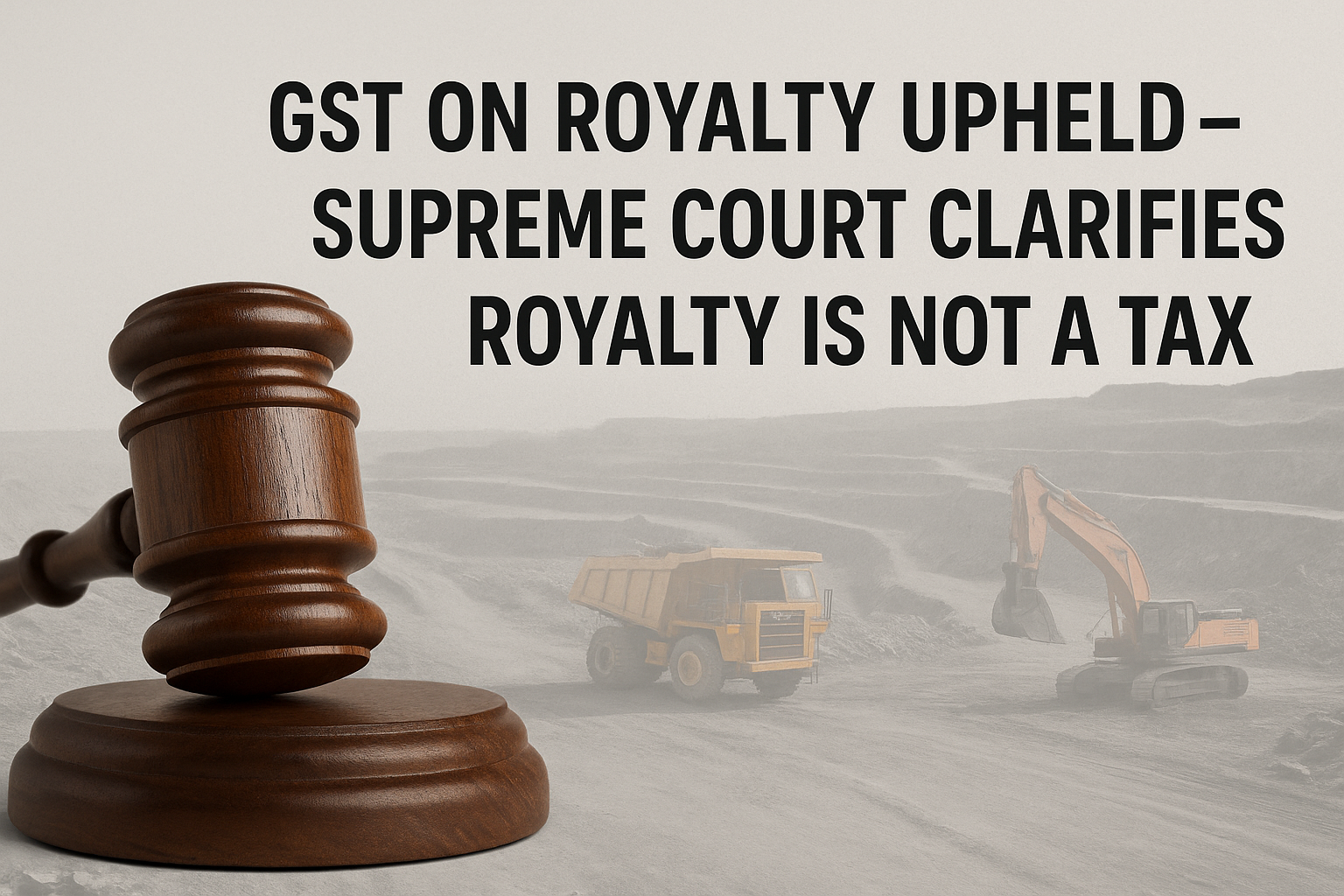
The Court noted that the petitioner’s reliance on India Cement Ltd. was misplaced in light of the subsequent nine-judge bench decision in Mineral Area Development Authority v. Steel Authority of India Ltd., 2024 INSC 554. The Supreme Court in this landmark judgment expressly overruled India Cement and held that royalty is not a tax but a contractual payment for the grant of mining rights. Consequently, royalty payments fall within the ambit of “supply” and attract GST under Section 9 of the CGST Act. The Court emphasized that once the highest court has settled the position, the High Court cannot interfere with the levy.
Judgement (Paras 5–6)
The Court upheld the demand notices and summons issued to the petitioner dated 16.02.2024 and 15.03.2024. The writ petition was dismissed with no order as to costs. The High Court concluded that levy of GST on royalty is legally valid as per the binding pronouncement of the Supreme Court.
Table of Cases Referred
| Case | Court | Verdict |
|---|---|---|
| India Cement Ltd. v. State of Tamil Nadu (1990) 1 SCC 12 | Supreme Court (7-Judge Bench) | Held royalty to be a tax; GST not leviable simultaneously. Overruled later. |
| Mineral Area Development Authority v. Steel Authority of India Ltd., 2024 INSC 554 | Supreme Court (9-Judge Bench) | Held royalty is not a tax but consideration; GST leviable on royalty for mining concessions. Binding precedent applied. |
Between Fine Lines
This judgment firmly settles that GST on royalty for mining rights is valid and enforceable. With the Supreme Court’s nine-judge bench ruling, all pending litigations challenging GST on royalty will now lose ground. For businesses in mining and allied sectors, royalty payments must be treated as taxable supplies under GST and compliances aligned accordingly, as refund claims or disputes based on earlier India Cement precedent will not sustain.
Disclaimer – “The above summary is for academic purpose only; not formal legal opinion. Seek professional opinion before application. Author or publisher or website shall not be responsible for any usage in any form.”

