ChatGPT said:
Case Summary
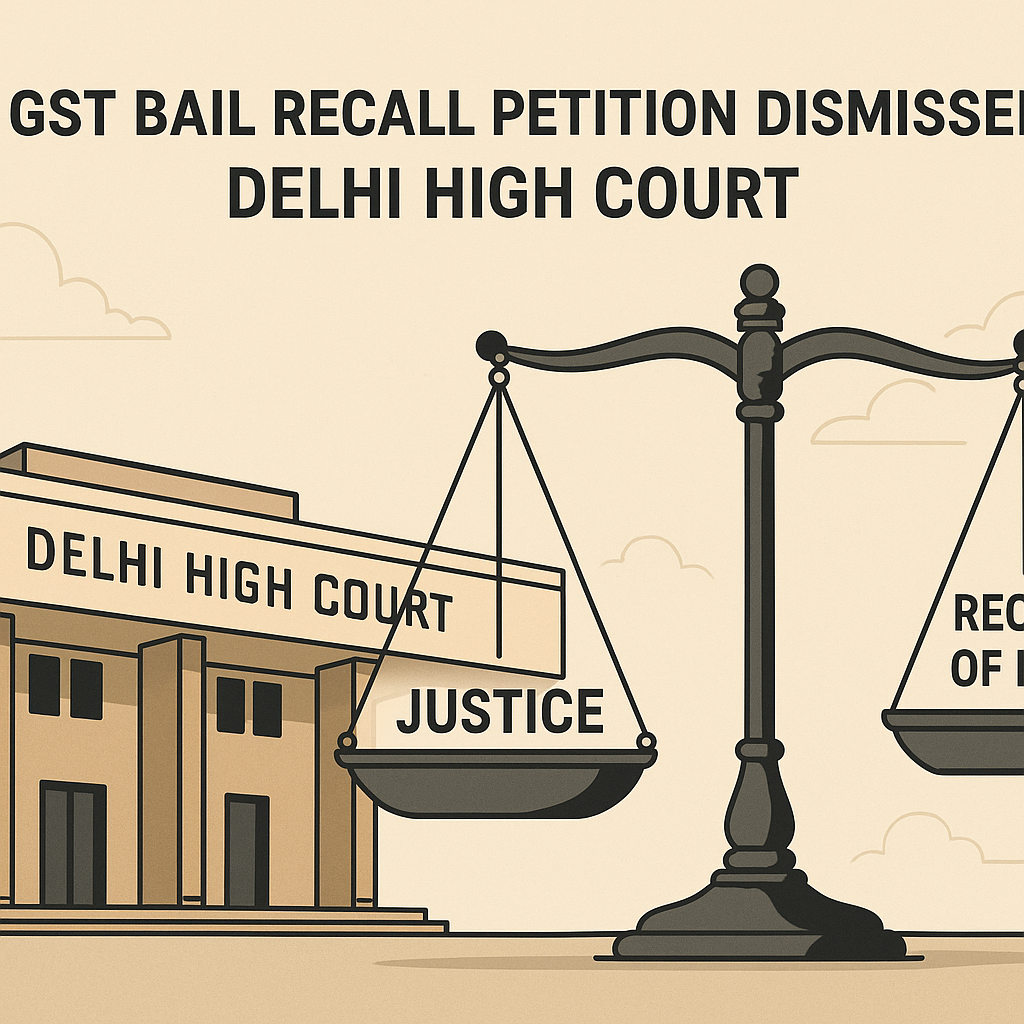
Case Title: Directorate General of GST Intelligence v. Rakesh Kumar Goyal
Court: High Court of Delhi
Petition No.: CRL.M.C. 631/2021
Date of Judgment: 27 June 2025 (Reserved on 04 March 2025)
Relevant Sections: Section 132(1)(c) of the CGST Act, 2017; Section 482 & 439 of CrPC, 1973
Category: Bail in GST Fraud/ITC Availment Case
Facts (Paras 1–6, 9–20)
The Directorate General of GST Intelligence (DGGI) filed a petition under Section 482 CrPC seeking recall of the bail order dated 23.12.2020 granted to Rakesh Kumar Goyal. The respondent was accused of orchestrating fraudulent availment of Input Tax Credit (ITC) through companies such as M/s Aastha Apparels Pvt. Ltd., M/s JBB Apparels Pvt. Ltd., M/s JBN Apparels Pvt. Ltd., and M/s Nautilus Metal Craft Pvt. Ltd. Investigations revealed circular trading and use of fictitious firms, leading to fraudulent ITC claims and IGST refunds worth over ₹61 crores. Despite repeated summons, the respondent allegedly remained non-cooperative. His bail had been earlier rejected twice but was granted by the CMM on the third application.
Questions before the Court (Paras 6–14, 35–37)
-
Whether the grant of bail by the CMM on the third application amounted to judicial impropriety in absence of change in circumstances.
-
Whether the respondent’s past conduct and non-cooperation warranted cancellation of bail.
-
Whether filing of the complaint/chargesheet was sufficient to constitute a change in circumstance justifying bail.
Observations (Paras 23–41)
The Court referred to Laxman Irappa Hatti v. State of Maharashtra (2004 CRILJ 3802), which clarified that considerations before and after filing of a chargesheet differ. At the investigation stage, courts must consider whether custody is essential to prevent tampering or obstruction. However, after chargesheet filing, the focus shifts to the gravity of offence and the triple test: risk of flight, likelihood of influencing witnesses, and tampering with evidence.
The Court noted that in this case the evidence was largely documentary, unlikely to be tampered with post-bail. There was no evidence that the respondent was a flight risk or had misused bail. The grant of bail by CMM was thus not perverse. Parity with co-accused was not the sole ground; it was one among several considerations.
Judgment (Paras 42–43)
The High Court held that filing of the chargesheet was indeed a substantial change of circumstances. The discretion of the CMM in granting bail was judiciously exercised. There was no misuse of liberty by the respondent post-bail, nor any hindrance to trial. Consequently, the petition to recall bail was dismissed.
Table of Cases Referred
| Case | Court & Citation | Ratio/ Verdict |
|---|---|---|
| Shahzad Hasan Khan v. Ishtiaq Hasan Khan (1987 AIR SC 1613) | Supreme Court | Held that dismissal by one judge and grant of bail by another without change in circumstances is judicial impropriety. |
| State of Maharashtra v. Captain Buddhikota Subha Rao (1989 AIR SC 2292) | Supreme Court | Once bail is rejected, grant on similar grounds without new circumstances amounts to overruling earlier decision. |
| Neera Yadav v. State of UP (Crl. Appeal No.1272/2015) | Supreme Court | Reinforced principles of judicial propriety in successive bail applications. |
| Ajay Sagar v. DRI (2009 (3) JCC 1726) | Delhi HC | Addressed bail discretion in economic offences. |
| Laxman Irappa Hatti v. State of Maharashtra (2004 CRILJ 3802) | Bombay HC | Filing of chargesheet constitutes change in circumstances for considering bail. |
| State of Gujarat v. Mohanlal Jitamalji Porwal (1987) 2 SCC 364 | Supreme Court | Economic offences are grave and affect national economy; courts must adopt stringent approach. |
Between Fine Lines
For businesses and trade, this case underscores that filing of a chargesheet is a game-changer in bail jurisprudence. Once investigations are complete, courts are more inclined to weigh bail on the triple test rather than mere allegations of fraud. For GST fraud cases, unless the accused is a flight risk, likely to tamper with evidence, or influence witnesses, bail is less likely to be cancelled once granted.
Disclaimer – “The above summary is for academic purpose only; not formal legal opinion. Seek professional opinion before application. Author or publisher or website shall not be responsible for any usage in any form.”