
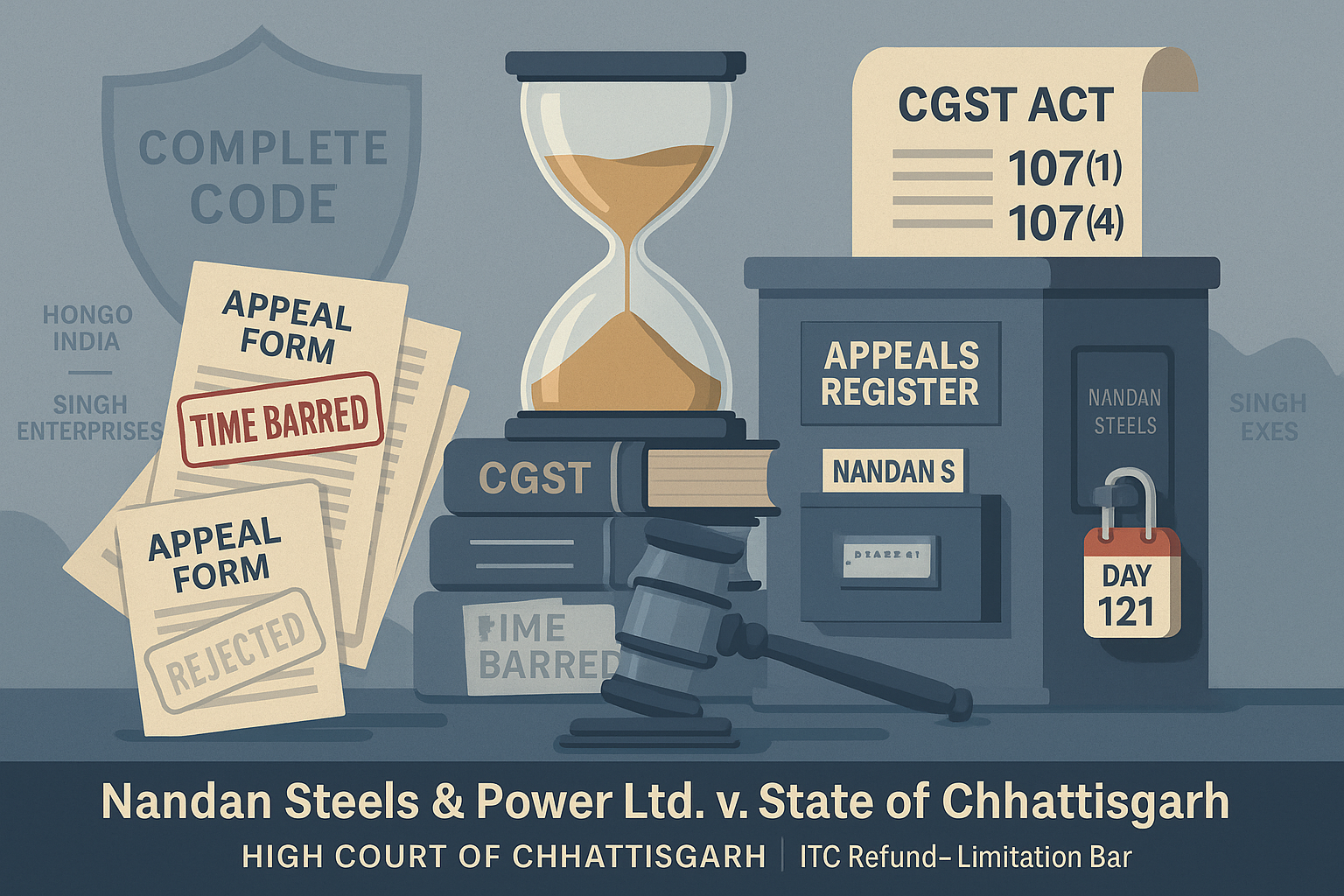
Case Title: Nandan Steels and Power Ltd. v. State of Chhattisgarh
Court: High Court of Chhattisgarh
Petition No.: WA No. 104 of 2021
Category of Dispute: Refund / Input Tax Credit – Limitation under CGST
Date of Judgment: 10 August 2022
Relevant Sections: Section 107(1) and 107(4) of the CGST Act, 2017; Section 29(2) of the Limitation Act, 1963
Facts of the Case
- The appellant, Nandan Steels and Power Ltd., filed Form TRAN-1 to claim CGST input tax credit of ₹30,74,436/-. The adjudicating authority disallowed ₹25,33,950/- through order dated 26.06.2019
- An appeal was filed under Section 107(1) of the CGST Act on 16.12.2019 with a 10% pre-deposit, but it was rejected by the Appellate Authority on 20.12.2019 for being time-barred
- A writ petition challenging the rejection was dismissed by the Single Judge, stating that the appeal was filed beyond the condonable period under Section 107(4) of the CGST Act
Questions in Consideration
- Whether the Appellate Authority under CGST Act could entertain an appeal beyond the total period of limitation including the condonable period.
- Whether the provisions of the Limitation Act, especially Section 5, can be invoked for condonation of delay beyond the outer limit under Section 107(4) of the CGST Act
Observations of the Court
- Section 107(1) of the CGST Act prescribes a 3-month period to appeal, with a further 1-month condonable delay under Section 107(4). This shows legislative intent to strictly limit condonation
- Section 29(2) of the Limitation Act permits application of Sections 4 to 24 unless expressly excluded. However, courts must assess whether such exclusion is implicit in a special statute like the CGST Act
- Based on precedents like Hongo India, Singh Enterprises, and P. Radha Bai, it was reiterated that if the statute is a complete code, Section 5 of the Limitation Act is inapplicable unless expressly or necessarily included
- CGST Act provides for condonation in some cases (e.g., Section 117 for High Court appeals) but limits it in others (like Section 107), evidencing legislative selectivity, thereby excluding Limitation Act’s application by implication.
Judgment of the Court
The Division Bench upheld the Single Judge’s order and dismissed the appeal, holding that the Appellate Authority under Section 107(4) of the CGST Act could not entertain an appeal filed beyond the additional 1-month period after the original 3 months. The Limitation Act, including Section 5, was held inapplicable
Between Fine Lines
- Appeals under CGST must be filed within 3 months, extendable by only 1 month.
- No power lies with authorities to condone delay beyond this 4-month window.
- The Limitation Act’s Section 5 cannot override CGST timelines.
- CGST is treated as a self-contained code regarding limitation.
- This decision narrows the scope of delay condonation in GST appellate matters.
Summary of Referred Cases
| Name of Case | Citation | Summary | Verdict |
| Patel Brothers v. State of Assam | (2017) 2 SCC 350 | Held that provisions of Limitation Act do not apply unless expressly stated in special statutes. | Limitation Act excluded. |
| P. Radha Bai v. P. Ashok Kumar | (2018) 99 taxmann.com 64 / (2019) 13 SCC 445 | Arbitration Act’s limitation clause held self-contained, rejecting extension under Limitation Act. | Limitation Act excluded. |
| Singh Enterprises v. CCE | (2008) 3 SCC 70 | Condonation of delay restricted to statutory time, not beyond. | Delay beyond statutorily permitted time not condonable. |
| Hongo India Pvt. Ltd. | (2009) 5 SCC 791 | CEA held complete code; Limitation Act provisions not applicable. | High Court cannot condone delay beyond provided time. |
| Asst. Commissioner (CT) v. Glaxo Smith Kline | AIR 2020 SC 2819 | Delay condonable only to the statutorily permitted extent under AP VAT Act. | Delay beyond 60 days not condonable. |