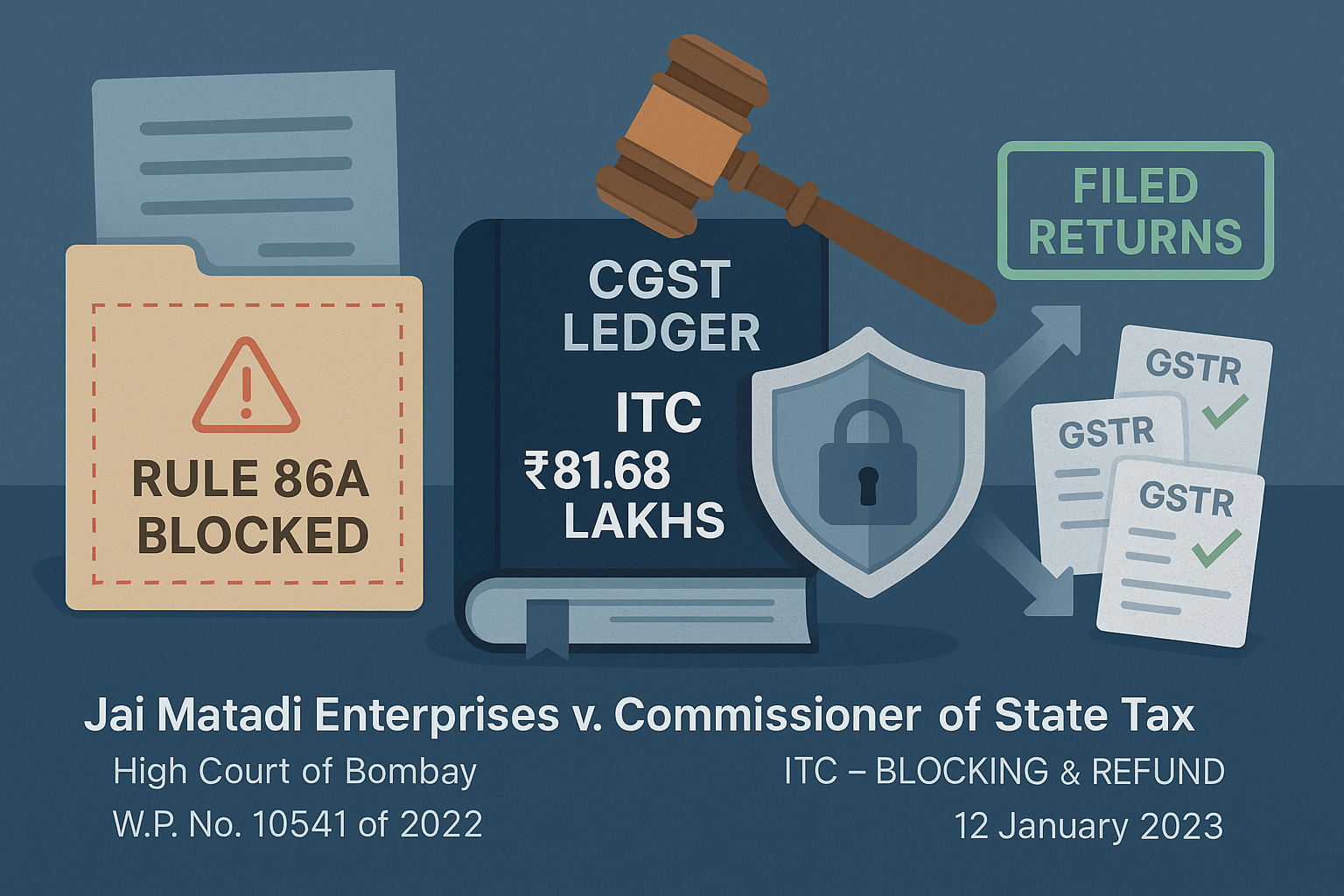
Case Title: Jai Matadi Enterprises v. Commissioner of State Tax
Court: High Court of Bombay
Petition Number: Writ Petition No. 10541 of 2022
Relevant Section: Rule 86A of the CGST Rules, 2017; Sections 47, 50, 62, 73, and 74 of the CGST Act
Category of Dispute: Input Tax Credit (Blocking and Refund)
Date of Judgement: January 12, 2023
Relevant Provisions:
Section 47 – Late fee for delayed filing of returns
Section 50 – Interest on delayed payment of tax
Section 62 – Best judgment assessment
Section 73/74 – Demand and recovery proceedings
Rule 86A – Blocking of ITC in electronic credit ledger
Facts of the Case
- The petitioner, Jai Matadi Enterprises, approached the High Court seeking unblocking of ITC amounting to ₹81,68,812/- and refund thereof, waiver of late fees and interest for the period February 2022 to August 2022, and direction to not pass assessment orders under Section 62 until the ITC was unblocked
- The ITC was blocked under Rule 86A due to concerns over potential fraudulent availment based on the status of some suppliers. The petition was first heard on 13 September 2022, when the Court ordered temporary unblocking of the ITC account until 15 October 2022
- The petitioner utilised the ITC post-unblocking and filed pending returns. The State did not challenge the interim order dated 13 September 2022
- The State later argued that the initial unblocking was granted without their full reply and that the petitioner should not be entitled to the relief.
Question(s) in Consideration
- Whether the blocking of ITC under Rule 86A was valid in the facts of the case?
- Whether the relief sought for refund and waiver of late fee and interest can be granted?
- Whether the proceedings under Sections 73/74 are a more appropriate remedy than blocking ITC under Rule 86A?
- Whether the writ petition had become infructuous in light of the implementation of the interim order?
Observation of the Court
- The Court noted that the interim order dated 13 September 2022 had been implemented, and the ITC had been unblocked and utilized by the petitioner. There was no challenge to that order by the State.
- The Court found that while the State objected that the unblocking order was passed without their full representation, they had nevertheless allowed the ITC to be utilized without challenging the order, making it binding and effective.
- The Court acknowledged that the proper course of action regarding further adjudication of the matter would be under the pending proceedings (likely under Section 74), and the legal questions could be addressed in that forum.
Judgement of the Court
- The Court disposed of the writ petition on the basis that the relief sought in prayer clause (a) stood concluded by the order dated 13 September 2022, which had been acted upon.
- Other issues, including late fee waiver and further adjudication under Section 74, were kept open for decision in appropriate legal proceedings
Between Fine Lines
- The High Court ruled that once an interim relief like ITC unblocking is acted upon without challenge, it becomes binding.
- Rule 86A-based blocking of ITC must be supported by timely action and reply from the department.
- The dispute on the legality of ITC blockage and refund was left open for consideration in Section 74 proceedings.
- The petitioner’s claim for refund was not pressed due to the unblocking and usage of credit.
- This case underscores that department inaction post-court interim order may result in waiver of rights to contest it later.
Summary of Referred Cases
| Name | Citation | Summary | Verdict |
| No explicit case citations were mentioned in the judgement. | — | — | — |