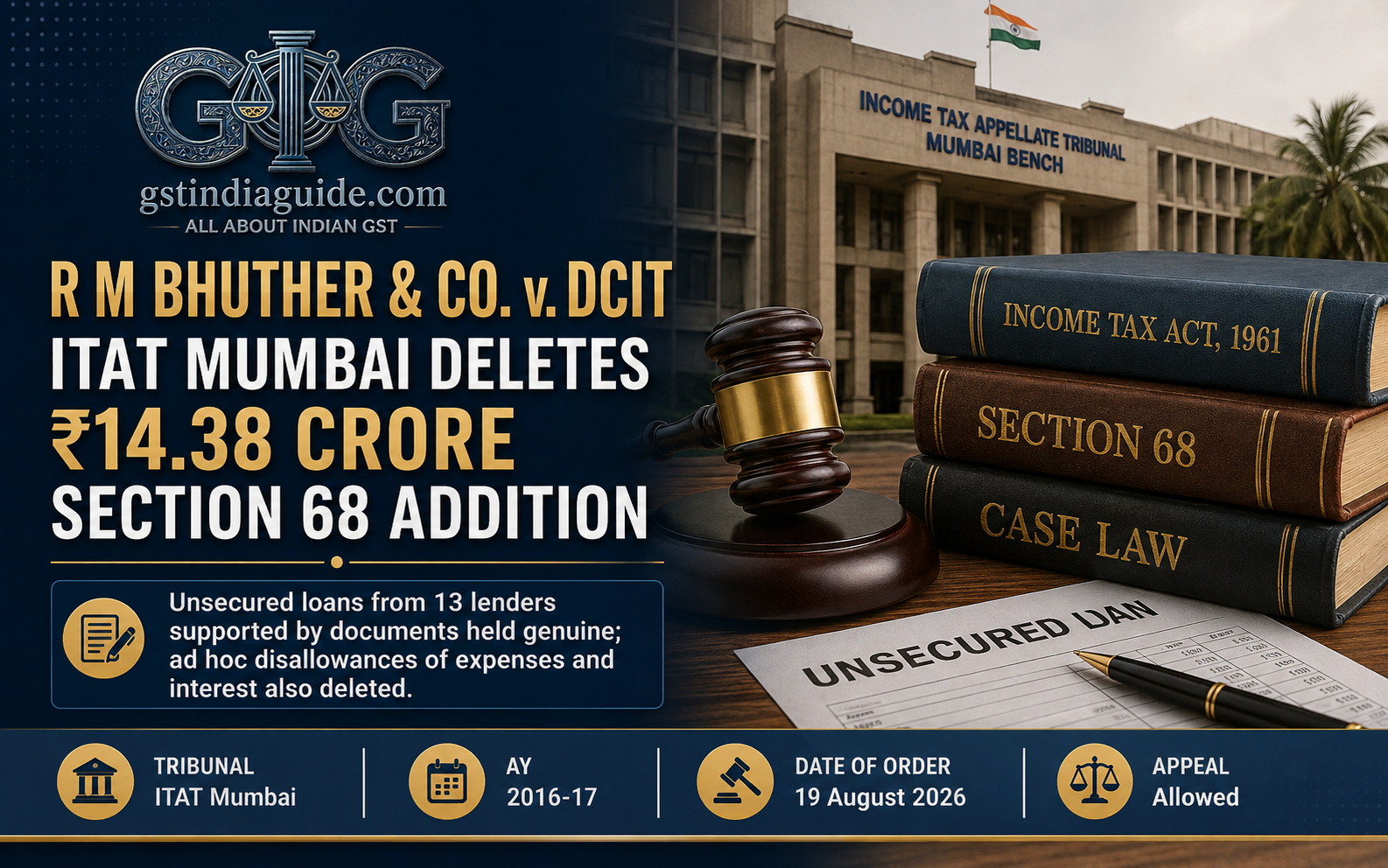
The Mumbai Bench of the Income Tax Appellate Tribunal has granted substantial relief to R M Bhuther And Co. in two connected appeals concerning Assessment Year 2016-17. The principal controversy related to an addition of ₹14.38 crore under Section 68 of the Income-tax Act, 1961, representing unsecured loans received from thirteen corporate entities.
The assessee, a partnership firm engaged in the business of builders and developers, had originally filed its return declaring income of ₹18,02,870. The original scrutiny assessment under Section 143(3) accepted the returned income. Subsequently, reassessment proceedings resulted in addition of ₹14.38 crore under Section 68 on the ground that the assessee had allegedly failed to establish the genuineness and creditworthiness of the lenders.
Documentary Evidence Cannot Be Rejected Without Transaction-Specific Enquiry
Before the tax authorities, the assessee furnished creditor-wise confirmations, PAN and income-tax particulars, ledger accounts, audited financial statements and bank statements showing the movement of funds through banking channels. It was also asserted that the loans were subsequently repaid through banks and interest was paid wherever applicable.
The Tribunal explained that, for the purposes of Section 68, an assessee is required to establish the identity of the creditor, creditworthiness and genuineness of the transaction. At the same time, once primary documentary evidence addressing these requirements is produced, such material must be examined on its intrinsic merits. If the Revenue seeks to disregard it, there must be material or enquiry capable of displacing that evidentiary foundation.
The Tribunal found no lender-wise examination demonstrating that any creditor lacked the financial capacity to advance the respective loan. There was also no finding that the confirmations, financial statements or bank records were false or fabricated, nor was any cash trail established showing that the funds advanced by the lenders had originated from the assessee itself.
General Investigation Wing Information Not Sufficient by Itself
The Revenue had substantially relied upon Investigation Wing information concerning entities allegedly involved in accommodation-entry activities. The Tribunal observed that such information may justify a deeper enquiry, but it cannot automatically establish that every transaction entered into by an identified entity is fictitious.
According to the Tribunal, there must be connecting material between the general investigation information and the specific credit appearing in the assessee’s books. Where third-party statements are proposed to be relied upon substantively against an assessee, principles of fairness also require that the relevant material be properly confronted.
On the evidence available, the Tribunal held that the assessee had furnished sufficient primary material requiring a transaction-specific rebuttal from the Revenue. Since the evidence remained unrebutted on the essential factual aspects, the ₹14.38 crore addition under Section 68 was deleted.
30% Ad Hoc Disallowance of Business Expenses Deleted
The second appeal involved, among other issues, an ad hoc disallowance of ₹32,06,980, representing 30% of aggregate business expenditure of ₹1,06,89,936.
The Assessing Officer had proceeded on the basis that the assessee did not have business or professional income during the year. The Tribunal, however, noted that there was no finding that the business had been permanently closed or abandoned. Nor had any particular expense been identified as fictitious, inflated, personal or unrelated to the business.
The Tribunal held that the absence of business receipts during a particular year does not by itself establish discontinuance of business. Expenditure incurred for maintaining the business establishment may retain its business character even during a period of commercial inactivity. Since the 30% disallowance lacked any identified factual defect or rational basis, it was directed to be deleted.
Interest Disallowance of ₹9.39 Lakh Also Deleted
The Assessing Officer had also disallowed ₹9,39,288 as interest expenditure relating to loans from Gulzar Hire Purchase Pvt. Ltd. and Gleam Finance Pvt. Ltd., since the underlying loans had earlier been treated as non-genuine.
The Tribunal noted that there was no independent finding that the interest was not actually paid, was fictitious or excessive, or that the borrowed funds had been diverted for non-business purposes. Once the underlying Section 68 addition itself was deleted, the foundation for the consequential interest disallowance ceased to exist. The interest disallowance was accordingly deleted.
Current-Year Business Loss Eligible for Set-Off Against Capital Gains
The assessee accepted that the gain arising from sale of Shop No. 8 could be assessed under the head “Capital Gains”. The remaining question was whether the current-year business loss could be adjusted against such capital gain.
The Tribunal distinguished a current-year business loss from a brought-forward business loss and directed the Assessing Officer to recompute the current-year business loss after giving effect to its findings and thereafter allow the eligible set-off against capital gains in accordance with Section 71(2) and other applicable provisions.
The Assessing Officer was also directed to ensure that the deleted ₹14.38 crore addition did not remain in the computation while giving effect to the consolidated order.
Key Takeaway
The ruling emphasises that an addition under Section 68 must ultimately rest on an evidence-based examination of the particular credit. Where an assessee produces confirmations, financial statements, bank records, tax particulars and other primary evidence, general investigation inputs alone cannot substitute for a transaction-specific enquiry capable of rebutting such evidence.
The decision also reiterates that business expenditure cannot be disallowed merely through an arbitrary percentage when no specific expenditure is identified as inadmissible, and that absence of business receipts in a particular year does not automatically establish cessation of business.