

Case Summary – National Internet Exchange of India v. Union of India & Ors. (Delhi High Court, W.P.(C) 871/2022, decided on 09.08.2023)
Category: Refund – Zero-Rated Supply / Limitation under Section 54 / Validity of Deficiency Memos
Relevant Provisions: Section 54 CGST Act; Section 16 IGST Act; Rule 89 & Rule 90 CGST Rules.
Facts (Paras 1–10)
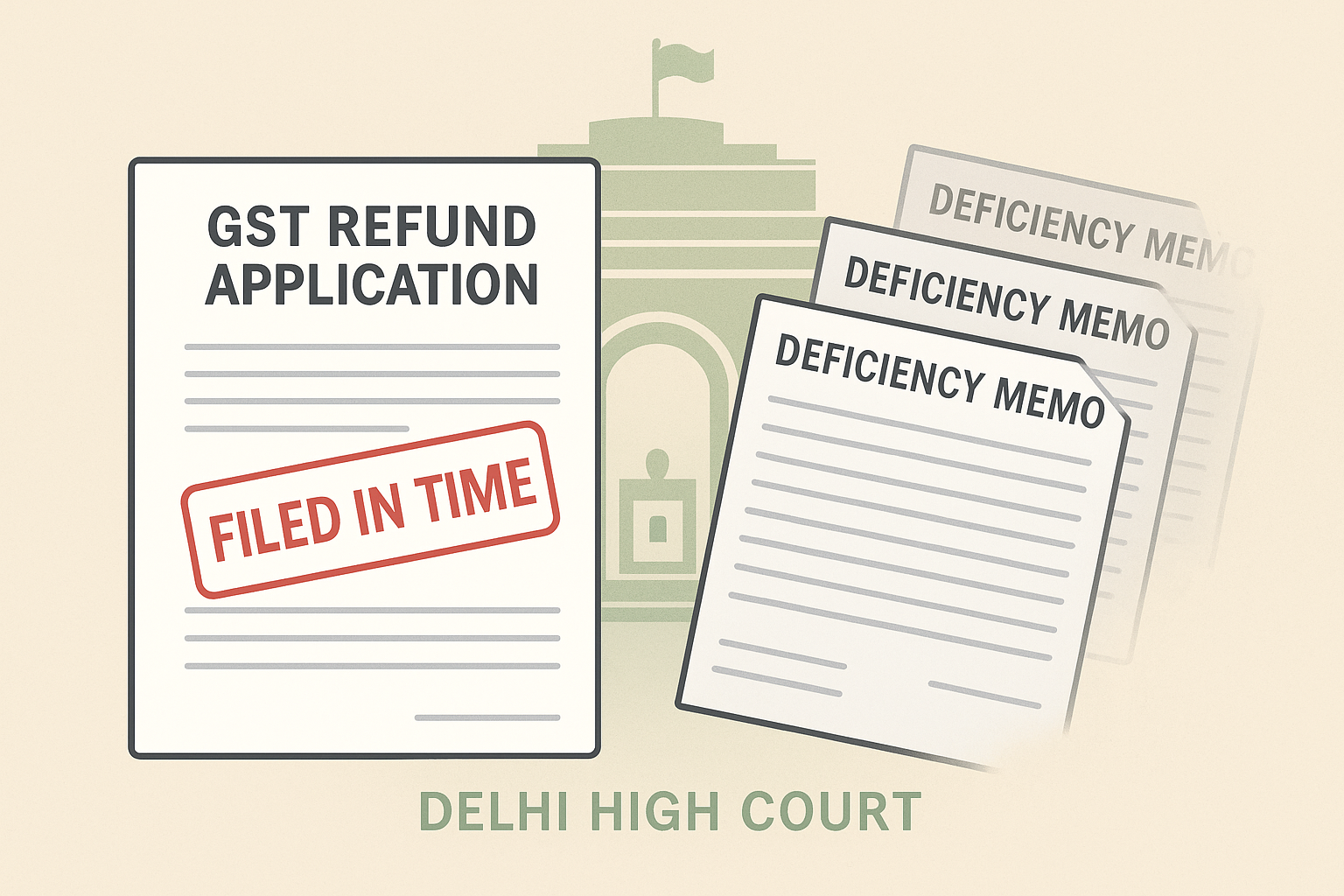
The petitioner, National Internet Exchange of India, a non-profit entity providing internet infrastructure services and exporting services such as .IN domain registry operations, filed a refund application on 17.10.2019 seeking refund of IGST paid on zero-rated supplies for October 2017. The application was filed within the statutory period of two years prescribed under Section 54(1) CGST Act, with all mandatory documents as required under Rule 89(2) CGST Rules .
The proper officer, however, issued a series of deficiency memos dated 21.10.2019, 11.11.2019, and 14.09.2020, directing the petitioner to re-file the application. The petitioner complied each time and filed applications on 31.10.2019, 20.02.2020, and 02.11.2020. The third re-filed application was issued a show-cause notice dated 02.03.2021, proposing rejection on the ground that the “fresh” application was beyond limitation.
The officer relied on Circular 125/44/2019-GST, paras 10 and 12, and Rule 90(3), contending that once a deficiency memo is issued, the refund application becomes non est and a fresh application must be made within two years. The petitioner challenged both the rejection order and the Circular/Rule as ultra vires, reiterating that its first application was complete, filed within time, and any subsequent filings were only responsive clarifications.
Questions for Determination (Derived from Paras 11–14, 18–20)
-
Whether a refund application filed with all mandatory documents under Rule 89(2) can be treated as non est merely because the officer seeks further clarification.
-
Whether issuance of a deficiency memo under Rule 90(3) restarts limitation or invalidates a timely-filed application.
-
Whether Circular 125/44/2019-GST and Rule 90(3) can override Section 54(1) by requiring “fresh” applications even when the original was complete and within limitation.
Court’s Observations (Paras 18–27)
The Court undertook a contextual interpretation of Section 54 CGST Act, which mandates filing the refund application “in such form and manner as prescribed” within two years. Rule 89(2) prescribes the set of documentary evidences that must accompany the refund application.
The Court noted that:
-
The petitioner’s application dated 31.10.2019 met all the mandatory requirements of Rule 89(2) and therefore could not be rejected as incomplete (Para 23).
-
The “deficiencies” recorded in Deficiency Memo No. 2 (reproduced extensively in Paras 21–23) revealed that the officer was essentially seeking verification, reconciliation and additional clarification—not treatment as an incomplete application.
-
A distinction must be drawn between:
(i) incompleteness under Rule 89(2), and
(ii) further scrutiny under Rule 90(5). -
When an application is complete as per Rule 89(2), the proper officer must issue acknowledgment under RFD-02, and if he doubts eligibility, must issue RFD-08 (show-cause notice) instead of RFD-03 (deficiency memo) (Para 20).
-
The Court reiterated its earlier ruling in BSNL v. Union of India (2023:DHC:2482-DB), where it held that a deficiency memo cannot nullify a complete application nor can it reset limitation (Paras 26–27).
Thus, the Court held that treating the timely, complete application as non est was contrary to statute and that limitation stops on the date of first valid filing, irrespective of subsequent deficiency memos.
Judgment (Paras 29–30)
The High Court quashed the rejection order dated 13.04.2022, holding that the officer acted contrary to Section 54 and Rule 89. The refund application dated 31.10.2019 must be treated as validly filed within limitation.
The matter was remanded to the proper officer to evaluate the refund on merits, without being influenced by the limitation objection.
Circular 125/44/2019-GST and Rule 90(3) were not adjudicated on vires since the petitioner did not press the challenge after the Court’s finding that the case was squarely covered by BSNL.
Summary of Cases Referred
| Case | Issue | Court’s Verdict | Relevance |
|---|---|---|---|
| BSNL v. Union of India (2023:DHC:2482-DB) | Whether deficiency memos nullify refund applications | Held that deficiency memos cannot render a complete application non est; limitation stops with first filing | Applied as binding precedent; directly covers present dispute |
Between the Fine Lines – Practical Takeaways for Trade
Taxpayers who file refund applications within two years and ensure that their filing conforms to Rule 89(2) cannot be forced into endless cycles of re-filing merely because the proper officer prefers additional documents or clarifications. A deficiency memo does not wipe out the original filing. Officers must either acknowledge the application under RFD-02 or issue a show-cause notice (RFD-08). This judgment prevents misuse of deficiency memos as a tool to deny refunds on limitation grounds.
Disclaimer – “The above summary is for academic purpose only; not formal legal opinion. Seek professional opinion before application. Author or publisher or website shall not be responsible for any usage in any form.”

 cannot be nullified by deficiency memos under Rule 90(3). Limitation under Section 54 stops on first valid filing.)