


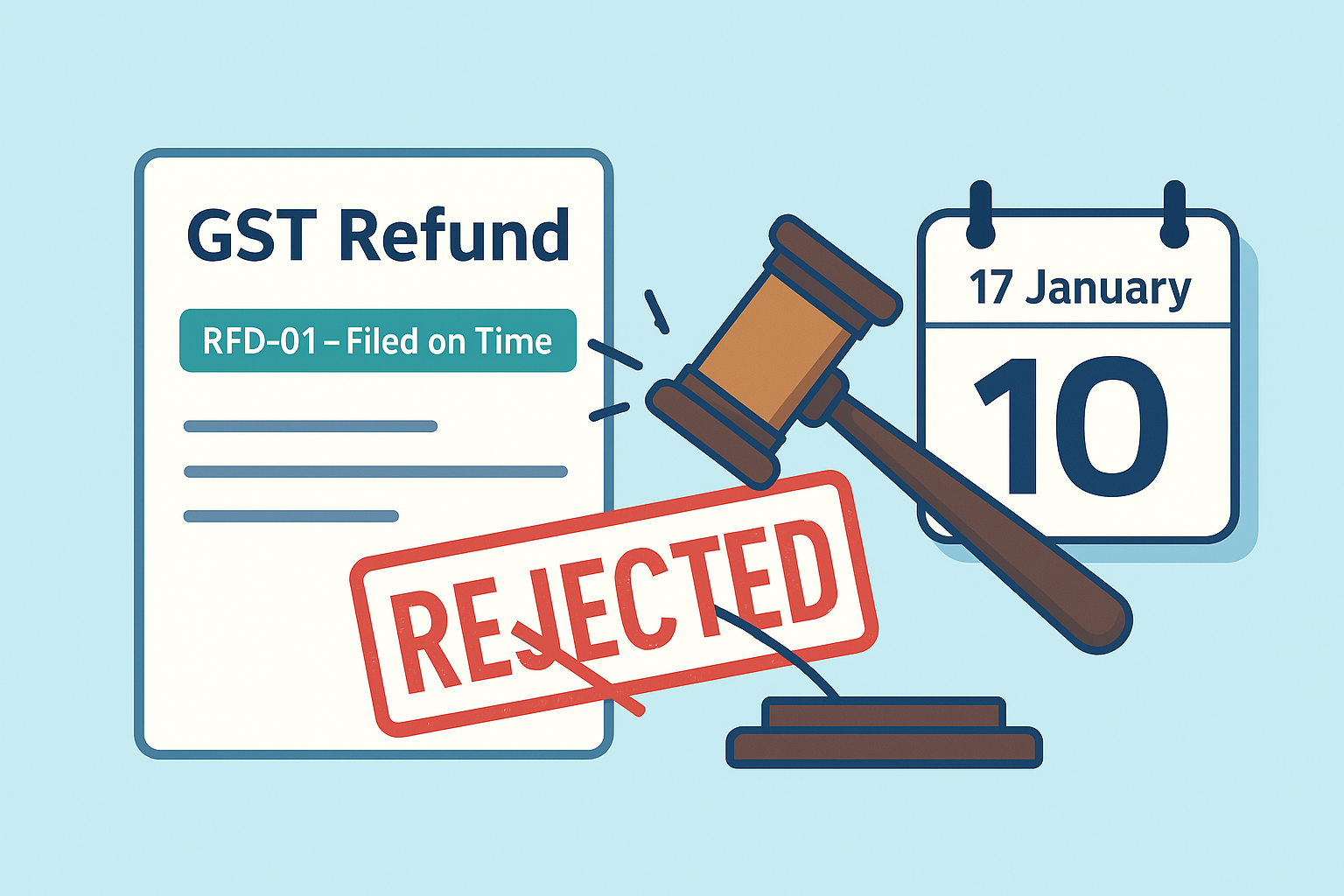
Case Summary: BSNL v. Union of India & Ors., Delhi High Court, W.P.(C) 3550/2023, Decision dated 06.04.2023 – Refund claim remanded as rejection based on treating a duly-filed online application as “non-est” was held erroneous
Case Identification
-
Case Title: Bharat Sanchar Nigam Limited v. Union of India & Ors.
-
Court: High Court of Delhi
-
Petition No.: W.P.(C) 3550/2023
-
Date of Judgment: 06 April 2023
-
Statutory Provisions Involved:
-
Section 54, CGST Act, 2017 – Refund of tax
-
Rule 89(2), CGST Rules, 2017 – Documentary evidence with RFD-01
-
Rule 90(3), CGST Rules, 2017 – Deficiency memos and fresh applications
-
-
Category: Refund – Excess payment of tax
-
Neutral Citation: 2023:DHC:2482-DB
Facts of the Case (Paras 1–18)
The petitioner, BSNL, challenged the order dated 25.11.2021 of the Additional Commissioner (Appeals-II) rejecting its appeal against the adjudicating authority’s order dated 29.04.2020 denying refund (paras 1–2). BSNL had erroneously paid excess GST of ₹2,63,98,462 for December 2017 due to misinterpretation of a project payment received from the Department of Telecommunications (paras 3–7). Upon receiving a clarification letter dated 22.02.2018 from DOT confirming that the amount paid was inclusive of GST, BSNL recomputed its liability and filed a refund application in Form RFD-01 on 17.01.2020, which was undisputedly within the two-year limitation under Section 54 (paras 7–9, 19).
A deficiency memo was issued on 31.01.2020 (para 9), and BSNL submitted clarifications; however, the portal acknowledged these clarifications as a “fresh application”, creating confusion (paras 11–14). The adjudicating authority treated the clarifications uploaded on 10.02.2020 as the “actual” refund application and held it time-barred (paras 15–16). The appellate authority upheld this view by incorrectly assuming that the 17.01.2020 application was filed “physically” and thus invalid (para 18).
Questions / Issues (Derived from Paras 15–20, 27–29)
-
Whether BSNL’s refund application dated 17.01.2020 was validly filed online and within limitation?
-
Whether a refund application accompanied with documents prescribed under Rule 89(2) can be treated as non-est simply for want of clarifications sought subsequently under Rule 90(3)?
-
Whether the limitation period under Section 54 restarts from the date of submission of clarifications pursuant to a deficiency memo?
Court’s Observations (Paras 19–29)
The Court held that BSNL had indeed filed an online refund application on 17.01.2020, and the revenue did not dispute this fact (para 19). The rejection was therefore based on a “palpably erroneous premise.”
The Court rejected the respondent’s argument that the application was “incomplete” due to absence of documents under Rule 89(2)(k)–(m), expressly noting that Form RFD-01 itself requires disclosure of excess tax details (paras 23–24).
Most crucially, the Court clarified that Rule 90(3) cannot be interpreted to treat an otherwise valid refund application as non-est merely because further documents or clarifications are sought. An application that contains the documentary evidence specified under Rule 89(2) must stop the limitation clock on the date of filing (para 29). It is erroneous to treat the application as “complete” only after subsequent clarifications (paras 28–29).
Final Judgment / Verdict (Paras 30–31)
The Court held:
-
BSNL’s refund claim was wrongly treated as time-barred.
-
The 17.01.2020 application was valid and within limitation.
-
Rule 90(3) does not justify treating the application as non-est.
-
The rejection by both lower authorities was set aside.
-
Matter was remanded to the Adjudicating Authority for fresh consideration in light of the Court’s findings (para 31).
Summary of Case Law Referred (Table)
(The judgment does not refer to external precedents. Hence, table reflects “No external precedents cited.”)
| Case Referred | Court | Issue | Verdict Summary |
|---|---|---|---|
| None cited in the judgment | – | – | – |
Between the Fine Lines (Trade / Industry Takeaways)
The ruling clarifies a critical compliance safeguard: a refund application filed with mandatory documents under Rule 89(2) cannot be invalidated simply due to subsequent deficiency memos or clarifications. Businesses should note that once Form RFD-01 is filed with requisite documents, the limitation under Section 54 is secured, preventing revenue authorities from treating later clarifications as a fresh application to deny refund as time-barred. This protects taxpayers from procedural unfairness arising from portal-related misclassifications or officer-driven deficiency memos.
Disclaimer – “The above summary is for academic purpose only; not formal legal opinion. Seek professional opinion before application. Author or publisher or website shall not be responsible for any usage in any form.”

 is valid for limitation purposes and cannot be treated as non-est due to deficiency memos; refund rejection was quashed and matter remanded.)