


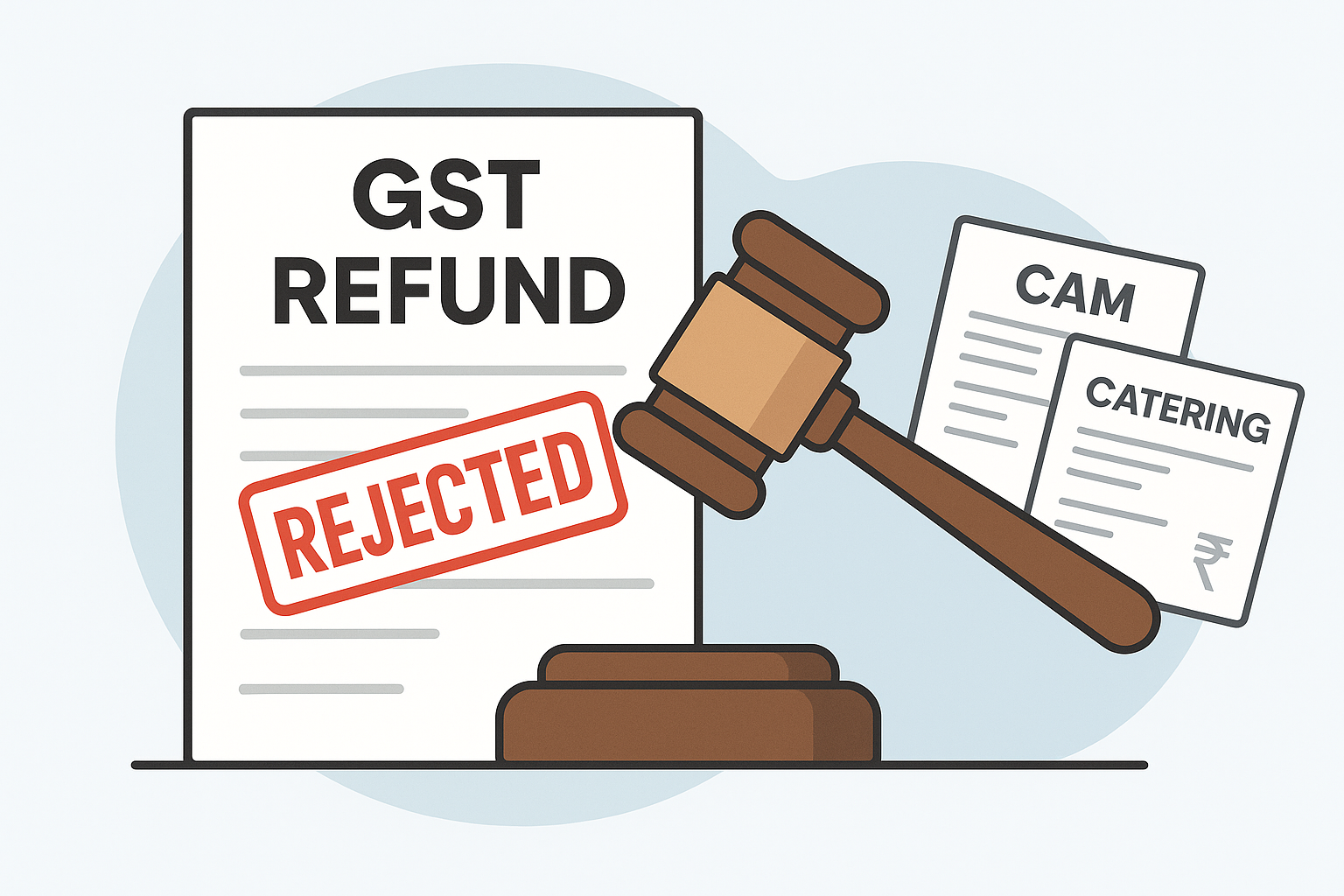
Case Summary
Chegg India Pvt. Ltd. v. Commissioner of Central Goods & Services Tax, Delhi East & Anr.
Delhi High Court • W.P.(C) 14886/2022 • Decision dated: 19 July 2023
Category of Dispute: Refund of Input Tax Credit on Zero-Rated Supplies (Exports)
Relevant Provisions:
-
Section 16 IGST Act, 2017 – Zero-Rated Supply
-
Sections 16, 17(5), 107 CGST Act, 2017 – Eligibility & Appeals
-
Rule 92(3) CGST Rules, 2017 – Mandatory Show-Cause Notice prior to Refund Rejection
Facts of the Case (Paras 1–7)
The petitioner, Chegg India Pvt. Ltd., engaged in software and content development services for export to over 70 countries, supplied zero-rated services under Section 16 of the IGST Act and accumulated ITC on input services. It filed eleven refund applications for the periods April 2018–August 2018 and October 2018–March 2019 aggregating ₹2,41,98,274/- (para 4) seeking refund of unutilised ITC.
The department, vide order dated 02.03.2020, rejected ₹39,18,756/- of the claim attributing the rejection to catering charges and Common Area Maintenance (CAM) charges (para 6). Appeals filed under Section 107 CGST Act were dismissed by the common Order-in-Appeal dated 21.09.2021, holding that Section 17(5)(b) blocked credit on these services (para 8).
The rejection of ITC worth ₹17,75,688/- (CAM) and ₹7,29,050/- (invoices not furnished) remained the core grievance (para 3).
Questions of Law / Issues
-
Whether CAM charges and catering services could be disallowed as ineligible ITC under Section 17(5)(b) of the CGST Act without reasoned analysis?
-
Whether refund of unutilised ITC can be rejected without issuance of a mandatory notice under Rule 92(3) of the CGST Rules?
-
Whether the Order-in-Appeal complied with the statutory obligation to provide reasons as required under Section 107 and principles of natural justice?
Observations of the Court (Paras 8–11)
The Court found that the Appellate Authority had merely cited Section 17(5)(b) as the basis for disallowance but failed to articulate how this provision applied to CAM and catering services (para 8). The Court noted that the reasoning was “not clearly discernible” (para 9).
More significantly, the Court held that the refund claim was processed in fundamental violation of Rule 92(3) because no notice containing reasons for rejection was issued before disallowance (para 11). Consequently, the petitioner was denied the statutory opportunity to submit a reply in Form RFD-09, rendering the process flawed.
Judgment / Verdict (Paras 12–15)
The High Court set aside the Order-in-Appeal dated 21.09.2021 as well as the refund rejection orders to the extent refund was denied (para 12). The authority was directed to:
-
Issue a fresh notice under Rule 92(3) specifying reasons for proposed rejection (para 13).
-
Allow the petitioner to file a reply in Form RFD-09 (para 13).
-
Pass a fresh reasoned and lawful order after considering the reply (para 14).
All rights and contentions were expressly kept open (para 14). The writ petition was disposed accordingly (para 15).
Summary of Cases Referred (if any)
No external precedents are referenced in the judgment.
Therefore, the table below summarises only the orders within the case record.
| Sr. No. | Order / Authority | Essence of Decision | Outcome |
|---|---|---|---|
| 1 | Refund Rejection Order (02.03.2020) | Refused refund on CAM and catering charges | Held unsustainable for violating Rule 92(3) |
| 2 | Common Order-in-Appeal (21.09.2021) | Upheld rejection citing Section 17(5)(b) without analysis | Quashed for lack of reasoning |
Between the Fine Lines (Trade / Industry Takeaways)
This ruling underscores that refund rejections cannot be mechanical. Authorities must issue mandatory Rule 92(3) notices, articulate precise statutory reasons, and offer the taxpayer a fair opportunity to rebut. Rejection based merely on citing Section 17(5)(b) without demonstrating its applicability to the service in question—like CAM charges—is legally indefensible. Exporters claiming refund of accumulated ITC should rely on this precedent to challenge perfunctory or non-speaking orders.
Disclaimer – “The above summary is for academic purpose only; not formal legal opinion. Seek professional opinion before application. Author or publisher or website shall not be responsible for any usage in any form.”

 notice and without reasoned analysis under Section 17(5)(b) is invalid.)