


Preamble
The e-way bill mechanism under the Goods and Services Tax (GST) law was envisaged as an anti-evasion tool, ensuring transparent tracking of goods in movement. However, the rigidity of its procedural requirements has often led to genuine consignments being penalised for minor lapses, even when there is no underlying intention to evade tax. Courts across jurisdictions have repeatedly emphasised that the penal provisions under Section 129 of the Central Goods and Services Tax Act, 2017 (“CGST Act”) cannot be invoked in the absence of mala fide intent or deliberate contravention. This article delves into judicial pronouncements where relief from penalty was granted in cases of e-way bill deviations, crystallising the principle that substantive justice must prevail over procedural lapses.
Statutory Scheme of E-Way Bill and Penalty Provisions
The statutory scheme flows from Section 68 of the CGST Act, 2017 read with Rule 138 of the CGST Rules, 2017, mandating generation of e-way bills for movement of goods beyond the prescribed value. The transporter is obliged to carry such e-way bill along with the goods, failing which detention, seizure and penalty proceedings may be initiated under Section 129 of the CGST Act.
Section 129 prescribes that where goods are transported in contravention of the Act or Rules, they are liable to detention and release only upon payment of applicable tax and penalty. While the provision is stringent in its letter, the spirit underlying it is to curb tax evasion and ensure revenue protection. The absence of any mens rea or intent to evade tax, therefore, has been the consistent defence in several litigations where taxpayers suffered penalty solely due to technical defects in e-way bills.
Procedural Deviations Without Mens Rea – Judicial Safeguards
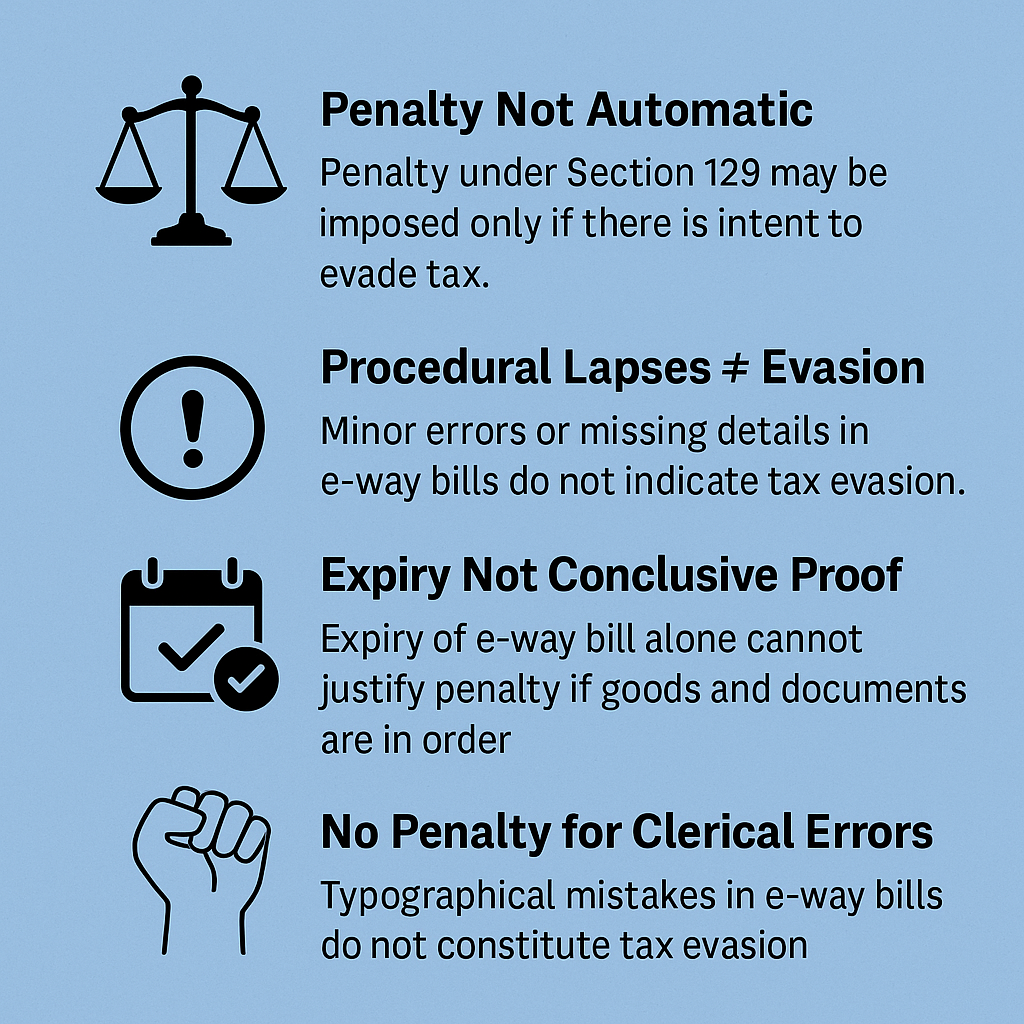
Courts have been categorical that penalty is not automatic and cannot be levied merely for technical breaches. In VSL Alloys (India) (P.) Ltd. v. State of U.P., Writ tax No. 637 of 2018, April 13, 2018 (Allahabad HC), the vehicle was accompanied by an invoice but Part-B of the e-way bill was not filled. The High Court quashed the penalty, holding that absence of Part-B could not, by itself, demonstrate intent to evade tax.
Similarly, in Citykart Retail (P.) Ltd. v. Commissioner, Commercial Tax, [2022], (Allahabad HC), Writ.C No. 22285 of 2019, September 6, 2022, the Court reiterated that failure to furnish Part-B is a procedural lapse and, unless revenue establishes deliberate evasion, penalty is unsustainable. These rulings underscore that mere irregularity is not tantamount to tax evasion.
Clerical Errors and Typographical Mistakes – Not Tax Evasion
Typographical or clerical mistakes in e-way bills are another frequent cause of litigation. The Allahabad High Court in Ms. Sangeeta Jain v. Union of India, Writ Tax No. 783 of 2023 (22 April 2024) examined a case where the dispatch address in the e-way bill contained a clerical error. The Court observed that mens rea is a prerequisite for penalty under Section 129, and such inadvertent mistakes cannot be equated with attempts to evade tax. It was emphasised that the authorities must apply their mind to determine whether a violation was willful or inadvertent before proceeding punitively.
This principle resonates with the age-old maxim that substance must prevail over form, and genuine trade cannot be harassed merely on account of clerical imperfections.
Expiry or Technical Invalidation of E-Way Bill During Transit
Transit delays leading to expiry of e-way bills are also a common ground for detention. The Tripura High Court in Balaji Steel Rolling Mills Ltd. v. State of Tripura, WP(C) No. 548 of 2021 (3 January 2023) dealt with such a situation where the e-way bill expired mid-transit. The Court observed that in the absence of any material to establish evasion of tax, expiry of validity alone could not justify penalty. The State was directed to refund the tax and penalty deposited.
The judgment reaffirmed that expiry of e-way bill is not conclusive proof of intent to evade tax, especially when documents establish that the goods are bona fide and the transaction is genuine.
Relief Against Overzealous Recovery Actions
Courts have also shielded taxpayers from coercive recoveries under the guise of e-way bill violations. The Telangana High Court in Kamlesh Steels v. Deputy State Tax Officer, W.P. No. 2563 of 2020 (11 November 2020) deprecated detention of goods despite the presence of a valid e-way bill, merely because the vehicle was stopped at Jeedimetla. It was held that such high-handed actions without tangible proof of evasion cannot be sustained.
Likewise, in Shahil Traders v. State of U.P., Writ Tax No. 178 of 2023 (Allahabad HC, 25 May 2023), goods were detained notwithstanding valid invoices and e-way bills. The Court categorically quashed the penalty under Section 129(1)(b), reiterating that mere suspicion or assumption cannot ground punitive action.
Emerging Jurisprudence – Intent as the Touchstone
The common thread emerging from these decisions is the judicial insistence on mens rea as the touchstone for invoking Section 129. The legislative object of the e-way bill mechanism is to combat tax evasion, not to convert every procedural lapse into an occasion for penalty. Courts have struck a balance by recognising that while compliance with e-way bill provisions is mandatory, genuine mistakes, clerical slips or procedural delays cannot be equated with evasion.
Circular No. 64/38/2018-GST, dated 14.09.2018, had also clarified that minor mistakes in documents should not attract proceedings under Section 129, and instead a token penalty under Section 125 may be considered. Judicial precedents now reinforce this principle with greater clarity.
Conclusion
The jurisprudence on e-way bill penalties has steadily evolved towards a justice-oriented interpretation, whereby bona fide taxpayers are protected from harsh consequences of minor deviations. Courts have consistently held that without cogent evidence of intent to evade tax, penalties under Section 129 cannot stand. This approach preserves the integrity of the GST regime by distinguishing genuine business errors from deliberate tax evasion. For businesses, the lesson is clear—while meticulous compliance with e-way bill rules is indispensable, the judiciary offers relief when the violation is merely procedural, not intentional.
Disclaimer
This article is meant purely for educational purposes and does not constitute professional advice. Readers are advised to seek independent professional guidance before acting on the basis of the contents herein.

