
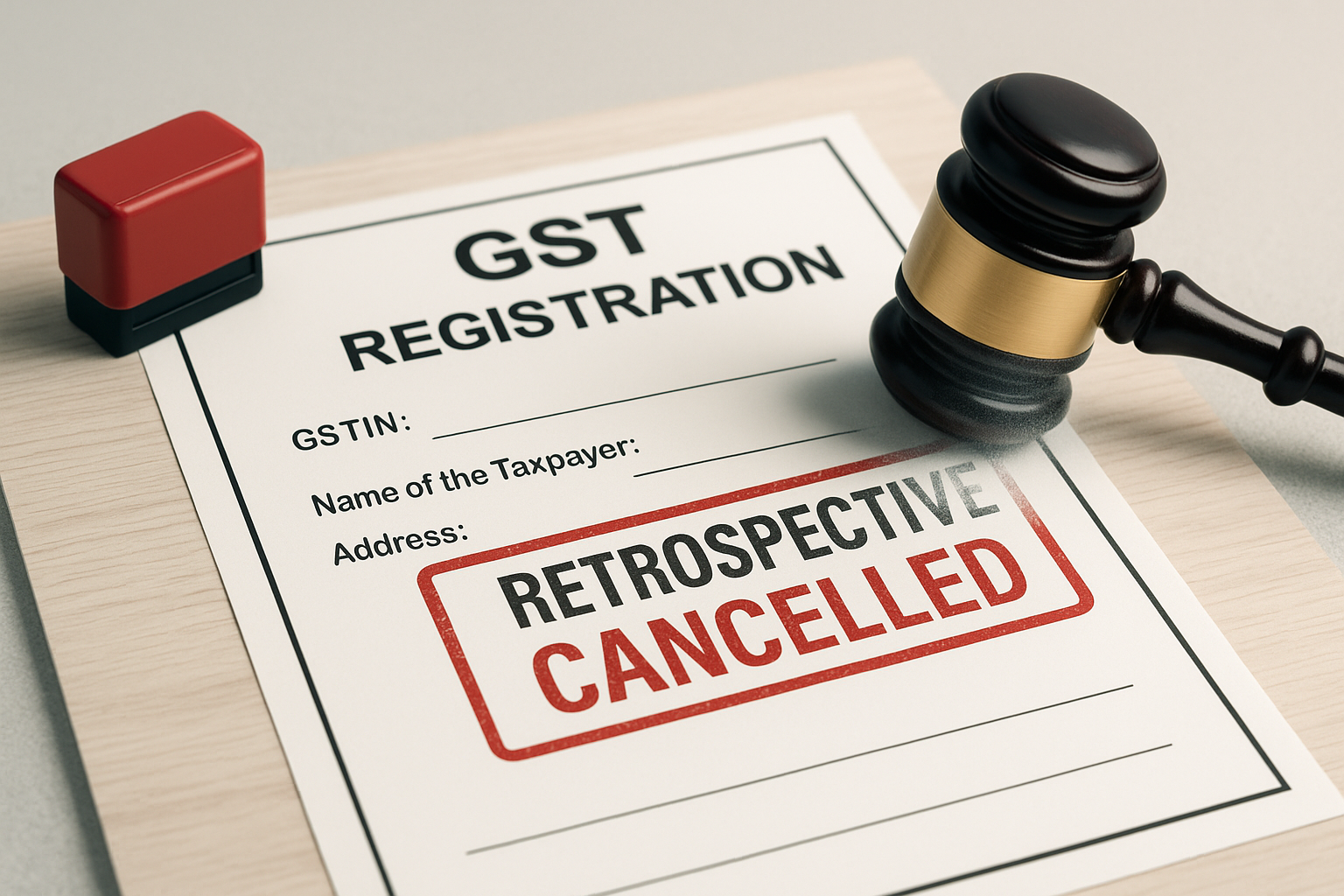
M/s Raj Enterprises v. Superintendent Range-25, GST Division, New Delhi
Delhi High Court | W.P.(C) 15777/2023 | Decision dated 20.12.2023
Issue: Cancellation of GST Registration (Retrospective Effect)
Sections: Section 29(2)(c) CGST Act; Rule 21A CGST Rules
Facts of the Case (Paras 1–6)
The petitioner, M/s Raj Enterprises, was engaged in trading magnetic/optical readers and allied appliances. It obtained GST registration on 19.10.2020. Owing to cessation of business, it applied on 19.10.2021 for cancellation, which was rejected on 30.11.2021 due to unanswered online queries. A second cancellation request was filed on 01.12.2021, proposing cancellation from 15.11.2021, and returns were filed till 31.12.2021.
Subsequently, the department issued a show-cause notice dated 10.08.2022 proposing cancellation for non-filing of returns for six months and simultaneously suspended the registration. The petitioner did not reply, and the proper officer passed an order dated 27.09.2022 cancelling the registration retrospectively from the date of grant, i.e., 19.10.2020.
Questions / Issues for Determination (Paras 7–10)
-
Whether cancellation of GST registration under Section 29(2)(c) can validly be ordered with retrospective effect merely because returns were not filed for six consecutive months.
-
Whether retrospective effect is valid when the SCN does not propose or disclose such retrospective cancellation.
-
Whether the officer applied the mandatory objective criteria before invoking retrospective cancellation.
Observations of the Court (Paras 7–12)
The Bench held that although Section 29(2)(c) empowers cancellation from any date, retrospective cancellation cannot be whimsical or mechanical and requires objective justification. The only stated ground was continuous non-filing of returns, which does not logically justify wiping out the registration for periods when the taxpayer was active and filing valid returns.
The department’s justification—avoidance of ITC flow to buyers—was viewed with reservations. Even assuming such a consequence, it only reinforces the need for a reasoned order based on objective criteria. The Court underscored that the SCN was silent on retrospective effect, thereby depriving the petitioner of an opportunity to respond meaningfully. Since the petitioner had ceased business on 19.10.2021 and filed returns till 31.12.2021, the cancellation could not legally operate from 19.10.2020.
Judgment / Verdict (Paras 12–14)
The High Court modified the cancellation order, holding that the impugned retrospective cancellation was illegal. The Court directed that the cancellation shall take effect only from 31.12.2021, being the last date up to which returns were filed. The authorities were left free to initiate proceedings for statutory violations, if any.
Case Classification under GST Act, 2017
Category: GST Registration – Cancellation & Retrospective Effect
Statutory Provisions:
-
Section 29(2)(c), CGST Act – Grounds for cancellation for non-filing of returns.
-
Rule 21A, CGST Rules – Suspension of registration.
Dispute Type: Validity of retrospective cancellation.
Table of Cases Referred (With Summary & Verdict)
| Case | Summary | Verdict |
|---|---|---|
| No external cases specifically cited in the judgment | — | — |
Between Fine Lines (Trade Takeaways)
This judgment reiterates that officers cannot mechanically cancel GST registrations with retrospective effect. A SCN must clearly specify retrospective intent; otherwise, the cancellation is ultra vires. Retrospective cancellation impacts ITC chains and must be justified through objective reasoning. Businesses that ceased operations but filed returns regularly cannot be penalised by arbitrary back-dating of cancellation.
Disclaimer – “The above summary is for academic purpose only; not formal legal opinion. Seek professional opinion before application. Author or publisher or website shall not be responsible for any usage in any form.”



, where the Court restricted retrospective GST registration cancellation due to lack of objective reasoning and improper show-cause notice.)