
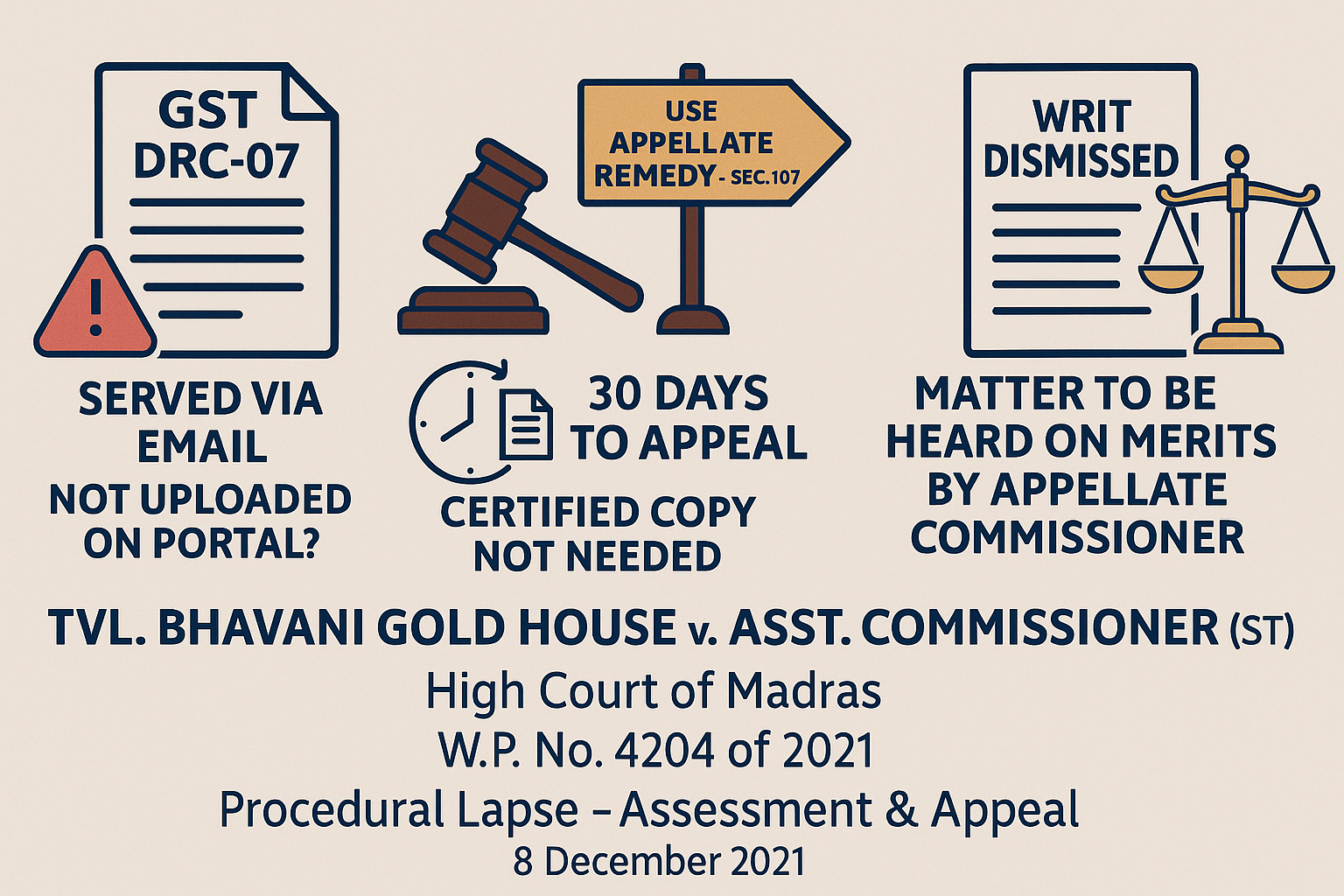
Case Title: Tvl. Bhavani Gold House v. Assistant Commissioner (ST)
Court: High Court of Madras
Petition Number: W.P. No. 4204 of 2021 with W.M.P. Nos. 4798 and 4799 of 2021
Category of Dispute: Procedural lapse / Challenge to Assessment Order
Date of Judgement: 8th December 2021
Relevant Section: Section 107 of Tamil Nadu Goods and Services Tax Act, 2017
Relevant Rules: Rule provisions under Tamil Nadu GST Rules, 2017
Facts of the Case [¶1–4]
- The petitioner challenged the demand notice dated 24.12.2019 issued in Form GST DRC-07.
- It was alleged that the impugned assessment order dated 18.12.2019 was passed without uploading it on the portal, contrary to statutory requirements under TNGST Act and Rules.
- The respondent countered that the order was served via email and several reminders were issued prior to passing the final order.
- The petitioner argued that although the respondent claims non-receipt of replies, their reply dated 27.05.2019 had been acknowledged by the department.
Questions in Consideration [¶6]
- Whether the impugned assessment order was served in compliance with the statutory provisions?
- Whether the petitioner is entitled to maintain a writ petition bypassing the appellate remedy under Section 107 of TNGST Act?
Observations of the Court [¶6–8]
- The Court held that there was no merit in the contention that no hearing notice was issued.
- Even if there were procedural lapses, the petitioner had an alternate statutory remedy of appeal before the Appellate Commissioner under Section 107.
- The Court allowed the petitioner liberty to file an appeal within 30 days, and directed the Appellate Commissioner to decide the matter on merits, preferably within 3 months, even without requiring a certified copy of the original order.
Judgement of the Court [¶7–9]
- The writ petition was dismissed on the ground of alternate remedy.
- Liberty was granted to the petitioner to file an appeal within 30 days from receipt of the order.
- The Appellate Commissioner was directed to provide a personal hearing and decide the matter in accordance with law, within 3 months.
- No costs were awarded; connected miscellaneous petitions were also closed.
Between Fine Lines
The High Court did not delve into the merits of the petitioner’s claim regarding procedural lapses in GST order delivery. Instead, it emphasized the availability of the appellate remedy under Section 107 of the TNGST Act. The Court facilitated access to appellate redressal by relaxing procedural formalities like submission of certified copies. Essentially, taxpayers must approach appellate authorities first, unless extraordinary grounds justify direct writ relief.
Summary of Referred Cases
| Name of Case | Citation | Summary | Verdict |
| No specific precedent referred | — | — | — |
Takeaway: No Shortcut to Appeal – High Court Reinforces Statutory Remedy under GST Act