


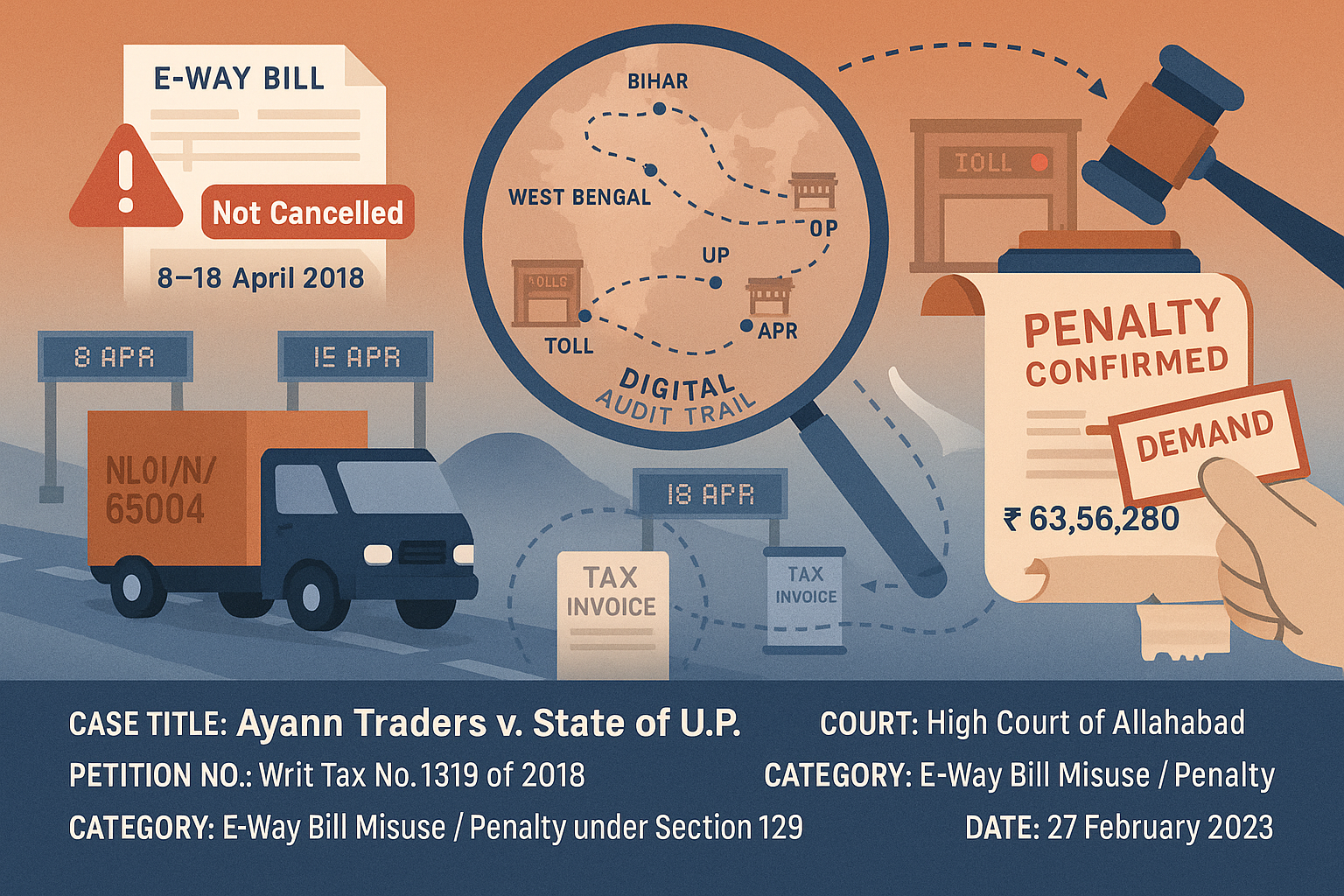
Case Title: Ayann Traders v. State of U.P.
Court: High Court of Allahabad
Petition Number: Writ Tax No. 1319 of 2018
Relevant Section: Section 129(3) of the U.P. GST Act, 2017; Rule 138(9) of the CGST Rules, 2017
Category of Dispute: E-Way Bill – Detention and Penalty
Date of Judgement: 27 February 2023
Relevant Sections: Section 129(3) of the U.P. GST Act, 2017; Rule 138(9) and Rule 138B of the CGST Rules, 2017
Facts of the Case
(Para 3–5)
- The petitioner, Ayann Traders, a registered dealer, sold 300 bags of Pan Masala worth ₹33.81 lakhs to a dealer in Meghalaya. IGST @28% and Cess @60% were levied.
- E-Way Bill and transporter bility were generated on 8-4-2018 showing Truck No. NL01N/6504 for the dispatch.
- The said truck was engaged in other trips between 7-4-2018 and 17-4-2018, transporting goods to West Bengal and Bihar, before allegedly being made available to the petitioner on 17-4-2018.
- Goods were intercepted at Kanpur on 18-4-2018 and found to be accompanied only by tax invoice and bility, leading to seizure and imposition of tax, cess and 100% penalty totalling ₹63,56,280.
- The appeal before the Appellate Authority failed, leading to the writ petition.
Questions in Consideration
(Para 2, 6–8)
- Whether the seizure and penalty order under Section 129(3) was valid in light of an E-Way Bill that was generated but not cancelled despite goods not being dispatched on the same day?
- Whether failure to cancel the E-Way Bill when vehicle was not available amounted to tax evasion or misuse of the E-Way Bill mechanism?
Observations of the Court
(Para 10–14)
- E-Way Bill was generated on 8-4-2018 with vehicle details filled, indicating readiness for movement.
- Under Rule 138(9), if movement does not begin, the E-Way Bill must be cancelled within 24 hours. No such cancellation was done.
- The same vehicle was used for other trips (to West Bengal and Bihar) during the supposed transport time, proving the vehicle was not available for the petitioner’s claimed dispatch.
- The claim that rice was sent to a dealer in Darbhanga was false, as the dealer had ceased business months earlier.
- Multiple trips using the same E-Way Bill and tax documents were evident from toll records, indicating repeated misuse.
Judgement of the Court
(Para 15–16)
- The Court upheld the findings of the taxing authorities and dismissed the writ petition.
- It held that there was clear misuse of the E-Way Bill and statutory provisions by the petitioner.
Between Fine Lines
This case confirms that an E-Way Bill must be used in real-time for actual movement of goods. If dispatch is delayed beyond 24 hours, the bill must be cancelled. Using the same E-Way Bill and vehicle number for multiple transactions across days attracts penalty under Section 129. Evidence from toll plazas and false claims about dealers will be used against the transporter or supplier. Proper documentation and timely actions are critical for GST compliance.
Summary of Referred Cases
| Name | Citation | Summary | Verdict |
| None explicitly referred to in judgement | – | – | – |
Takeaway
“E-Way Bill Misuse Unmasked: One Truck, Many Tales”

