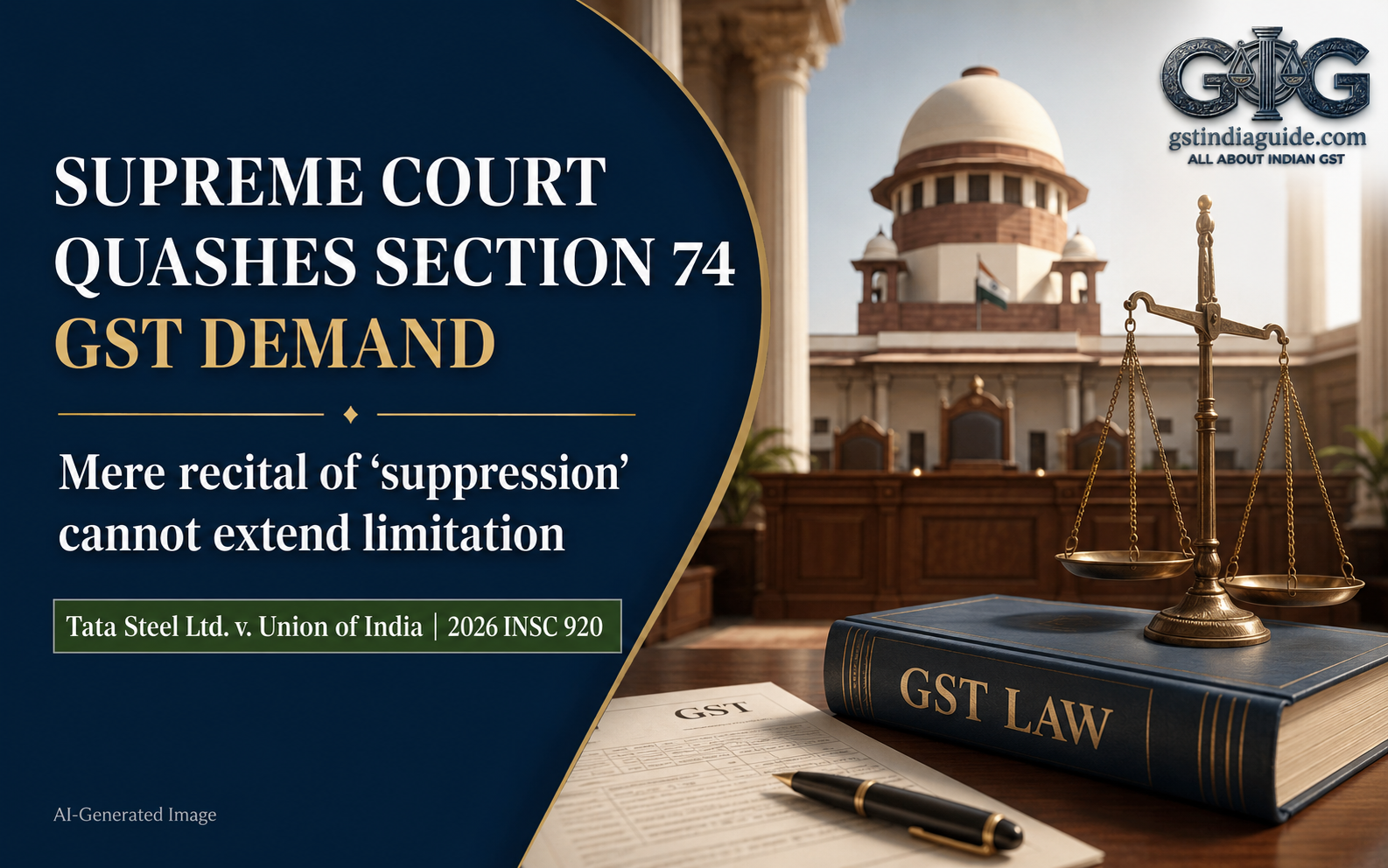
The Supreme Court, in M/s Tata Steel Limited v. Union of India through the Secretary, Ministry of Finance and Others, has held that the extended limitation period under Section 74 of the Central Goods and Services Tax Act, 2017 cannot be invoked merely by mechanically using expressions such as “fraud”, “wilful misstatement” or “suppression of facts” in a show cause notice.
The dispute arose from a show cause notice dated 13 June 2025 concerning an alleged mismatch of input tax credit for the financial years 2018-19 to 2020-21 and an alleged short payment of tax for the financial year 2019-20. The proceedings originated from objections raised during an audit conducted by the office of the Comptroller and Auditor General of India.
Tata Steel contended that the notice did not contain any specific allegation or foundational facts establishing fraud, wilful misstatement or suppression of facts. Therefore, the Department could not invoke Section 74 and apply its extended limitation period.
Audit Objection Does Not Replace Proper Officer’s Satisfaction
The Supreme Court observed that proceedings under Sections 73 and 74 can be initiated only upon the satisfaction of the proper officer. An audit observation or objection, by itself, does not dispense with the requirement that the proper officer must independently apply his mind before issuing a notice.
For invoking Section 74, it is not sufficient for the officer to be satisfied merely about an alleged mismatch of input tax credit or short payment of tax. The officer must also be satisfied that such mismatch or short payment resulted from fraud, wilful misstatement or suppression of facts.
The Court noted that the Department had contested the audit objection before the Public Accounts Committee. This indicated that the Department itself had not reached a definite satisfaction regarding the alleged mismatch or short payment, much less regarding any suppression by the assessee.
Foundational Facts Must Appear in the Notice
The Court held that the foundational facts supporting an allegation of fraud, wilful misstatement or suppression must be evident from the show cause notice itself.
Merely reproducing statutory expressions does not demonstrate application of mind. The extended limitation period is not intended to be invoked through a mechanical recital of the language used in Section 74.
The Court observed that the notice contained only a vague statement that Tata Steel had availed input tax credit without documentary evidence and had suppressed facts. It did not disclose any factual material establishing a deliberate device to evade tax or wrongfully avail input tax credit.
Accordingly, the bare allegation of suppression was held insufficient to sustain the notice under Section 74.
Protective Demand Not Recognised Under GST Law
The Department had initially transferred the show cause notice to the “call book”, thereby keeping it in abeyance, because the audit objection was being contested before the Public Accounts Committee. It subsequently revived the proceedings and proposed a protective demand on the ground that the matter was time-bound under GST law.
The Supreme Court observed that the concept of a protective assessment or protective demand is not statutorily recognised under the GST Act.
Supreme Court’s Decision
The Supreme Court set aside the show cause notice dated 13 June 2025 and the consequential Order-in-Original dated 26 December 2025.
However, the Court granted liberty to the Department to initiate appropriate proceedings under Section 74, if considered necessary, provided that the notice itself contains the foundational facts supporting the allegations of fraud, wilful misstatement or suppression. Any such order must be passed before 28 February 2027.
The appeal filed by Tata Steel was accordingly allowed.
Key Takeaway
The extended limitation period under Section 74 of the CGST Act cannot be invoked merely by inserting statutory expressions such as “suppression of facts” in a show cause notice. The notice must disclose specific foundational facts demonstrating a deliberate act of fraud, wilful misstatement or suppression. An audit objection cannot substitute the independent satisfaction and application of mind required from the proper officer.