, without a saving clause, applies to pending IGST refund proceedings and ends the restriction.)
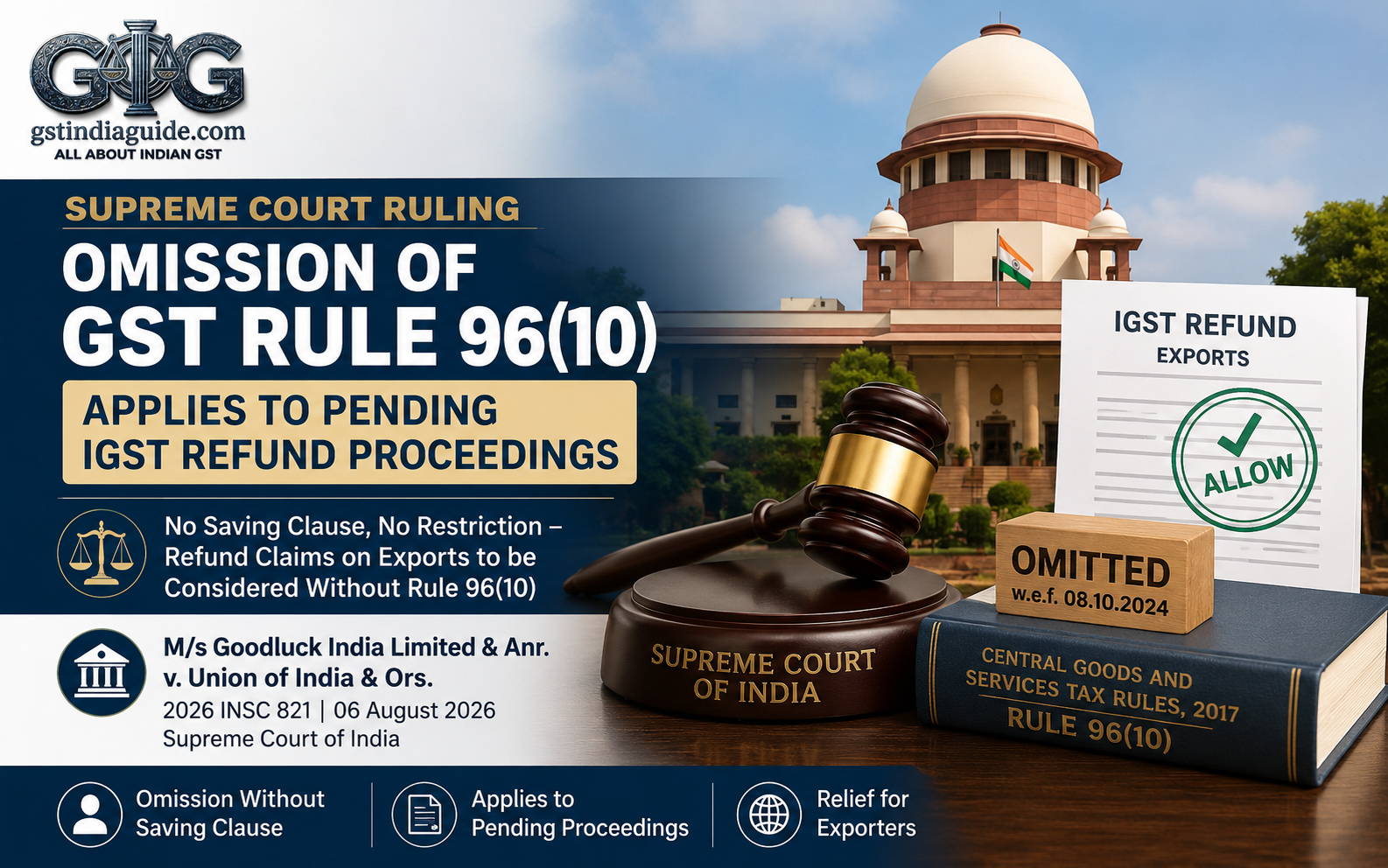
Case: M/s Goodluck India Limited & Anr. v. Union of India & Ors.
Court: Supreme Court of India
Citation: 2026 INSC 821
Lead Matter: Special Leave Petition (C) No. 24550 of 2025
Date of Judgment: 06 August 2026
Bench: Justice J.B. Pardiwala and Justice K. Vinod Chandran
Subject: GST – IGST Refund on Exports – Rule 96(10) of the CGST Rules, 2017
In a significant ruling concerning refund of Integrated Goods and Services Tax (IGST) paid on exports, the Supreme Court of India has upheld the view that the omission of Rule 96(10) of the Central Goods and Services Tax Rules, 2017, with effect from 08 October 2024, operates in respect of pending proceedings where the restriction contained in the erstwhile rule was being applied.
The batch of matters arose from challenges concerning the legal effect of the omission of Rule 96(10) through Notification No. 20/2024. The Union of India and the Department challenged the High Court’s conclusion that the omission would apply to proceedings pending on the date of omission. In two petitions filed by assessees, including M/s Goodluck India Limited, the vires and validity of Rule 96(10) itself had also been challenged.
Core Issue
The principal question before the Supreme Court was whether the omission of Rule 96(10) of the CGST Rules with effect from 08 October 2024 would benefit assessees in pending proceedings involving claims for refund of IGST paid on goods and services exported outside India.
The issue assumed importance because Rule 96(10), before its omission, imposed restrictions on refund where the person claiming refund had received supplies after availing specified benefits under the notifications referred to in the rule.
Supreme Court’s Observations
The Supreme Court noted that Rule 96(10) had been omitted without incorporating any saving clause or sunset provision preserving its application to pending proceedings.
The Court referred to the Constitution Bench judgment in Kolhapur Canesugar Works Ltd. v. Union of India, (2000) 2 SCC 536, which dealt with the legal consequences of omission of a rule. The principle emerging from that decision was that where a rule is omitted, proceedings under the omitted rule can continue only if there is an express provision preserving such proceedings or another statutory mechanism creating a legal fiction permitting their continuation.
The Court observed that no such saving mechanism had been provided when Rule 96(10) was omitted.
The Union relied upon the minutes of the 54th GST Council Meeting held on 09 September 2024, wherein the Law Committee had recommended omission of Rule 96(10), Rule 89(4A) and Rule 89(4B) with prospective effect.
The Supreme Court, however, noted that the GST Council’s recommendation was advisory in nature and did not bind the rule-making authority. More importantly, the actual amendment omitting Rule 96(10) did not contain any saving clause preserving the restriction for pending proceedings.
The Court also took note of the reason recorded by the Law Committee for recommending the omission—namely, that the operation of Rule 96(10) was leading to unnecessary complications without serving any intended benefit.
According to the Supreme Court, the omission without a saving clause reflected an intention to bring those complications to an end rather than continue them in pending proceedings.
Verdict
The Supreme Court found no reason to interfere with the High Court’s judgment and upheld the position that the omission of Rule 96(10) applies to pending proceedings.
Accordingly, pending claims for refund of IGST paid on exports are to be considered without applying the restriction contained in the omitted Rule 96(10).
The appeals challenging the High Court’s view were dismissed.
The two SLPs filed by the assessees challenging the vires and validity of Rule 96(10), including SLP (C) No. 24550 of 2025, were dismissed as infructuous in view of the relief flowing from the Court’s ruling on the effect of the omission.
Recognising that several proceedings concerning the same issue were pending before different High Courts and that conflicting decisions had been rendered, the Supreme Court directed its Registry to forward a copy of the order to all High Courts. The High Court Registries were directed to ensure that matters relating to the omission of Rule 96(10) are placed expeditiously before the appropriate roster benches.
Between Fine Lines
The judgment draws an important distinction between an executive or advisory recommendation that an amendment should operate prospectively and the actual language used by the rule-making authority.
Although the GST Council’s recommendation referred to prospective omission, the final amendment did not preserve Rule 96(10) for proceedings already initiated. The absence of a saving clause therefore became decisive.
The ruling establishes that restrictions imposed solely through the omitted Rule 96(10) cannot continue to govern pending proceedings merely because those proceedings commenced while the rule was in force. For exporters facing pending IGST refund disputes under the erstwhile Rule 96(10), the judgment provides authoritative guidance on the legal consequences of its omission.