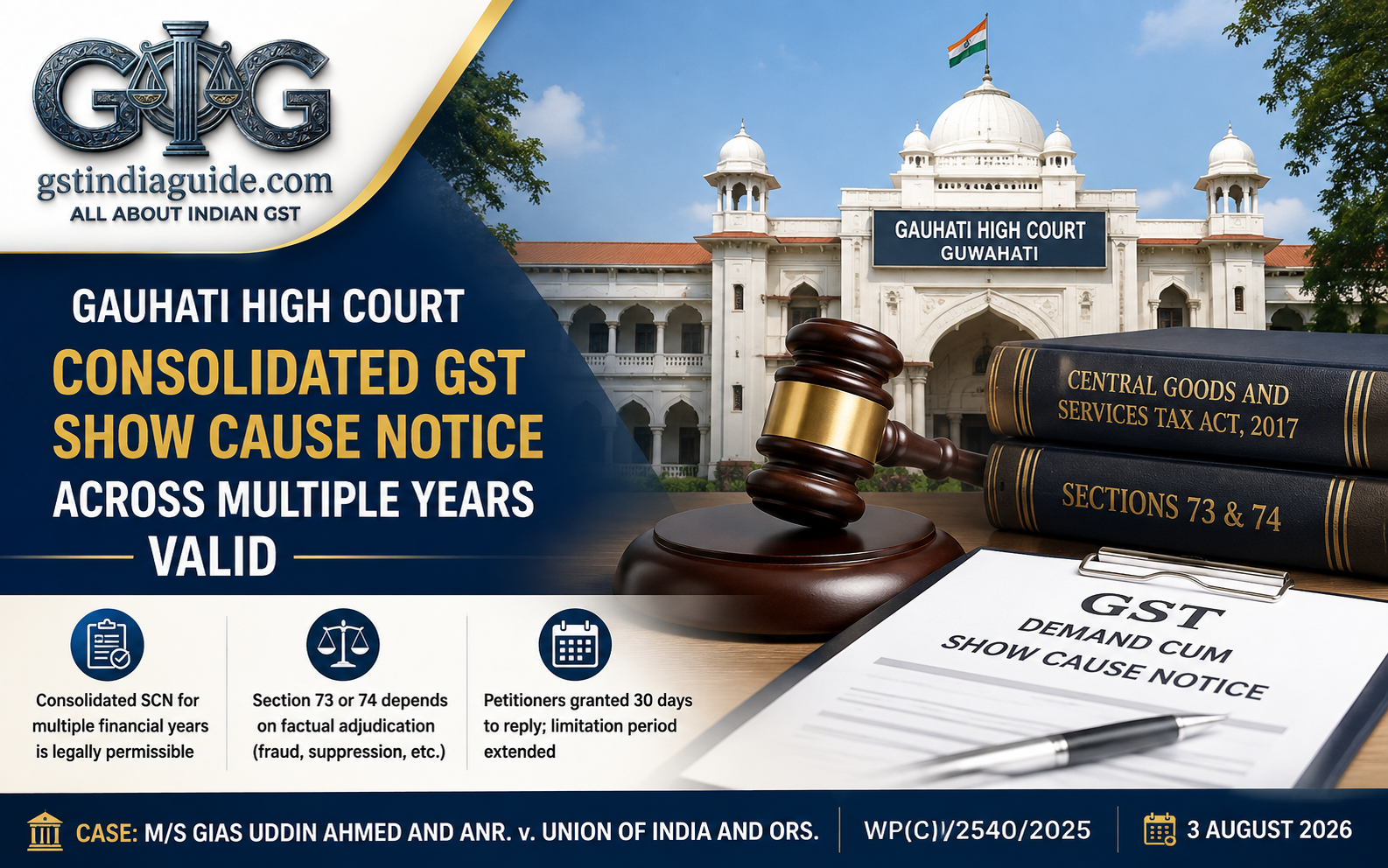
The Gauhati High Court, in M/s Gias Uddin Ahmed and Anr. v. Union of India and Ors., considered a challenge to a Demand-cum-Show Cause Notice issued by the Directorate General of Goods and Services Tax Intelligence covering four financial years. The principal challenge was that a consolidated show-cause notice for multiple years was impermissible and that the proceedings ought to fall under Section 73 of the Central Goods and Services Tax Act, 2017 rather than Section 74.
The petitioners had challenged the Demand-cum-Show Cause Notice dated 17 April 2024 primarily on the ground that it consolidated demands relating to four years. They further contended that, on the facts of their case, the proceedings could at best be initiated under Section 73 of the CGST Act and not under Section 74 and, consequently, the notice was barred by limitation.
Consolidated GST Show Cause Notice Permissible
The High Court held that the issue relating to the validity of a consolidated show-cause notice covering different financial years was no longer open for consideration. Relying upon its earlier decision in M/s Tata Projects Limited v. Union of India, the Court reiterated that there is no statutory bar on issuing a consolidated show-cause notice for different financial years under either Section 73(1) or Section 74(1) of the CGST Act.
The Court further noted that a consolidated adjudication order covering different financial years can also be passed under Section 73(9) or Section 74(9). Accordingly, issuance of a consolidated notice by the Proper Officer did not suffer from a jurisdictional defect merely because it covered several financial years.
Section 73 or Section 74 Requires Factual Adjudication
On the petitioners’ contention that the proceedings should have been initiated under Section 73 instead of Section 74, the High Court held that the issue necessarily depends upon factual determination.
The Court observed that proceedings under Section 73 may arise where tax has not been paid or has been short-paid, tax has been erroneously refunded, or input tax credit has been wrongly availed or utilised. Section 74, however, applies where such circumstances arise by reason of fraud, wilful misstatement or suppression of facts with an intention to evade tax.
Whether fraud, wilful misstatement or suppression of facts exists is therefore a matter requiring examination of evidence and factual adjudication. Such issues, according to the Court, are appropriately determined by the Proper Officer during adjudication rather than by the High Court in proceedings under Article 226 of the Constitution.
Statutory Appellate Remedies Available
The Court also emphasised the statutory remedies available under the CGST Act. An order passed under Section 73 or Section 74 is appealable before the Appellate Authority under Section 107, followed by a further appeal before the Appellate Tribunal under Section 112.
Since questions concerning the applicability of Section 73 or Section 74 could be examined during adjudication and subsequently before the statutory appellate forums, the High Court declined to entertain the writ petition on that ground.
Fresh Opportunity to Reply to the GST Notice
Although the writ petition was not entertained, the High Court considered it appropriate, in the interests of justice, to give the petitioners another opportunity to respond to the Demand-cum-Show Cause Notice.
The petitioners were therefore granted 30 days from the date of the judgment to submit their reply. They were permitted to raise all contentions taken in the writ petition except the objection to the jurisdiction of the Proper Officer to issue a consolidated show-cause notice, that question having already been settled.
Limitation Period Excluded During Proceedings
While granting the additional opportunity to reply, the Court also balanced the interests of the Revenue. It directed that the period from 18 April 2024 until the date of the judgment, 3 August 2026, would stand excluded while computing the limitation period available to the authorities for passing an adjudication order pursuant to the impugned show-cause notice.
The ruling therefore clarifies that consolidation of different financial years in a GST show-cause notice does not by itself invalidate the proceedings. At the same time, whether a particular case falls under Section 73 or the more stringent provisions of Section 74 depends upon factual findings concerning fraud, wilful misstatement or suppression of facts and must ordinarily be determined through the statutory adjudication process.
Case: M/s Gias Uddin Ahmed and Anr. v. Union of India and Ors.
Court: Gauhati High Court
Case No.: WP(C)/2540/2025
Judgment Date: 3 August 2026
Relevant Provisions: Sections 73, 74, 107 and 112 of the Central Goods and Services Tax Act, 2017
Key Issue: Validity of consolidated GST show-cause notice for multiple financial years and determination of proceedings under Section 73 versus Section 74.