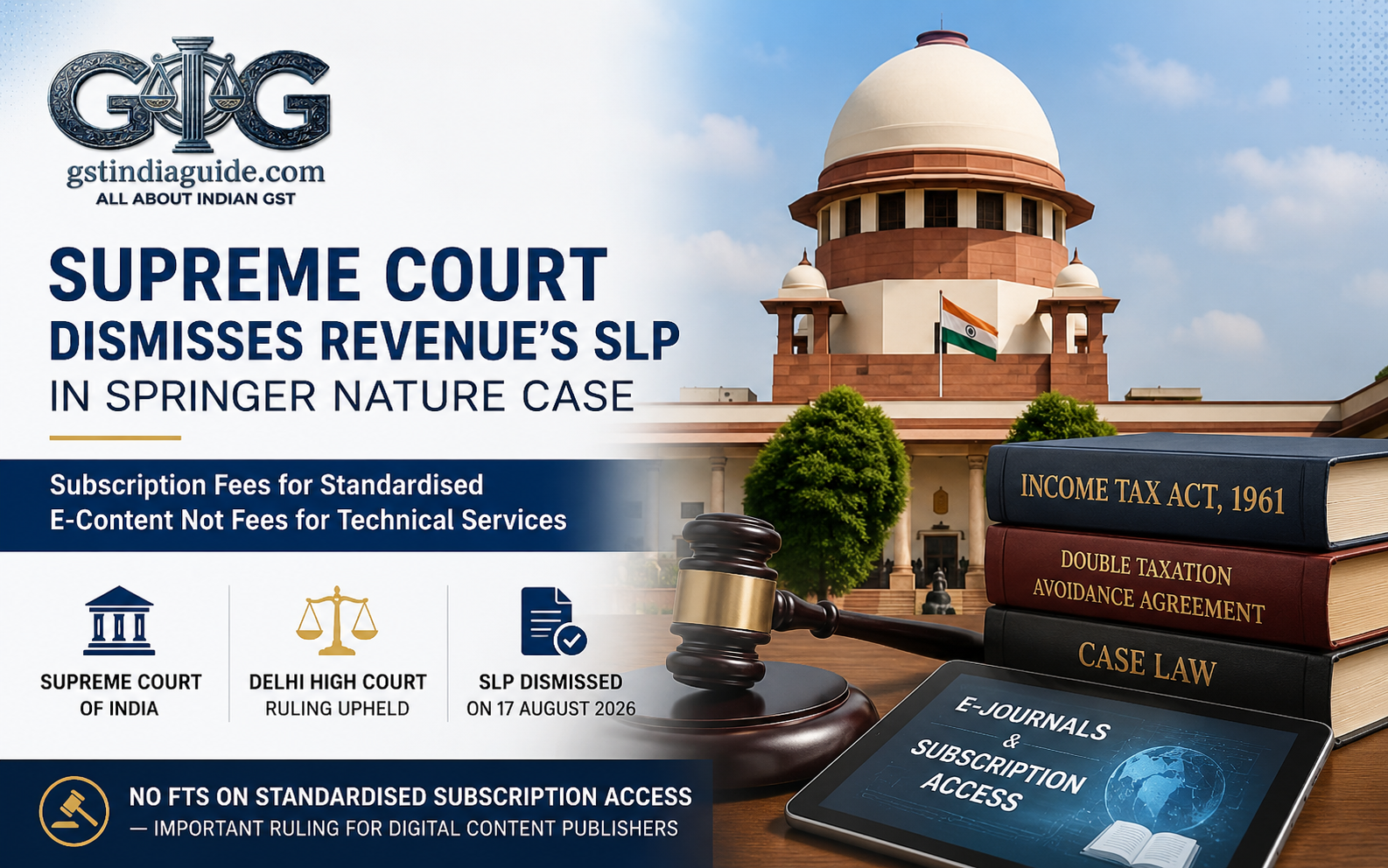
The Supreme Court has declined to interfere with the Delhi High Court’s ruling in the case concerning Springer Nature Customer Service Centre, thereby leaving undisturbed the finding that subscription fees received for access to standardised e-journals, e-magazines and other online content do not constitute Fees for Technical Services (FTS) under Section 9(1)(vii) of the Income Tax Act, 1961.
The Revenue had approached the Supreme Court against the Delhi High Court’s judgment dated 16 April 2025. The Supreme Court condoned the delay in filing the Special Leave Petition but, after hearing the Revenue, stated that it was not inclined to interfere with the impugned order. The SLP was accordingly dismissed.
Background of the Dispute
Springer Nature Customer Service Centre GMBH is a company incorporated under German law and a tax resident of Germany. It forms part of the Springer Nature Group, which publishes books, journals and scientific, technical and medical content.
The assessee had entered into a Commissionaire Agreement with Springer Nature India Pvt. Ltd. under which it acted as a non-exclusive sales representative for promoting, selling and distributing printed products and electronic products, including online books, journals and archives.
For Assessment Years 2020-21 and 2021-22, the Assessing Officer treated both the commission income and subscription fees received by the assessee as FTS. The assessed income was determined at approximately ₹63.71 crore for AY 2020-21 and ₹69.63 crore for AY 2021-22.
The ITAT, however, followed the earlier Delhi High Court judgment in the assessee’s own case and set aside the assessment orders. The Revenue thereafter carried the dispute before the Delhi High Court.
Commission Income Already Covered in Assessee’s Favour
On the question of commission income, the Delhi High Court recorded that the issue was already covered in favour of Springer Nature by its earlier decision in Commissioner of Income-tax, International Taxation v. Springer Nature Customers Services Centre GMBH, reported at [2023] 458 ITR 728.
The principal controversy before the High Court therefore concerned whether the subscription fees received for access to online journals, books and other content could nevertheless be characterised as FTS under Section 9(1)(vii).
Standardised Subscription Access Is Not a Technical Service
The Delhi High Court examined the meaning of “fees for technical services” under Explanation 2 to Section 9(1)(vii). It referred to the established distinction between rendering a specialised technical service to a particular customer and merely providing access to a standard facility or product.
The Court observed that for a receipt to qualify as FTS, the consideration must relate to the rendering of managerial, technical or consultancy services. Such services are required to be understood in a comparatively narrow sense and ordinarily involve specialised services provided according to the requirements of the recipient.
A standard facility made available to all customers on payment of subscription charges does not acquire the character of technical services merely because sophisticated technology or specialised knowledge was used in creating the underlying product.
No Customised Service to Subscribers
In Springer Nature’s case, the subscription fees were received from third parties for access to e-magazines and content which was standardised and was not specifically collected, prepared or generated for any individual subscriber.
The High Court therefore held that the subscription fee could not be treated as FTS within the meaning of Explanation 2 to Section 9(1)(vii).
Significantly, the Court held that mere access to a technical database or technical literature does not amount to provision of technical services. Similarly, the sale or supply of technical texts, information or research material, even where such material has been compiled through extensive research, does not by itself constitute rendering of technical services.
Specialised Service Distinguished from Standard Facility
The Delhi High Court relied upon principles emerging from decisions including Skycell Communications Ltd. v. Deputy Commissioner of Income-Tax, Commissioner of Income-Tax v. Bharti Cellular Ltd., Commissioner of Income Tax v. Kotak Securities, and Commissioner of Income-Tax, International Taxation v. Relx Inc.
The Court emphasised that a technical service contemplated under Section 9(1)(vii) involves something more than the use of technology. An exclusive, customised or specialised service rendered according to the particular requirements of the customer may fall within the provision, whereas standard access available uniformly to subscribers ordinarily constitutes a facility rather than technical services.
The judgment also referred to the commentary on Article 12A of the United Nations Model Double Taxation Convention, including the distinction between access to a general database and creation of a customised database using the service provider’s expertise for a particular customer.
DTAA Examination Became Unnecessary
Having concluded that the subscription fee itself was not chargeable as FTS under the normal provisions of the Income Tax Act, the Delhi High Court held that it was unnecessary to separately examine the provisions of the India-Germany Double Taxation Avoidance Agreement.
The Court accordingly found that no substantial question of law arose and dismissed the Revenue’s appeals.
Supreme Court Dismisses Revenue’s SLP
The Revenue challenged the Delhi High Court judgment before the Supreme Court through SLP (Civil) Diary No. 27540/2026.
On 17 August 2026, the Supreme Court condoned the delay but expressly stated that, after hearing the Revenue’s senior counsel, it was not inclined to interfere with the impugned order. Consequently, the Special Leave Petition was dismissed and all pending applications were disposed of.
It is important to note that the Supreme Court’s order is an order declining interference with the High Court judgment; the detailed legal reasoning on the taxability of the subscription fees is contained in the Delhi High Court judgment.
Key Takeaway
Where an overseas publisher merely grants subscribers access to standardised online journals, e-magazines, databases or content, without rendering any customised managerial, technical or consultancy service to the individual customer, the subscription consideration does not constitute FTS under Section 9(1)(vii) of the Income Tax Act.
The Supreme Court’s dismissal of the Revenue’s SLP leaves the Delhi High Court’s ruling in Springer Nature’s favour undisturbed.