Commissioner, Commercial Tax v. Racket Backizer India Ltd.
High Court of Allahabad
Sales/Trade Tax Revision No. 91 of 2014
Category: Classification under VAT Act
Date of Judgment: 09 October 2018
Relevant Section: Section 58, U.P. VAT Act, 2008
Relevant Entry: Schedule II, Part A, Entry No. 20 of the UPVAT Act
Facts of the Case
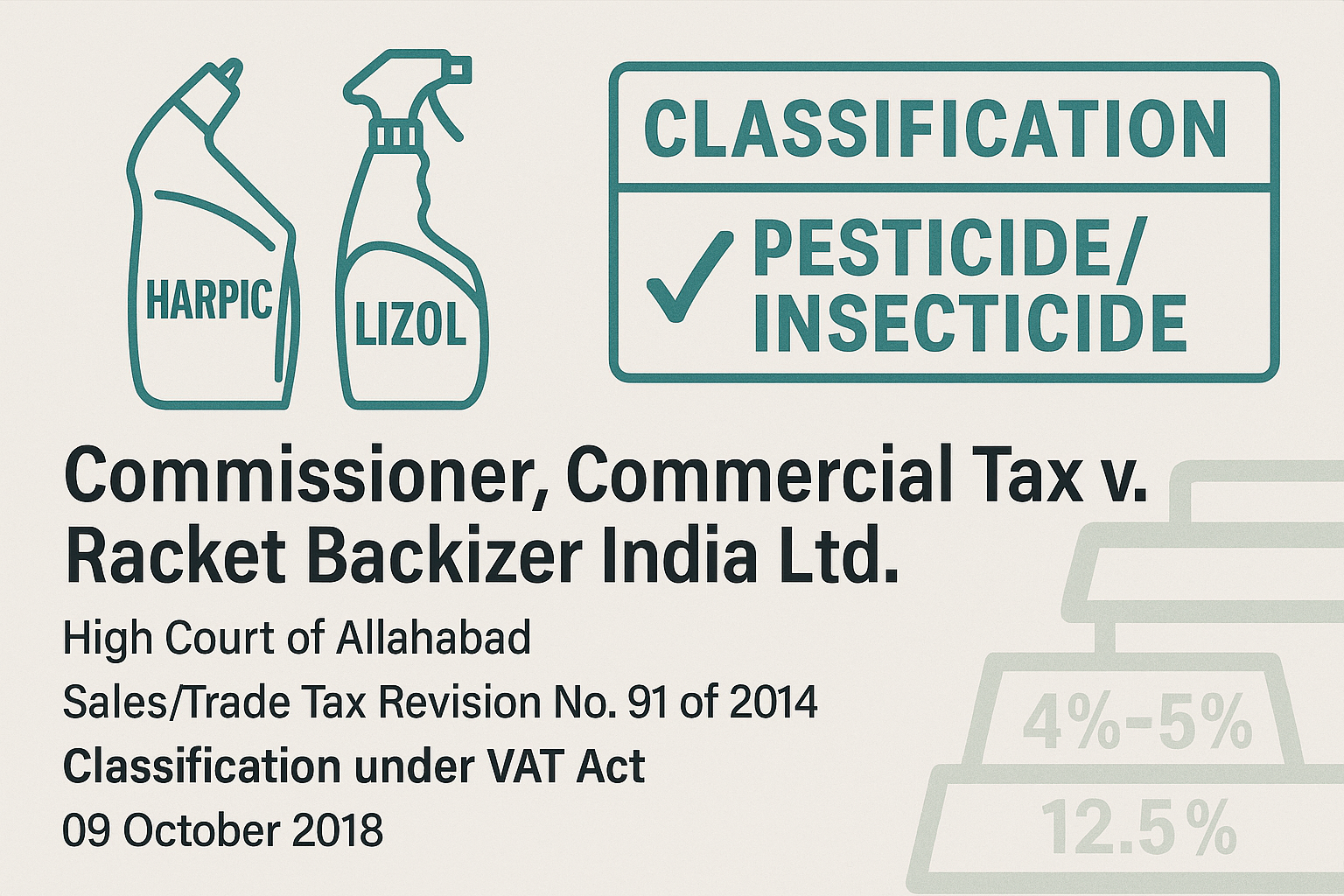
- The assessee, Racket Backizer India Ltd., engaged in the manufacture and sale of “Harpic” and “Lizol”, classified these products under Entry 20 of Part-A, Schedule II to the UPVAT Act (Pesticides/Insecticides), paying VAT at 4%–5% (Para 3).
- The Assessing Authority, however, treated the products as “unclassified goods” and imposed tax at the residual rate of 12.5% under Schedule V (Para 4).
- Appeals by the assessee were dismissed by the First Appellate Authority but succeeded before the Commercial Tax Tribunal, which restored the lower tax rate classification (Paras 5–7).
- The department challenged the Tribunal’s decision in a revision before the High Court under Section 58 of the UPVAT Act (Para 2).
Question(s) in Consideration
Whether “Harpic” and “Lizol”, being disinfectant toilet and floor cleaners, fall under the definition of “insecticides/pesticides” under Entry 20 of Schedule II Part A of the UPVAT Act, liable to VAT @ 4%–5%, or are to be taxed as unclassified goods under the residual entry at 12.5%? (Para 2)
Observations of the Court
- Referred to the Supreme Court’s judgment in Bombay Chemicals Pvt. Ltd. which recognized that disinfectants used to kill bacteria can fall within the ambit of “pesticides” (Paras 10–12, 35).
- Multiple High Court decisions (Andhra Pradesh, Gauhati, and Rajasthan) had held Harpic and Lizol as pesticides/insecticides eligible for lower VAT classification, and SLPs against these were dismissed by the Supreme Court (Paras 13, 36–38, 55).
- Expert reports from government-certified laboratories (SGS Lab, IICT Hyderabad) confirmed Harpic and Lizol as disinfectants capable of killing 99.999999% bacteria, reinforcing their functional identity as pesticides/insecticides (Paras 15, 24–26, 30).
- The products were also recognized as drugs/disinfectants under the Drugs and Cosmetics Act, requiring licenses for manufacture and being labeled as such, aligning with the broader definition of pesticides (Paras 28–29, 47–49).
- The burden of proof for classification lies with the revenue; ambiguity must be resolved in favour of the assessee. The department failed to disprove the product’s characteristics or submit contrary evidence (Paras 39–42).
- HSN classification, dictionary definitions, and trade parlance all supported the view that Harpic and Lizol are disinfectants with pesticide properties (Paras 31–34).
Judgment of the Court
The Allahabad High Court upheld the Tribunal’s order and dismissed the revision petition, ruling that Harpic and Lizol fall within the scope of Entry 20 of Schedule II, Part A of the UPVAT Act as insecticides/pesticides and are taxable at 4%–5%. The products are not to be treated as unclassified goods under Schedule V (Paras 50–56).
Between Fine Lines
- Harpic and Lizol were classified as disinfectants with germicidal properties, thereby qualifying as “insecticides/pesticides” under VAT law.
- The judgment emphasized consistency with national jurisprudence from other High Courts and the Supreme Court.
- Functional characteristics, trade parlance, and chemical composition played a central role in classification.
- Burden to prove alternate classification lies on the department, which was not discharged.
- Classification disputes must lean in favour of the assessee when ambiguity exists.
Summary of Referred Cases
| Case Name | Citation | Summary | Verdict |
| Bombay Chemicals Pvt. Ltd. v. CCE | 1995 taxmann.com 398 (SC) | Disinfectants that kill germs are broadly pesticides/insecticides. | Held disinfectants as pesticides |
| Rackitt Benckiser (India) Ltd. v. State of AP | [2014] 46 taxmann.com 65 | Harpic and Lizol classified as pesticides under AP VAT Act based on chemical properties. | Harpic/Lizol taxable @ 4% as pesticides |
| Reckitt Benckiser India (P.) Ltd. v. Assam | WP No. 1377 of 2010, Judgment dt. 18.9.2012 | Functionally held as pesticides due to germicidal action; disinfectant property emphasized. | Classified under pesticide entry of Assam VAT Act |
| Reckitt Benckiser (India) Ltd. v. ACTO, Rajasthan | Judgment dt. 7.4.2017 | Declared Harpic/Lizol as pesticide under Rajasthan VAT Act; SLP against it dismissed. | Classified as pesticide, not residual item |
| Ponds India Ltd. v. CTT | 2009 taxmann.com 934 | Expert reports and trade parlance essential for classification under tax laws. | Emphasized expert evidence for classification |
| Dunlop India Ltd. v. UOI | [1976] 2 SCC 241 | Residuary entry can only be invoked if goods not classifiable elsewhere. | Priority to specific over residuary classification |
| Voltas Ltd. v. State of Gujarat | [2015] 57 taxmann.com 16 | Ambiguity in classification to be resolved in favour of assessee. | View favouring assessee must prevail |