
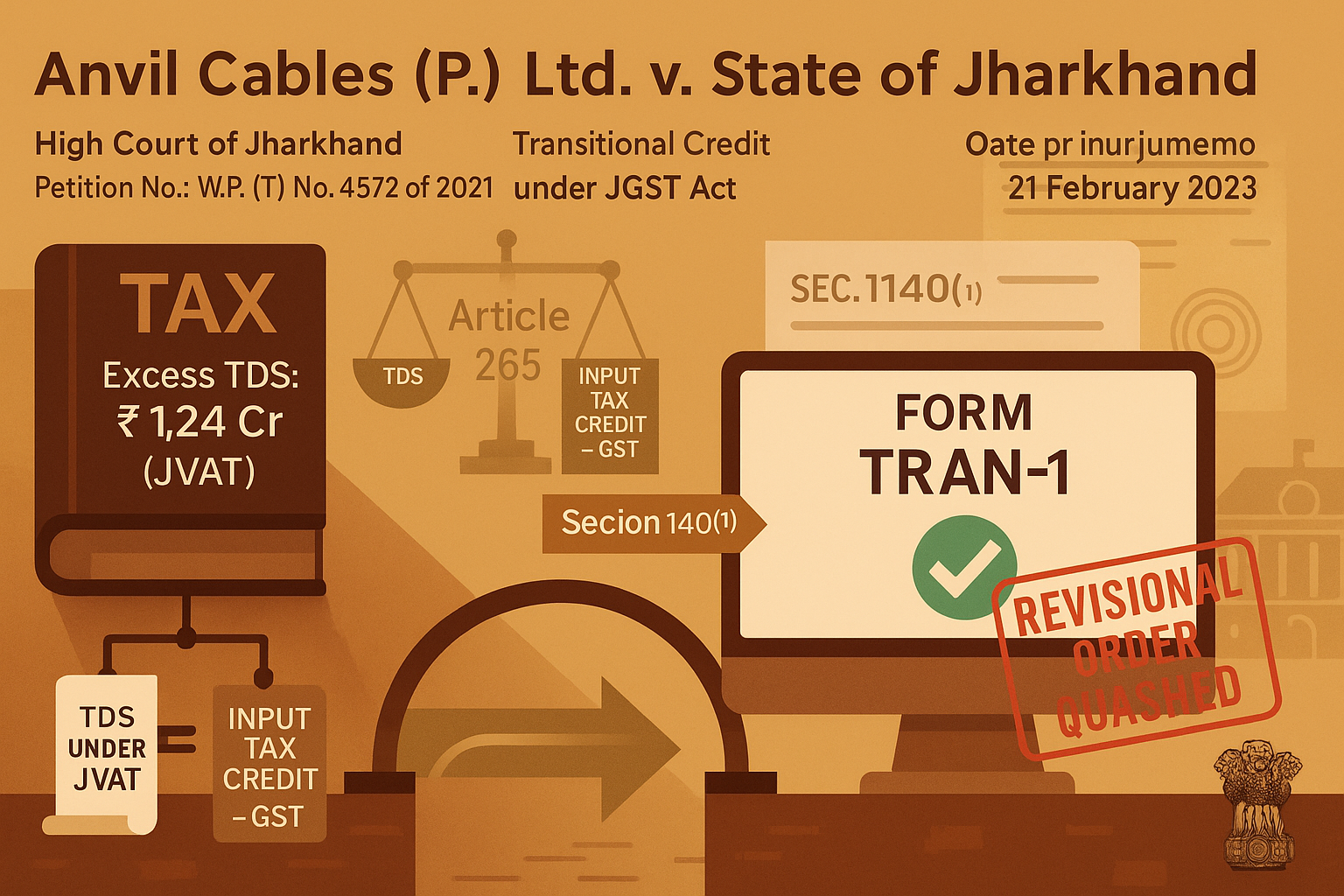
Case Title: Anvil Cables (P.) Ltd. v. State of Jharkhand
Court: High Court of Jharkhand
Petition Number: W.P. (T) No. 4572 of 2021
Category of Dispute: Transitional Credit under Section 140(1) of the JGST Act
Date of Judgment: 21 February 2023
Relevant Sections: Section 140(1) of the JGST Act, 2017; Section 45 of the JVAT Act, 2005; Rule 117 of the JGST Rules
Takeaway: “TDS as Tax – A Rightful Credit in GST Transition?”
Facts of the Case [¶3]
- The petitioner, Anvil Cables (P.) Ltd., a manufacturer and supplier to JBVNL, had excess TDS of ₹1,24,68,378.36 as of 30.06.2017 under Section 45 of the JVAT Act.
- It filed Form TRAN-1 under Section 140(1) of the JGST Act to transition ₹1,19,41,937.86 into the GST regime.
- Though initially accepted, an ex-parte revisional order dated 30.07.2021 reversed the benefit on the basis of AG audit objections (I.R. 48/2018-19), without hearing the petitioner and imposed penalty and interest totaling ₹1,60,02,196.69.
- The petitioner challenged this on the grounds that TDS deducted under JVAT assumes the character of tax under Article 265 and Section 45(4) and is eligible for transition.
Questions in Consideration [¶6]
- Whether TDS deducted under Section 45 of the JVAT Act, available as on 30.06.2017, qualifies as credit of VAT under Section 140(1) of the JGST Act, 2017 and is eligible for transition to the electronic credit ledger in GST?
Observations of the Court
- [¶6–7] The Court held that the issue is squarely covered by its earlier decision in Subhash Singh Choudhary v. State of Jharkhand, W.P.(T) No. 2404 of 2020.
- [¶16] It reiterated that the proviso to Section 140(1) only restricts migration where ITC is specifically disallowed under Section 17(5) of the GST Act.
- [¶17] Rule 117 cannot override Section 140(1) and must be ignored where it narrows the main provision.
- [¶18] The unadjusted TDS shown in Form JVAT-200 as “excess input tax credit” could have otherwise been claimed as a refund. Denial of migration would unjustly deprive the assessee of this tax.
Judgment of the Court [¶7]
- The impugned revisional order dated 30.07.2021 and consequent demand notice dated 31.07.2021 were quashed.
- Authorities were directed to refund or adjust the amount already recovered.
- The writ petition was allowed.
Between Fine Lines
- TDS deducted under JVAT assumes the character of tax and is eligible for migration under Section 140(1) of the JGST Act.
- Rule 117 of the JGST Rules, being a subordinate legislation, cannot restrict a substantive right granted under the Act.
- Department cannot initiate revision merely on audit objections without independent reasoning or hearing.
- Transitional ITC includes TDS if it reflects in returns as “credit” before 01.07.2017.
- Refund or carry-forward must be honored to prevent double loss to taxpayers.
Summary of Referred Cases
| Name of Case | Citation | Summary | Verdict |
| Subhash Singh Choudhary v. State of Jharkhand | [2023] 146 taxmann.com 560; W.P.(T) No. 2404/2020 | TDS under JVAT deemed VAT credit, allowed to be carried forward under GST via TRAN-1 | Allowed transitional credit, quashed demand |
| DMR Constructions v. Asst. Commissioner, CTD | [2021] 125 taxmann.com 252; W.P. No. 9991/2020 | TDS deducted is a tax under Article 265, thus treated as paid tax and eligible for adjustment | Recognised TDS as tax eligible for transition |
| Bharthidasan University v. AICTE | (2001) 8 SCC 676 | Subordinate legislation cannot override parent Act; rules outside statutory bounds cannot be enforced | Rules must conform to main legislation |
| Shree Bhagwati Steel Rolling Mills v. CCE | (citation not mentioned) | Courts may ignore rules that restrict statutory rights without striking them down formally | Subordinate rules restricting rights ignored |