


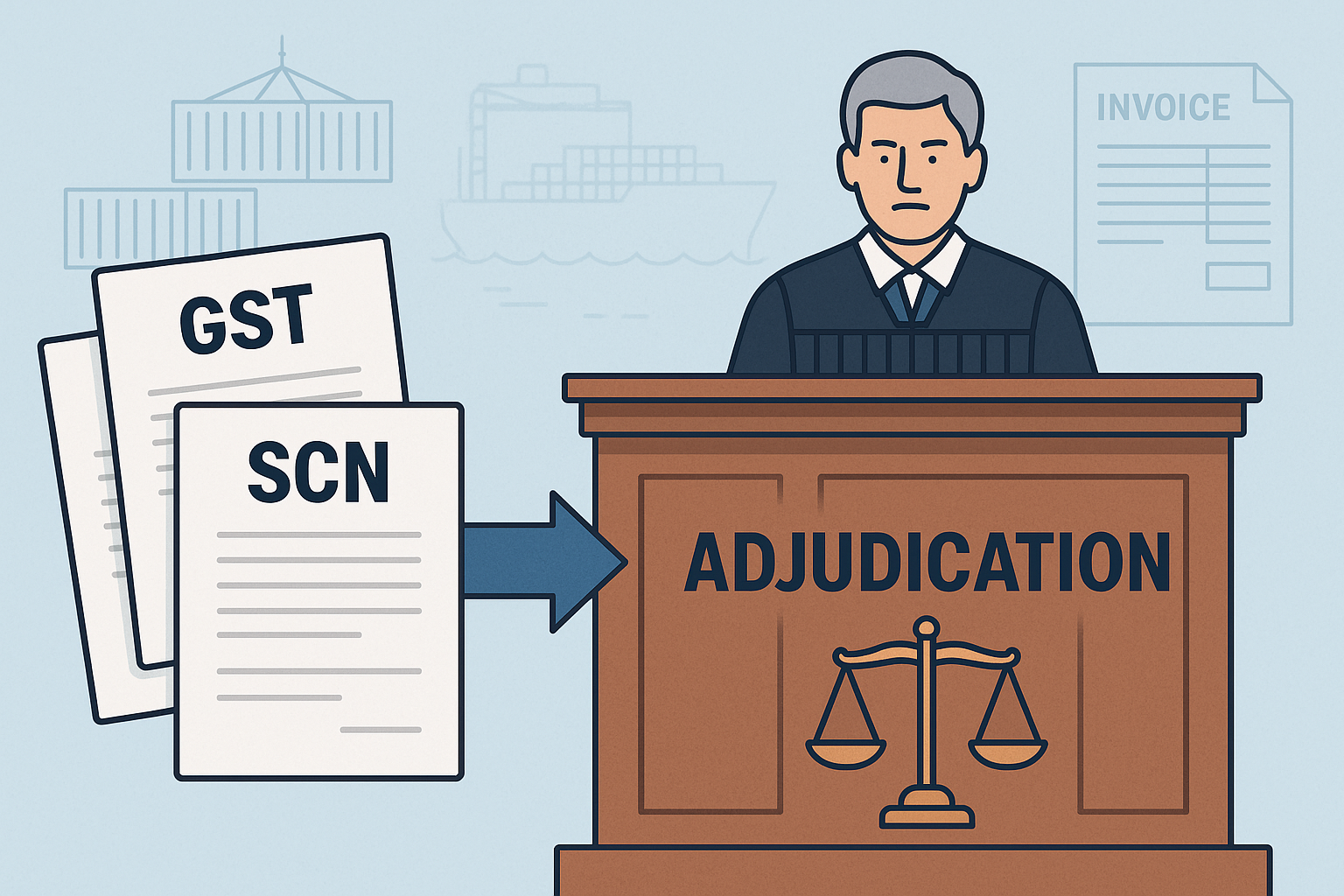
Case Summary: Show cause notice challenge dismissed as High Court held that issues must first be adjudicated by the proper authority with full opportunity of hearing
Case Title: M/s White Mountain Trading Pvt. Ltd. & Ors. v. Commissioner, Central Excise & CGST, Delhi South & Anr.
Court: High Court of Delhi
Petition No.: W.P.(C) 11890/2023, CM Appl. 46451/2023, 46452/2023
Date of Judgment: 06.09.2023
Relevant Statutory Provisions: Section 74, Section 16 & Section 54 of the CGST Act, 2017 (ITC, refund & fraud-related proceedings)
Category of Dispute: Input Tax Credit – Alleged availment on “good-less invoices” and challenge to SCN
Facts of the Case (Paras 3–8)
The petitioners, engaged in export of goods, availed input tax credit (ITC) which was used for payment of IGST on zero-rated supplies (para 4). A pre-show cause notice dated 07.06.2023 was issued alleging that the petitioners had availed ITC on “good-less invoices”, implying that no goods were supplied (para 5). The petitioners submitted a detailed reply to the pre-notice, placing reliance on e-way bills, supplier invoices, and filed returns demonstrating actual receipt and export of goods (para 6).
The petitioners contended that suppliers had paid GST on the transactions, and since the supplies were exports, tax recovery could not be made again; any tax paid would in any case be refundable as per zero-rated supply principles under Section 54 of the CGST Act (para 7). The petitioners also asserted that the subsequent SCN dated 26.07.2023 ignored their submissions and material placed before the department (para 8).
Questions/Issues Before the Court
-
Whether the pre-show cause notice and show-cause notice issued under Section 74 of the CGST Act are arbitrary and liable to be quashed at the threshold (para 3).
-
Whether the High Court should interfere when an efficacious adjudication mechanism is available before the proper officer (para 9).
-
Whether failure of the SCN to consider the reply to the pre-SCN warrants exercise of writ jurisdiction.
Court’s Observations (Paras 9–10)
The Court observed that the petitioners had full opportunity to respond to the SCN and the statutory authority was required to consider the reply in accordance with law (para 9). The adjudicating authority is the first forum competent to evaluate facts, materials, and legal submissions, including evidence regarding movement of goods, e-way bills, supplier tax payment, and nature of exports.
The Court held that at the SCN stage, intervention under Article 226 is limited, and the issues relating to ITC and alleged fraud require factual determination by the department (para 9). The Court further observed that if an adverse order is contemplated, the authority must give personal hearing and pass a detailed speaking order addressing all contentions (para 9).
The Court also clarified that if the petitioners file their reply within three weeks, it shall be considered without objection as to delay (para 10).
Judgment / Verdict (Paras 9–11)
The writ petition was disposed of with directions rather than quashing the SCN. The Court declined to interfere at the SCN stage (para 9) and directed:
-
The petitioners may submit their response to the SCN within three weeks (para 10).
-
The adjudicating authority shall consider the reply on merits, unaffected by any delay (para 10).
-
If proposing adverse action, the authority must provide full opportunity of hearing and pass a reasoned speaking order covering all submissions (para 9).
Accordingly, the writ petition and pending applications were disposed of (para 11).
Table of Cases Referred (with Verdict Summary)
| Case Name | Court | Issue | Verdict Summary |
|---|---|---|---|
| No external precedent is cited within the judgment | — | — | The Court decided the matter solely on principles governing interference at SCN stage. |
Between the Fine Lines (Trade-Friendly Takeaways)
This ruling reiterates that writ courts seldom quash GST show-cause notices unless they are without jurisdiction or patently illegal. Taxpayers must utilise the statutory adjudication process, ensuring that replies are comprehensive with documentary evidence. Importantly, the judgment safeguards taxpayers by mandating a fair hearing and a speaking order, ensuring that replies—especially in alleged “good-less invoice” cases—cannot be mechanically ignored. It reinforces that disputes concerning ITC on exports and supplier compliance must first be examined factually by departmental adjudicators.
Disclaimer – “The above summary is for academic purpose only; not formal legal opinion. Seek professional opinion before application. Author or publisher or website shall not be responsible for any usage in any form.”

