

Case Title: Vinod Maurya v. Union of India & Ors.
Court: High Court at Calcutta, Circuit Bench at Jalpaiguri
Petition No.: W.P.A. 1241 of 2025
Date of Judgment: 20.06.2025
Relevant Section: Section 129(3) of the CGST Act, 2017 read with Section 20 of the IGST Act, 2017
Category: Detention and Confiscation of Goods in Transit – Penalty for Excess Quantity
Facts (Paras 1–5)
The petitioner, proprietor of M/s Maa Kamakhya Traders, transported 493 bags of Assam dried areca nuts (34,510 kg) from Assam to Karnataka under proper tax invoice, e-invoice, e-way bill, and consignment note as per Rule 138A of the CGST Rules, 2017.
The CGST Anti-Evasion Unit at Siliguri intercepted the vehicle (AP 39 UN 9869) on 17 May 2025 and detained it, alleging an excess 590 kg of goods based on a weighment report (35,100 kg vs declared 35,003 kg).
A notice under Section 129(3) was issued on 27 May 2025 and a final order dated 3 June 2025 imposed penalty. The petitioner challenged the order, contending lack of jurisdiction and illegal valuation.
Questions Before Court (Paras 6–9)
-
Whether the writ petition was maintainable despite the availability of a statutory appellate remedy under Section 107 of the CGST Act.
-
Whether the weighment report relied upon by authorities was invalid and the penalty without intention to evade tax was sustainable.
-
Whether reasons beyond the show-cause notice could be invoked to impose penalty.
Observations (Paras 11–13)
The Court noted that the weighment slip showed reasonable evidence of excess goods (590 kg) and the petitioner failed to produce any contrary proof like a loading-point weighment certificate or payment evidence from the consignee. Even the driver’s statement raised doubts about the genuineness of the transaction.
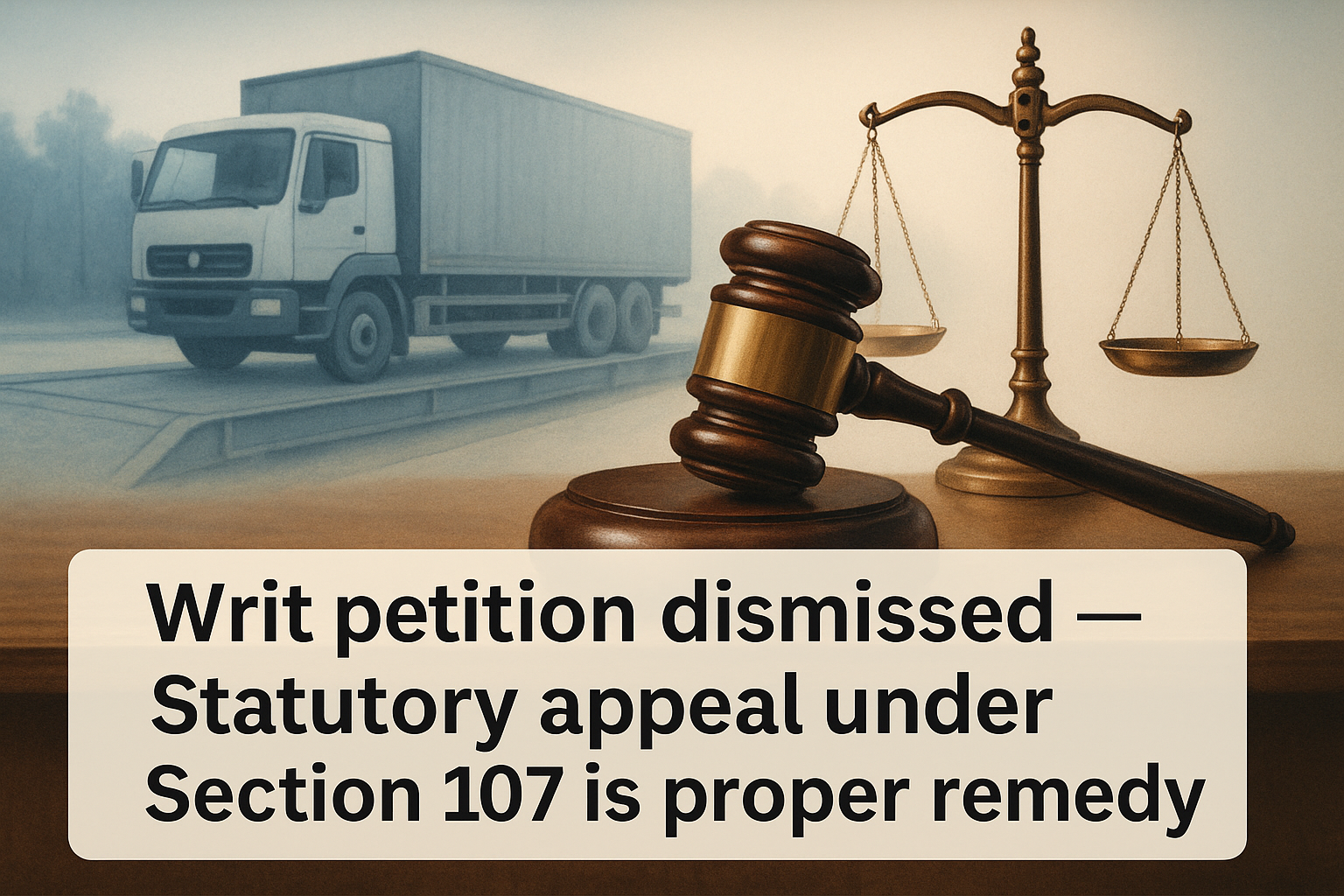
The order of the Assistant Commissioner reflected application of mind, reasoned findings, and no breach of natural justice. The valuation dispute and factual issues could not be adjudicated in writ jurisdiction. The proper remedy was an appeal under Section 107.
Judgment (Paras 14–16)
The High Court dismissed the petition holding that no jurisdictional error or procedural irregularity was shown. It emphasized that Article 226 cannot be used to re-examine facts or valuation issues when a statutory appeal exists.
However, liberty was granted to the petitioner to file an appeal under Section 107 of the CGST Act, to be decided independently without influence from the Court’s observations.
Summary of Cases Referred
| Sl. No. | Case Name | Citation / Court / Year | Verdict / Ratio |
|---|---|---|---|
| 1 | Kamal Envirotech (P) Ltd. v. Commissioner of GST | (2025) 170 Taxmann.com 508 (Delhi) | Penalty not leviable absent intent to evade tax. |
| 2 | Amplus Kn One Power (P.) Ltd. v. Assistant Commissioner State Tax | (2024) 166 Taxmann.com 479 | Procedural violation cannot justify penalty without mens rea. |
| 3 | M/s Tiwari Furniture v. State of West Bengal & Ors. | W.P. 365/2024 (11 Mar 2024) | Held that Section 129 invoked only where intent to evade is proven. |
| 4 | Ashok Sharma v. State of West Bengal | FMA 136/2025 (11 Feb 2025) | Interference not warranted where statutory appeal available. |
| 5 | M/s Raghav Metals v. State of Haryana | CWP 25057/2021 (P&H HC) | Penalty unsustainable without intent to evade. |
| 6 | Bishnu Supply Co. v. State of UP | (2024) 167 Taxmann.com 350 | Penalty cannot be based on enhanced valuation. |
| 7 | Rajeev Traders v. Union of India | (2022) 142 Taxmann.com 420 | Value enhancement beyond invoice not permissible for penalty. |
Between Fine Lines (Trade Takeaway)
This decision underscores that detention disputes under Section 129 should normally be resolved through the statutory appeal route. The High Court will not interfere where factual assessment like weight variance and valuation are disputed. Traders should maintain proper loading-point weighment records and bank proof of transaction to avoid penalty disputes during transit.
Disclaimer – “The above summary is for academic purpose only; not formal legal opinion. Seek professional opinion before application. Author or publisher or website shall not be responsible for any usage in any form.”

