


Case Summary
Case Title: Eximio Services and Solutions Pvt. Ltd. v. Superintendent of GST & Central Excise & Anr.
Court: High Court of Judicature at Madras
Petition No.: W.P. No. 20608 of 2025, decided on 11.06.2025
Judge: Justice Krishnan Ramasamy
Category of Dispute: Input Tax Credit & Procedural Remedies
Relevant Sections:
-
Section 16, CGST Act, 2017 (Input Tax Credit entitlement)
-
Section 107, CGST Act, 2017 (Appeal to Appellate Authority)
-
Article 226, Constitution of India (Writ Jurisdiction)
-
Section 83, CGST Act, 2017 (Provisional attachment of bank accounts)
Facts (Paras 3–5)
The petitioner, Eximio Services and Solutions Pvt. Ltd., challenged an Order-in-Original dated 27.08.2024 and subsequent bank attachment notice dated 04.04.2025. The dispute arose as rent payments with GST, though duly remitted to the landlord and further deposited with the Government, were incorrectly reported as B2C instead of B2B by the landlord. Consequently, the petitioner’s GSTR-2A did not reflect the ITC. The petitioner argued that despite producing evidence, the adjudicating authority ignored submissions and denied a fair hearing, thereby violating natural justice.
Questions before Court (Paras 6–7)
-
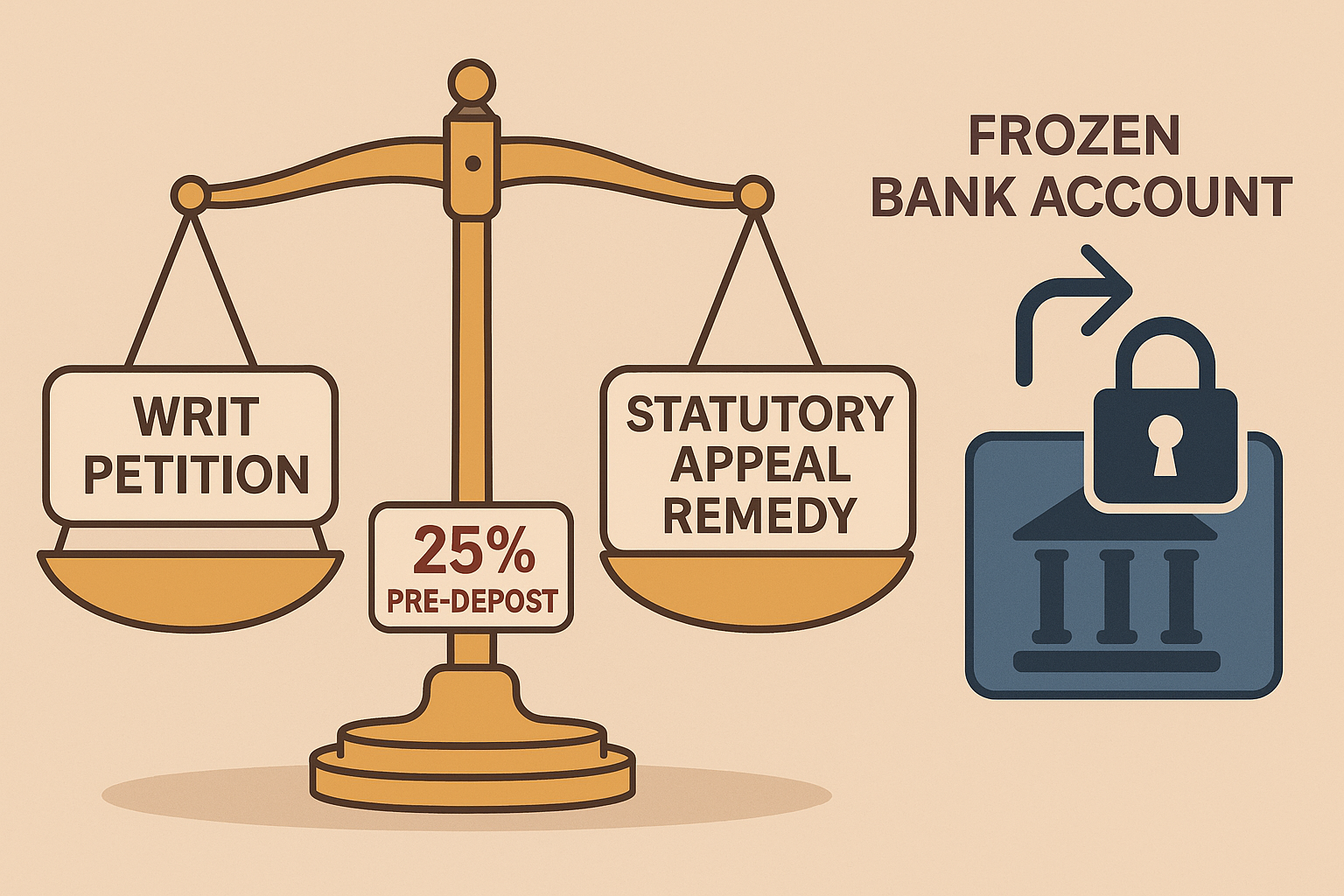
Whether the writ petition was maintainable against an Order-in-Original, bypassing the appellate remedy under Section 107 of the CGST Act?
-
Whether the petitioner could be permitted to approach the appellate authority despite lapse of limitation, considering their willingness to deposit 25% of the disputed tax?
Observations (Paras 8–10)
The Court noted that a statutory appeal remedy exists under Section 107 of the CGST Act. Hence, the writ petition was ordinarily not maintainable. However, given that the petitioner was willing to deposit 25% of the disputed tax (10% statutory pre-deposit + 15% voluntary), justice demanded that the appellate authority be directed to accept the appeal even beyond limitation. The Court further clarified that funds from the petitioner’s bank account could be utilized for the pre-deposit, after which the bank account should be defrozen.
Judgement (Paras 9–11)
The Court dismissed the writ petition but granted liberty to file an appeal within four weeks before the appellate authority. The appeal must be accompanied by a 25% pre-deposit of the disputed tax. On such compliance, the appellate authority shall accept the appeal without insisting on limitation and decide on merits. Further, the petitioner was allowed to withdraw the required amount from the frozen bank account for making the pre-deposit, after which defreezing would follow.
Table of Cases Referred
| Case | Citation | Verdict/Ratio |
|---|---|---|
| No external case laws cited | – | The judgment turned solely on statutory appeal remedy under GST Act and principles of natural justice |
Between Fine Lines
This judgment highlights that writ petitions against assessment orders under GST will not be entertained when a statutory appeal remedy exists. However, where procedural fairness is at stake, courts may relax limitation and allow appeals, provided taxpayers show bona fides by making higher pre-deposits. For businesses, the ruling reinforces the importance of promptly pursuing appellate remedies and ensuring vendor compliance in correctly reporting B2B supplies.
Disclaimer – “The above summary is for academic purpose only; not formal legal opinion. Seek professional opinion before application. Author or publisher or website shall not be responsible for any usage in any form.”

