

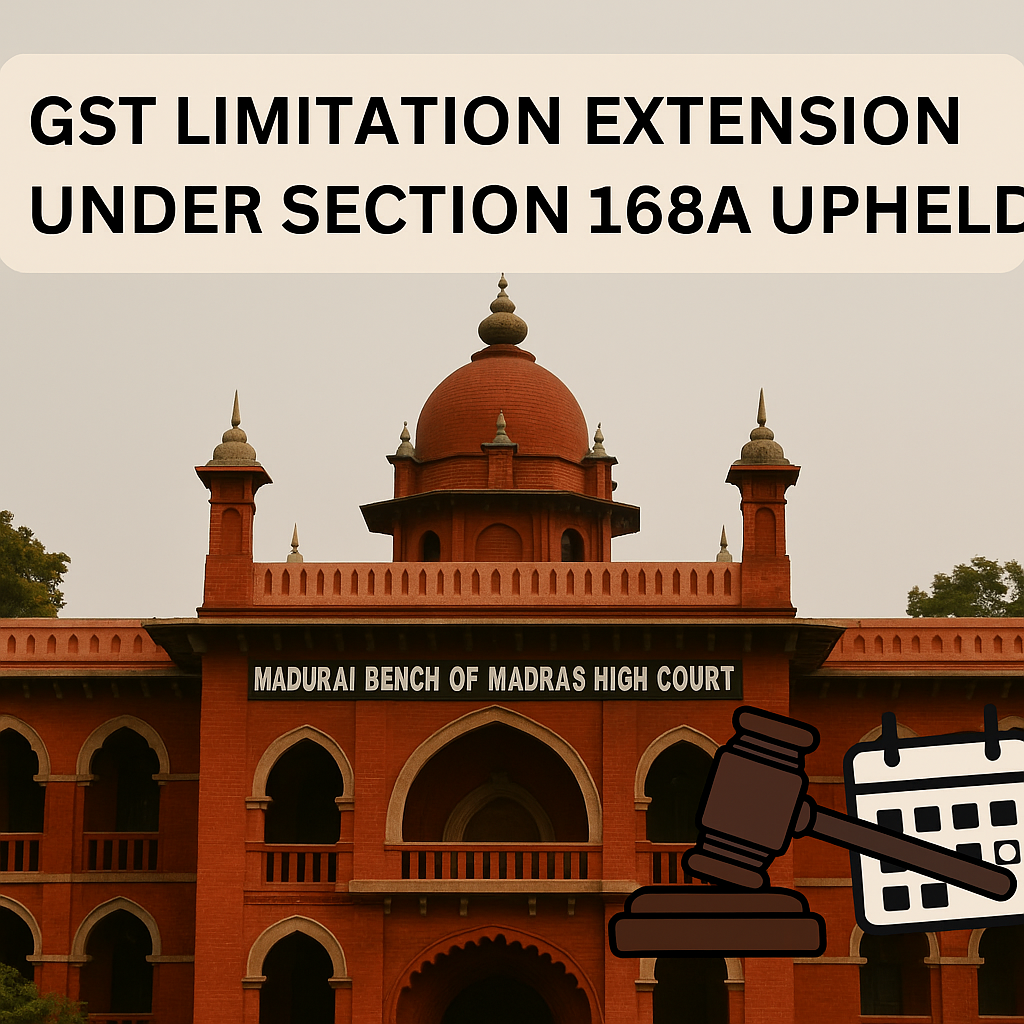
Case Title: Tvl. N.V.R. Sons v. Union of India & Others
Court: Madurai Bench of Madras High Court
Petition Number: W.P.(MD) No. 9947 of 2025, decided on 08.04.2025
Category: Limitation Extension under Section 168A of CGST/TNGST Act
Relevant Sections: Section 73(9), Section 168A of CGST Act and TNGST Act, Articles 14 and 19(1)(g) of the Constitution of India
Facts (Paras 1–4):
The petitioner, Tvl. N.V.R. Sons, challenged (i) Notification No. 56/2023-Central Tax dated 28.12.2023, (ii) G.O.(Ms) No. 1 dated 02.01.2024 issued by the State Government, and (iii) the assessment order dated 26.04.2024 passed by the Assistant Commissioner for FY 2018-19. The petitioner argued that both Central and State notifications were arbitrary, excessive, and without jurisdiction, contending that Section 168A was introduced only as a pandemic-related temporary measure to extend timelines due to force majeure. It was further alleged that the assessment was completed without due verification of GSTR-1, GSTR-2A, offset summary, and annual return (GSTR-9), thereby violating principles of natural justice.
Questions Before the Court (Paras 2–5):
-
Whether the Government validly exercised power under Section 168A of the CGST/TNGST Act to extend the time limit for FY 2018-19?
-
Whether the assessment order dated 26.04.2024 was void for want of proper inquiry or violation of natural justice?
Observations (Paras 6–11):
The Court noted that both the Central and State Governments had acted pursuant to the GST Council’s recommendation, and the extension of limitation up to 30.04.2024 for FY 2018-19 and 31.08.2024 for FY 2019-20 was clearly stated in the Annexure to G.O.(Ms) No.1 dated 02.01.2024. The Court held that Section 168A confers valid power to extend limitation in “exceptional circumstances,” and the exercise of such power did not exceed jurisdiction.
Further, the notifications were consistent with previous extensions issued during and after the pandemic period. The assessment was found to be procedurally valid, and failure to refer to specific GST return forms (GSTR-1, 2A, etc.) did not render it illegal when statutory requirements were otherwise met.
Judgement (Paras 10–12):
The Court upheld the validity of Notification No. 56/2023-CT and G.O.(Ms) No.1 (TNGST), holding that both were issued within the statutory framework of Section 168A and after due consideration by the GST Council. No violation of Articles 14 or 19(1)(g) was found, as the measures aimed to ensure uniformity and administrative continuity. Consequently, the writ petition was dismissed with no order as to costs.
Summary of Cases Referred (Tabular Form):
| Case Name | Citation / Context | Key Verdict / Principle |
|---|---|---|
| No external precedents cited | — | The Court relied solely on interpretation of Section 168A CGST Act and G.O.(Ms) No.1 dated 02.01.2024 extending limitation period for FY 2018-19 and 2019-20. |
Between Fine Lines (Practical Takeaway):
This judgment reaffirms that Government notifications extending limitation under Section 168A of CGST/TNGST Act are constitutionally valid when issued on GST Council’s recommendation. Taxpayers cannot contest such extensions merely because pandemic conditions have subsided. The decision strengthens the administration’s authority to finalize old GST assessments for FY 2018-19 and FY 2019-20 within extended timelines.
Disclaimer – “The above summary is for academic purpose only; not formal legal opinion. Seek professional opinion before application. Author or publisher or website shall not be responsible for any usage in any form.”

 No.1 (TNGST), confirming that time extension for FY 2018-19 under Section 168A CGST Act was lawful.)