


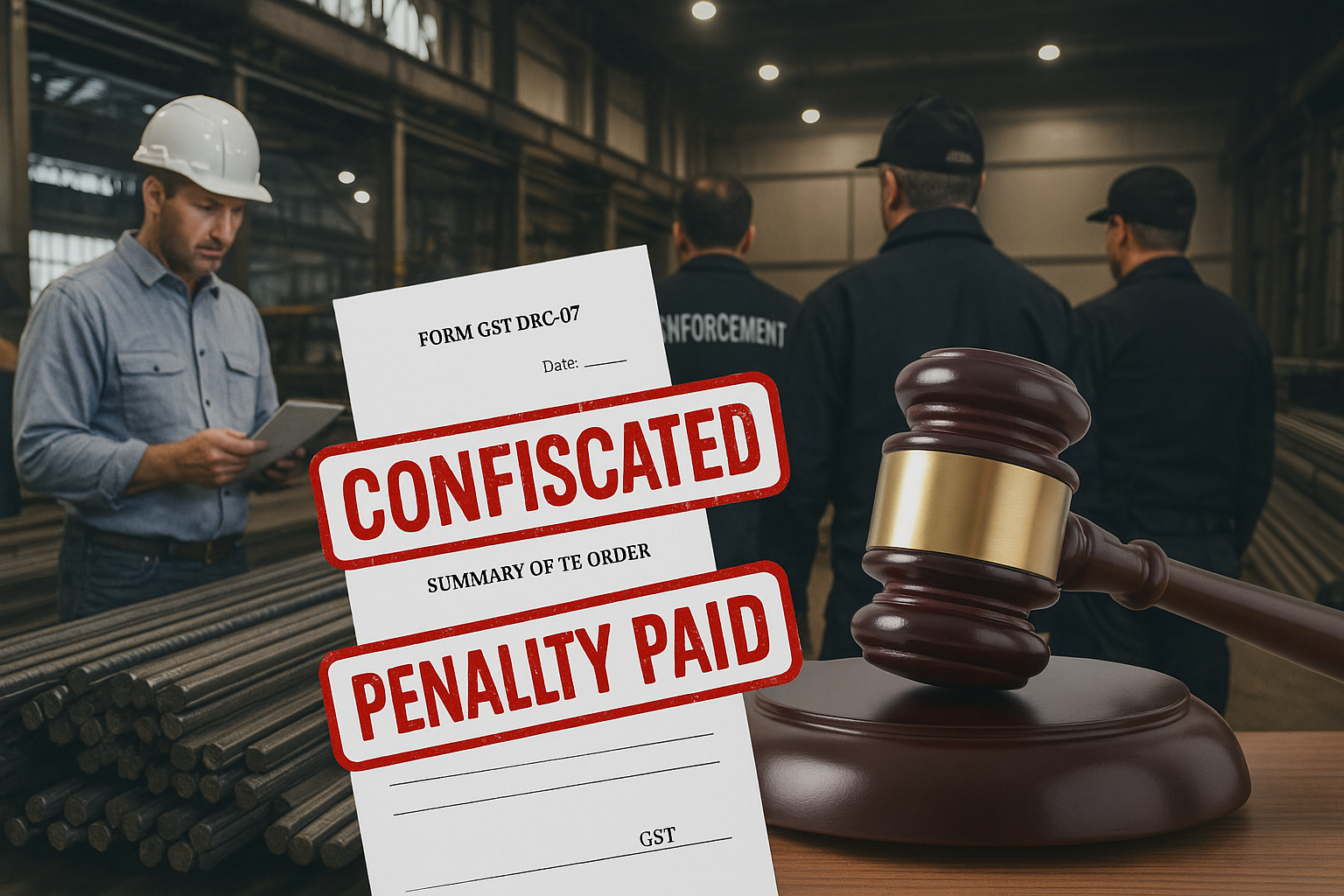
Case Name: M/s. Viraj Steel & Energy Private Ltd. v. Joint Commissioner of State Tax (Appeal), Sambalpur and Others
Court Name: High Court of Orissa, Cuttack
Petition No.: W.P.(C) No. 9367 of 2025
Date of Judgment: 15th May 2025
Relevant Sections: Sections 67, 107, 122, 130 of OGST Act, 2017
Category of Dispute: Confiscation and Redemption Fine under GST
Facts of the Case [¶1–¶2.4]
-
A search was conducted on 22nd March 2023 at petitioner’s factory, revealing unaccounted shortage of 341.360 MT of MS Billet worth ₹1.53 crore. [¶2]
-
Petitioner admitted stock discrepancies and agreed to pay the penalty and fine in lieu of confiscation under Section 130 read with Section 122. [¶2.1]
-
Demand order dated 29th March 2023 was issued imposing a penalty of ₹27,65,016 and redemption fine of ₹79,87,824, which was paid by the petitioner. [¶2.2]
-
An appeal under Section 107 was filed on 7th February 2025—almost two years later—which was dismissed as time-barred. [¶2.3]
-
Petitioner challenged both the appellate rejection and the original show cause notice/demand order via writ petition, claiming confiscation is invalid without physical goods. [¶2.4]
Questions in Consideration [¶4, ¶6]
-
Can goods be confiscated and redemption fine imposed under Section 130 when the goods are not physically available?
-
Whether writ jurisdiction under Article 226 is maintainable after expiry of statutory appellate limitation?
Observation of Court [¶6–¶19]
-
The Court distinguished between lack of jurisdiction and erroneous exercise of jurisdiction. In this case, the officer had jurisdiction under Sections 67, 122, and 130. [¶9]
-
Admitted payment of redemption fine and penalty was made without protest. Hence, petitioner cannot approbate and reprobate. [¶18]
-
Petitioner failed to avail statutory remedies within limitation and sought to indirectly challenge confiscation through writ jurisdiction. [¶17]
-
The Court relied on Weston Components and Finesse Creation cases to uphold confiscation where goods are released on bond; however, here, no such bond was executed. [¶14]
-
Held: absence of physical goods doesn’t bar imposition of redemption fine if statutory powers exist and procedural compliance is evident. [¶10]
-
Earlier Division Bench judgment in Shri D. Murali Mohan Patnaik followed for judicial consistency. [¶19]
Judgment of the Court [¶20–¶21]
-
Writ petition dismissed. Court held there was no palpable lack of jurisdiction and no protest made during payment.
-
Petitioner was not entitled to invoke Article 226 after delay in statutory appeal.
Between Fine Lines:
-
If you pay GST penalties without protest, you can’t later claim coercion in a writ.
-
Redemption fine can be levied even if goods are unavailable, if supported by statutory authority.
-
Courts differentiate between jurisdictional defect and procedural irregularity—only the former justifies writ.
-
Delay in appeal bars subsequent writ challenges unless gross violation of rights is proved.
-
A clear admission of liability weakens retrospective legal challenges.
Summary of Referred Cases
| Name of Case | Citation | Summary | Verdict |
|---|---|---|---|
| Chinku Exports v. CCE Calcutta | 1999 (112) ELT 400; aff. 2005 ELT A36 | Redemption fine not valid if goods not available and no bond executed. | Favour of Assessee |
| Weston Components Ltd. v. CCE | 2000 (115) ELT 278 (SC) | Goods released on bond allow subsequent redemption fine. | Favour of Revenue |
| Finesse Creation Inc. v. CC (Import), Mumbai | 2009 (248) ELT 122 (Bom.); aff. 2010 (255) ELT A120 | Redemption fine allowed if goods released on bond; not if not available. | Conditional |
| Commissioner of Customs v. Raja Impex (P) Ltd. | 2008 (229) ELT 185 (P&H) | Redemption fine not sustainable without bond or undertaking. | Favour of Assessee |
| Synergy Fertichem Pvt. Ltd. v. State of Gujarat | 2019 SCC OnLine Guj 6127 | Redemption fine permissible where statutory foundation exists. | Favour of Revenue |
| Kalabharati Advertising v. Hemant Narichania | (2010) 9 SCC 437 | Orders based on illegal foundations are nullities. | General Principle |
| Magadh Sugar v. State of Bihar | (2022) 16 SCC 428 | Writ maintainable only when authority lacks jurisdiction or violates fundamental rights. | Limited Scope |
Disclaimer – “The above summary is for academic purpose only; not formal legal opinion. Seek professional opinion before application. Author or publisher or website shall not be responsible for any usage in any form.”

