

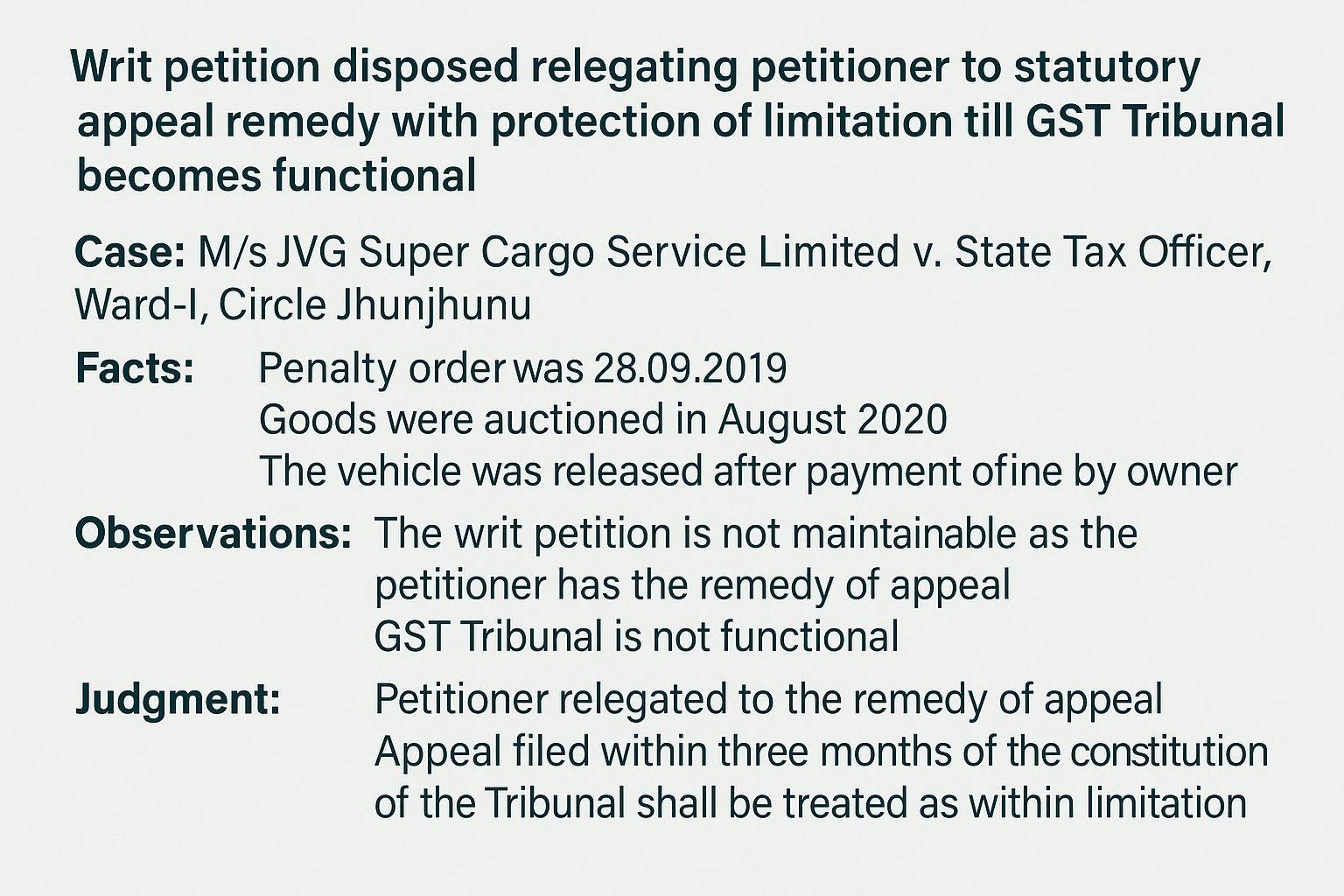
Case: M/s JVG Super Cargo Service Limited v. State Tax Officer, Ward-I, Circle Jhunjhunu
Court: Rajasthan High Court, Jaipur Bench
Petition No.: D.B. Civil Writ Petition No. 3610/2020
Category: Confiscation of goods and penalty under Sections 129 & 130 of RGST Act
Date of Judgment: 13 February 2025
Coram: Justice Avneesh Jhingan & Justice Pramil Kumar Mathur
Relevant Sections: Sections 129, 130, appeal provisions, and limitation principles under CGST/SGST Act
Facts (Para 1–2)
The petitioner, M/s JVG Super Cargo Service Limited, approached the Rajasthan High Court challenging the seizure of goods and vehicle under Sections 129 and 130 of the Rajasthan GST Act, 2017. They also assailed the penalty order dated 28.09.2019 and confiscation order dated 26.11.2019. The vehicle had already been released after the owner paid the fine, while the goods were auctioned in August 2020. The petitioner had earlier filed an appeal against the penalty order, which was dismissed.
Questions Before the Court
-
Whether the High Court should interfere with the penalty and confiscation orders under writ jurisdiction when a statutory appellate remedy exists.
-
Whether limitation for appeal would be protected given that the GST Appellate Tribunal is not yet constituted.
Observations (Para 3–4)
The Court observed that since the petitioner had already availed the remedy of appeal against the penalty order (which was dismissed), and the confiscation order also falls within the appellate framework, the writ petition was not maintainable as the proper remedy lies in the appellate forum. However, the Court took note of the fact that the GST Tribunal is presently non-functional. To balance equity, it directed that if the petitioner files an appeal within three months of the Tribunal’s constitution, it would be treated as filed within limitation, thereby protecting their substantive right to appeal.
Judgment (Para 3–4)
The writ petition was disposed of, relegating the petitioner to the remedy of appeal under the Act. The High Court further safeguarded the petitioner’s right by granting extension of limitation, clarifying that any appeal filed within three months of the GST Tribunal’s constitution shall be deemed within time.
Cases Referred – Summary Table
| Case Referred | Citation | Verdict / Principle |
|---|---|---|
| None cited specifically | – | – |
Between Fine Lines
The High Court reaffirmed the settled principle that writ jurisdiction should not ordinarily be invoked when a statutory appeal remedy exists under GST. However, considering the persistent delay in setting up the GST Appellate Tribunal, the Court provided equitable relief by safeguarding the limitation period, ensuring that taxpayers are not left remediless. For trade, this means that where confiscation and penalty orders are passed, businesses should prefer statutory appeals, but they can rely on the Court’s protection against limitation lapses due to the non-functionality of the Tribunal.
Disclaimer – “The above summary is for academic purpose only; not formal legal opinion. Seek professional opinion before application. Author or publisher or website shall not be responsible for any usage in any form.”

