Case Title: M/s Goyal Trading Co. & Ors. vs. Union of India & Ors.
Court: High Court of Madhya Pradesh, Indore Bench
Petition No.: W.P. No. 15428 of 2025 (with connected W.P. Nos. 15424, 15425 & 15427 of 2025)
Date of Judgment: 20 May 2025
Category: Input Tax Credit (Fake/Bogus ITC – Maintainability of Writ Petition)
Relevant Provisions:
-
Article 226, Constitution of India
-
Sections 74, 107, 122(1)(ii) of the CGST Act, 2017
-
Section 20 of the IGST Act, 2017
Facts (Paras 1–4)
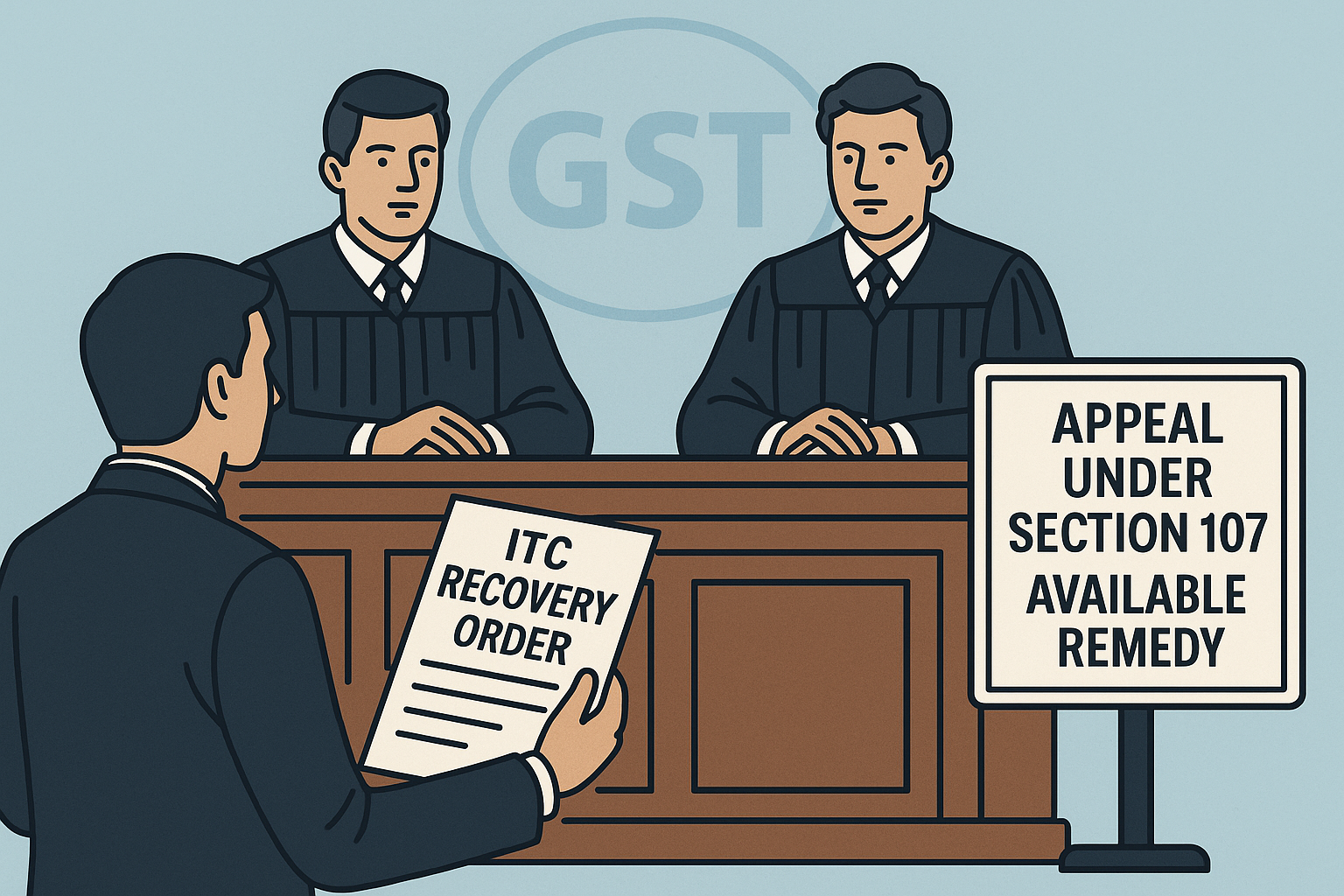
The petitioners, registered GST entities at Indore, challenged the Order-in-Original dated 19.12.2024 issued by the Additional Commissioner, CGST & Central Excise, Bhopal, relating to FY 2017–18 and 2018–19. The order demanded recovery of Input Tax Credit (ITC), interest, and penalty arising from a DGGI investigation against M/s R.A. Enterprises, alleged to have passed on bogus ITC worth ₹1.39 crore.
Instead of filing an appeal under Section 107 of the CGST Act, the petitioners filed writ petitions under Article 226, alleging violation of natural justice, particularly denial of cross-examination of witnesses and issuance of a common show-cause notice for multiple years.
Questions / Issues (Paras 5, 9)
-
Whether the High Court can entertain a writ petition under Article 226 when an alternative statutory remedy of appeal under Section 107 is available?
-
Whether denial of cross-examination constitutes a breach of natural justice sufficient to invoke writ jurisdiction directly?
Observations (Paras 7–10)
The Bench noted that territorial jurisdiction was proper as the business and investigation occurred at Indore.
However, on maintainability, it emphasized that the existence of an appellate remedy under Section 107 of the CGST Act cannot be bypassed merely by alleging procedural lapses.
The Court observed that the issue of cross-examination and its materiality can be adequately addressed by the appellate authority. Non-compliance with pre-deposit requirements cannot justify avoidance of the statutory appeal route.
The Court relied on:
-
State of Maharashtra v. Greatship (India) Ltd. (2022) 17 SCC 332 – where the Supreme Court held that writ jurisdiction should not be invoked when an appeal lies under statute.
-
Shrigovind Niranjan v. State of M.P. (2024 MPHC-JBP:56995) – on territorial jurisdiction and forum conveniens.
Judgment (Paras 11–12)
The Court held that since the CGST Act provides a complete appellate framework, the writ petitions were not maintainable. Petitioners were relegated to file appeals under Section 107 within limitation.
All writ petitions were accordingly dismissed with liberty to approach the appellate authority.
Summary of Cases Referred
| Sl. No. | Case Name & Citation | Court | Ratio / Verdict |
|---|---|---|---|
| 1 | State of Maharashtra & Ors. v. Greatship (India) Ltd. (2022) 17 SCC 332 | Supreme Court | High Courts must not entertain writs when an effective appellate remedy exists. |
| 2 | Shrigovind Niranjan & Ors. v. State of M.P. (2024 MPHC-JBP:56995) | MP High Court | Territorial jurisdiction valid if part of cause of action arises within forum. |
| 3 | Andaman Timber Industries v. CCE (2015) 324 ELT 641 (SC) | Supreme Court | Right to cross-examination is integral to natural justice. (Cited by petitioners but distinguished.) |
| 4 | D.Y. Beathel Enterprises v. STO (DATA Cell), Tirunelveli (2022) 58 GSTL 269 (Mad.) | Madras HC | Violation of natural justice permits writ – however, applicability depends on specific facts. |
Between Fine Lines (Trade Perspective)
This ruling reinforces that GST assessees must not bypass the statutory appeal mechanism under Section 107 merely by invoking natural justice grounds. The Court’s reliance on Greatship (India) Ltd. highlights judicial restraint in tax matters where efficacious remedies exist. Taxpayers must ensure timely filing of appeals with 10% pre-deposit rather than resorting to writs to delay recovery.
Disclaimer – “The above summary is for academic purpose only; not formal legal opinion. Seek professional opinion before application. Author or publisher or website shall not be responsible for any usage in any form.”