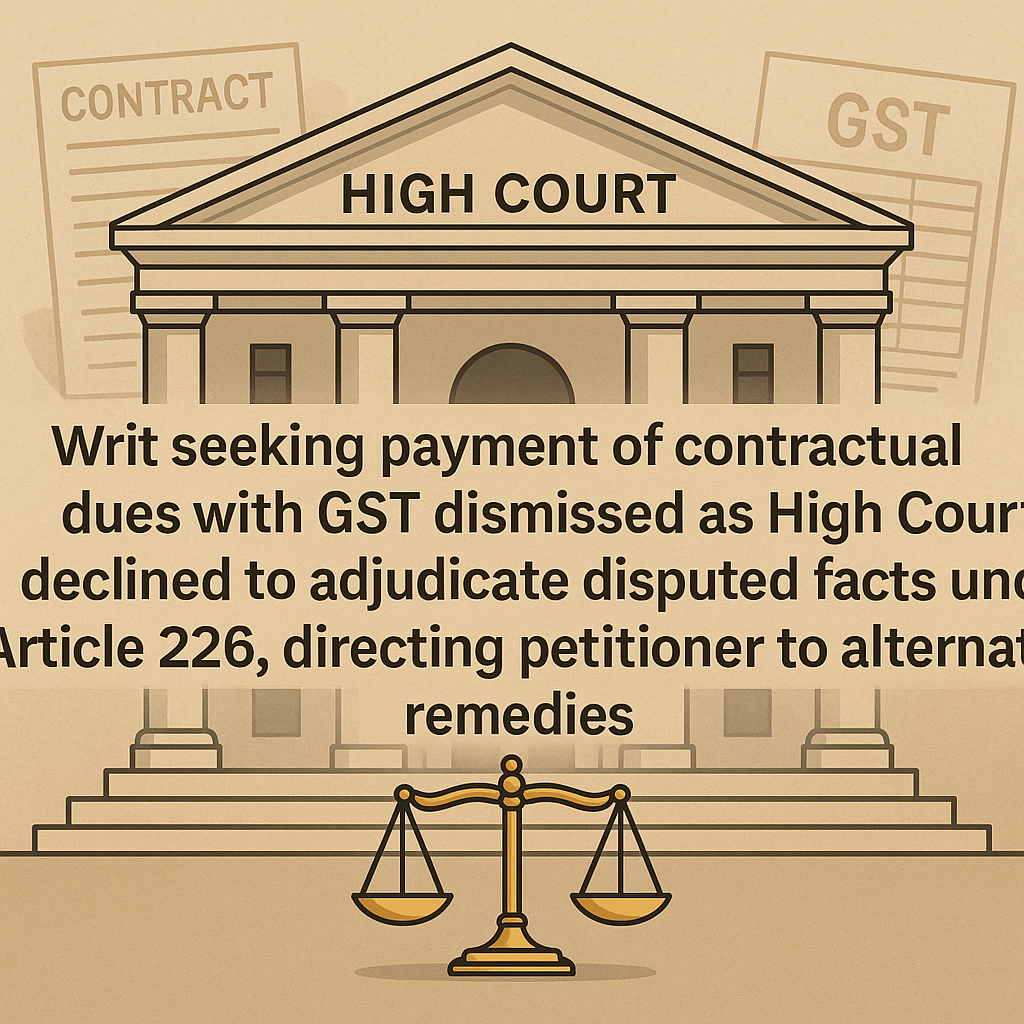
Case: M/s Akshat Steel v. State of Chhattisgarh & Ors.
Court: High Court of Chhattisgarh, Bilaspur
Petition: WPC No. 3702 of 2025
Date of Judgment: 17.07.2025
Category of Dispute: Contractual dues – claim for payment with GST and interest
Relevant Provision: Article 226 of the Constitution of India (jurisdiction of High Court in writ matters)
Facts (Paras 2–3)
M/s Akshat Steel, through its proprietor, filed a writ petition under Article 226 seeking directions to the authorities for release of ₹16,15,516/- plus GST along with interest as per the rate contract. The petitioner claimed that despite supplying materials under the government contract, payments were withheld. Relief was sought in the form of mandamus or certiorari to compel the respondents to release the due amount immediately.
The State opposed the petition, highlighting that identical issues had already been adjudicated in M/s Sai Info Services v. State of Chhattisgarh (WPC No. 2870/2025, decided on 16.06.2025), where the writ was dismissed as disputed facts were involved.
Questions before the Court (Paras 2–3)
-
Whether the High Court can entertain a writ petition under Article 226 to direct payment of contractual dues when disputed facts are involved.
-
Whether the claim of unpaid dues with GST and interest can be adjudicated in writ jurisdiction or requires recourse to alternate remedies.
Observations (Paras 3–4)
The Court observed that the relief claimed by the petitioner hinged on determination of disputed factual questions, such as the admissibility of amounts under the rate contract. Citing the earlier ruling in Sai Info Services (WPC No. 2870/2025), the Bench reiterated that writ jurisdiction is not an appropriate forum for resolving factual disputes arising out of contractual obligations.
The Court referred to established Supreme Court precedents which restrict writ jurisdiction in cases where disputed questions of fact are central to the claim. Thus, the matter could not be adjudicated under Article 226.
Judgment (Paras 4–5)
The Court dismissed the writ petition in terms of the earlier order dated 16.06.2025 in Sai Info Services. However, it reserved liberty for the petitioner to pursue appropriate alternate remedies available under law for recovery of dues. No costs were imposed.
Table of cases referred
| Case | Citation / Petition No. | Verdict |
|---|---|---|
| M/s Sai Info Services v. State of Chhattisgarh & Ors. | WPC No. 2870 of 2025, Chhattisgarh HC, decided on 16.06.2025 | Writ dismissed as contractual disputes involving facts cannot be resolved under Article 226; liberty to approach alternate remedies. |
Between Fine Lines
For businesses engaged in government contracts, this judgment underscores that claims for contractual payments with GST cannot be enforced through writ petitions if factual disputes exist. Instead, parties must resort to civil suits, arbitration, or other statutory remedies. Writ courts will not adjudicate on disputed invoices or rate contracts under Article 226.
Disclaimer – “The above summary is for academic purpose only; not formal legal opinion. Seek professional opinion before application. Author or publisher or website shall not be responsible for any usage in any form.”