


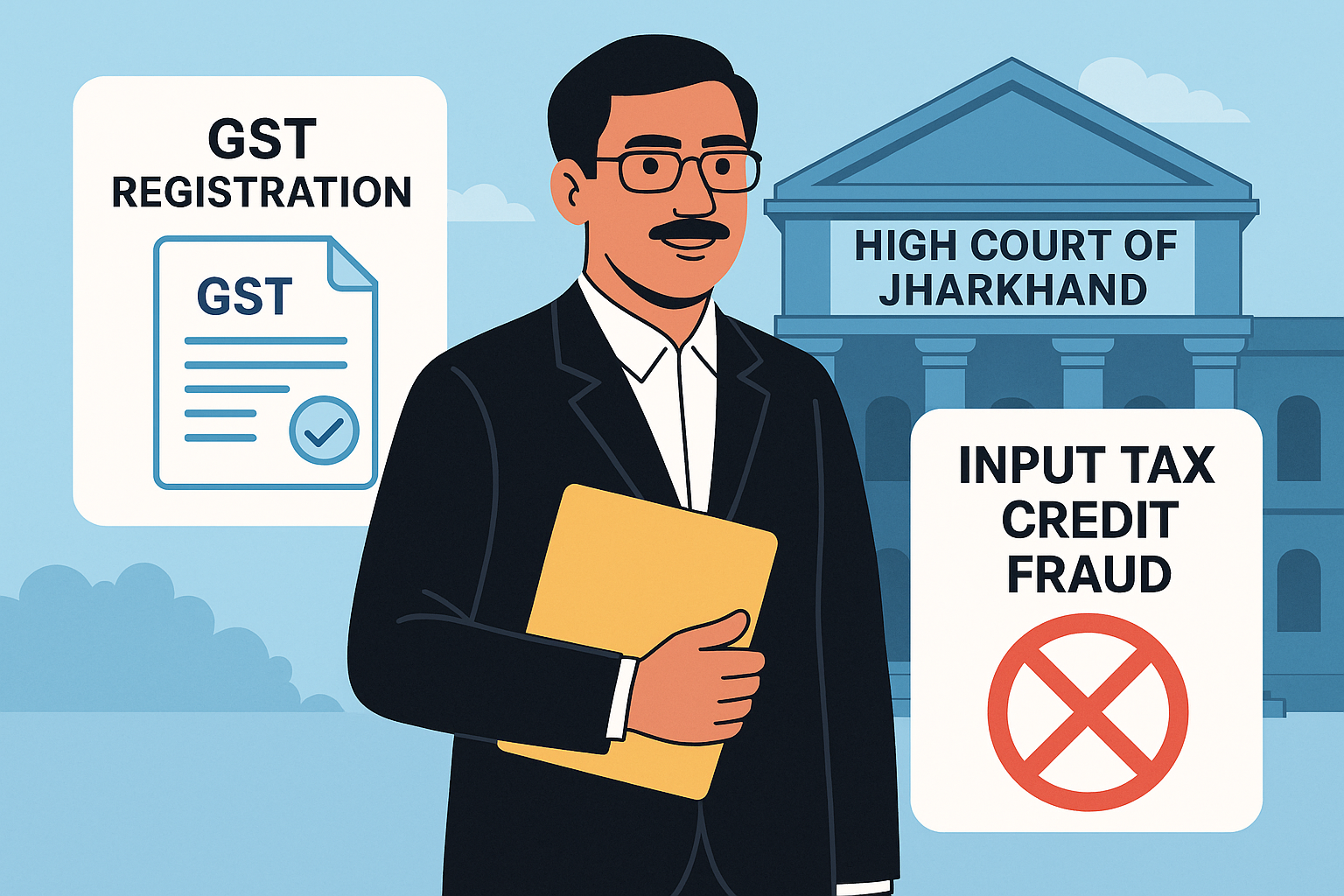
Case: Satya Prakash Singh v. State of Jharkhand & Anr.
Court: High Court of Jharkhand, Ranchi
Petition: A.B.A. No. 2096 of 2024
Category: Input Tax Credit fraud (anticipatory bail in GST evasion case)
Date of Judgement: 20.01.2025
Relevant Sections: Sections 406, 420, 468, 471, 120B IPC; Sections 132(1)(b), 131(1)(e), 132(1)(i) of JGST Act; Section 438(2) CrPC
Facts (Para 1–5)
The petitioner, a tax practitioner and advocate, apprehended arrest in connection with Telco P.S. Case No. 104 of 2018 registered under IPC provisions and JGST Act. The allegation was that he facilitated registration of a proprietary firm, P.K. Traders, using vague and forged documents, enabling co-accused to claim fraudulent Input Tax Credit. The petitioner contended that he had merely assisted in registration based on documents supplied by the client, and thereafter all papers were taken away by co-accused. He stressed that no ITC was credited in his name, nor was he a beneficiary. He argued that as an established professional, there was no likelihood of absconding and assured full cooperation with investigation.
Questions before the Court (Para 6)
Whether the petitioner, who facilitated GST registration of the co-accused, could be denied anticipatory bail despite lack of direct evidence linking him to wrongful availment of Input Tax Credit or financial gain from the fraud?
Observations (Para 7–9)
The Court noted that the petitioner’s role was confined to facilitating registration. The alleged fraudulent ITC was attributed to the co-accused, not the petitioner. The Court also emphasized that responsibility for verification of documents lay primarily with the authorities and not the tax practitioner. Since the petitioner continued to practice law and offered cash security along with assurances of cooperation, the apprehension of absconding was unfounded.
Judgement (Para 10–12)
The Court held that anticipatory bail was justified. Accordingly, in the event of arrest or surrender within six weeks, the petitioner was to be released on bail upon depositing cash security of ₹50,000 and executing a bond of ₹25,000 with two sureties. Conditions included furnishing Aadhar, mobile number (unchanged during proceedings), and cooperation with investigation as per Section 438(2) CrPC.
Table: Cases Referred in the Judgment
| Case | Citation | Verdict |
|---|---|---|
| No external case laws were specifically cited in this order | – | – |
Between Fine Lines
This ruling reassures professionals such as tax practitioners that their liability is not automatic in cases of fraudulent GST registrations. Unless specific evidence of collusion or benefit from fraudulent ITC is shown, mere facilitation of GST registration will not invite denial of bail. For industry, it highlights the importance of documentary diligence, while also affirming that responsibility for verification largely rests with GST authorities.
Disclaimer – “The above summary is for academic purpose only; not formal legal opinion. Seek professional opinion before application. Author or publisher or website shall not be responsible for any usage in any form.”

