


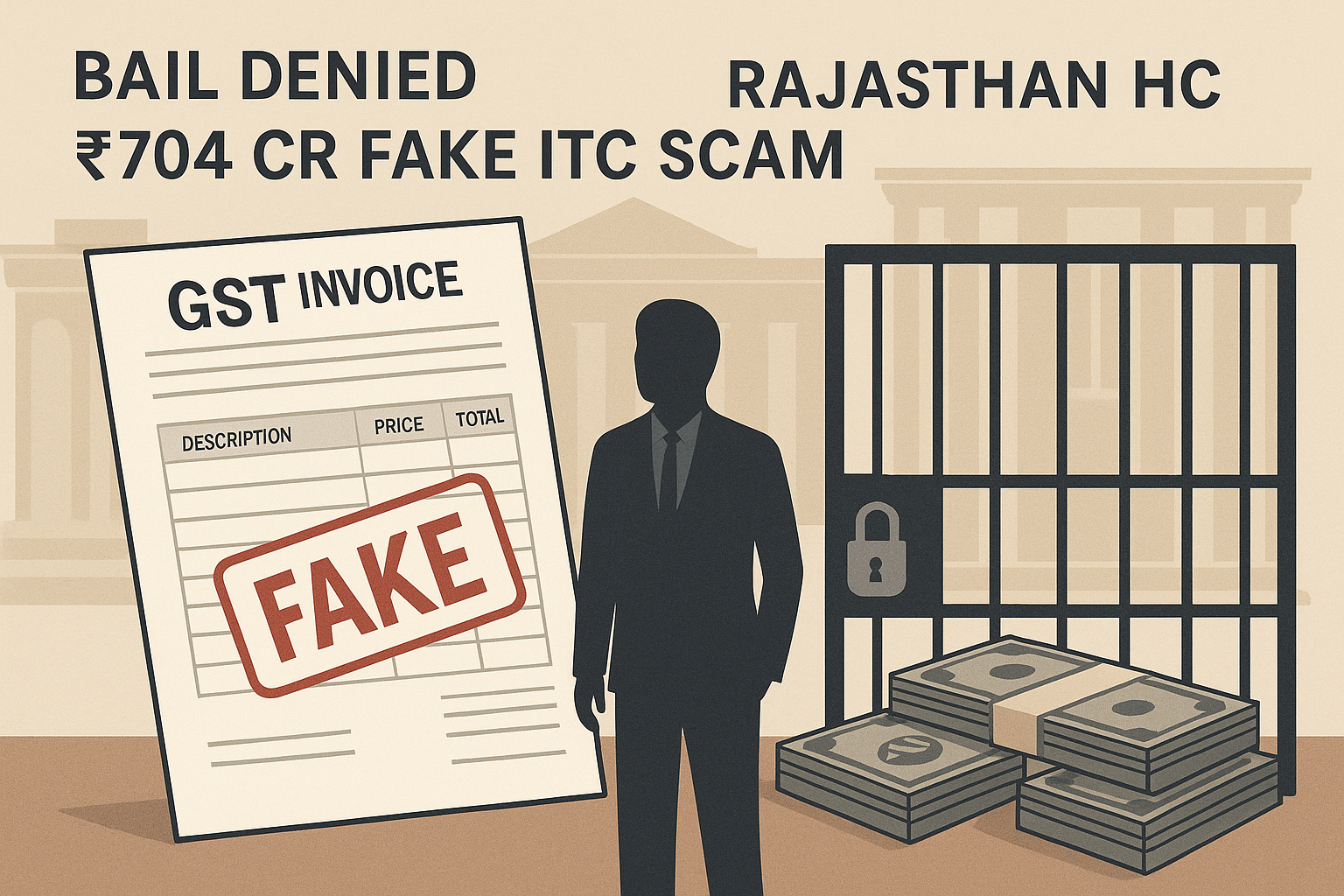
Case Summary
-
Case Title: Ankit Bansal v. Union of India
-
Court Name: High Court of Judicature for Rajasthan, Jaipur Bench
-
Petition No.: S.B. Criminal Miscellaneous Bail Application No. 4836/2025
-
Relevant Section: Section 132(1)(b)(c)(j)(l) of the CGST Act, 2017
-
Category of Dispute: Fraudulent Input Tax Credit (ITC), Arrest & Bail
-
Date of Judgement: 18.06.2025
-
CGST/IGST Sections Referred: Section 132 (1)(b)(c)(j)(l), Section 69 of CGST Act, 2017
-
Rules Referred: Not specified
Facts of the Case (Para 2–6)
The Directorate General of GST Intelligence (DGGI), Jaipur unearthed a massive GST ITC fraud involving ₹704 crores through bogus firms. Investigation began with Om Sai Traders and Suppliers and later revealed 353 fake/non-existent entities allegedly created by Ankit Bansal and his associates to issue fake invoices and rotate cash worth ₹1800 crores. ₹2.42 crores in unaccounted cash was seized, and several witness statements confirmed the petitioner’s key role in orchestrating this ITC scam.
Question(s) in Consideration (Para 1, 7–13)
Whether the accused-petitioner, Ankit Bansal, is entitled to regular bail in light of the allegations under Section 132 of the CGST Act, including:
-
The seriousness of the alleged GST evasion offence (₹704 crores);
-
Allegations of illegal arrest and custody;
-
Comparison with co-accused already released on bail;
-
Whether suppression of criminal antecedents and attempted absconding affects bail eligibility.
Observations of the Court
-
Nature and Gravity of Offence (Paras 28–33):
The court found that economic offences involving large sums—here ₹704 crores—require strict scrutiny. The creation of 353 bogus firms and evasion of ITC reflected a deep-rooted conspiracy impacting the country’s tax system. -
Suppression of Criminal Antecedents (Paras 22–24, 37, 45):
The petitioner had concealed a prior FIR under IPC and IT Act (Cyber Crime case), violating the duty of candor. This was considered serious misconduct and sufficient to deny bail. -
Attempt to Flee Custody (Paras 24–26, 39):
During judicial custody, Ankit Bansal attempted to escape from SMS Hospital with help from jail guards and family. An FIR was registered under BNS Sections 261 and 262. This raised concerns about his future conduct if released. -
Distinguishing Co-Accused (Paras 38):
Co-accused Rajesh Goyal’s bail did not set precedent here, as he lacked prior offences and hadn’t attempted to escape custody, unlike the petitioner. -
Precedents Relied Upon (Paras 29–34, 35–36, 41–43):
The Court discussed Vineet Jain v. UOI, Y.S. Jagan Mohan Reddy v. CBI, Rohit Tandon v. ED, and others. It clarified that white-collar crimes require a different approach, and Vineet Jain did not establish a blanket right to bail in all CGST cases.
Judgement of the Court (Paras 48–50)
The bail application was dismissed. The court held that:
-
The petitioner’s concealment of prior cases;
-
His escape attempt during pendency of bail;
-
The serious nature of the ₹704 crore fraud;
collectively disentitle him to discretionary relief of bail. The trial court is directed to conclude proceedings expeditiously to ensure his right to a speedy trial.
Between Fine Lines
-
Bail was denied due to multiple red flags: criminal history, escape attempt, and serious economic fraud.
-
Creation of 353 bogus firms and rotation of ₹1800 crores confirmed the magnitude of the offence.
-
Supreme Court rulings emphasise stricter bail scrutiny in white-collar crimes.
-
Petitioner’s misleading disclosure and absconding attempt damaged credibility.
-
High-value fraud cases won’t easily attract bail, even if triable by a Magistrate.
Summary of Referred Cases
| Name | Citation | Summary | Verdict/Ratio |
|---|---|---|---|
| Vineet Jain v. UOI | Criminal Appeal No.2269/2025 | Bail granted in a ₹10.87 Cr GST evasion case with no antecedents | Bail granted due to clean record, triable by Magistrate |
| Y.S. Jagan Mohan Reddy v. CBI | (2013) 7 SCC 439 | Seriousness of economic offences emphasized | Economic offences need strict bail approach |
| Nimmagadda Prasad v. CBI | (2013) 7 SCC 466 | White collar crimes more severe than regular offences | Bail can be denied if accused may tamper or abscond |
| Rohit Tandon v. ED | (2018) 11 SCC 46 | Emphasised gravity of white collar financial crimes | Bail denied due to potential misuse |
| Ash Mohammad v. Shiv Raj Singh | (2012) 9 SCC 446 | Conduct and antecedents important for bail | Bail can be refused based on bad conduct |
| State of Gujarat v. Mohanlal Porwal | (1987) 2 SCC 364 | Economic crimes undermine democracy | Firm hand needed in such cases |
| Serious Fraud Investigation Office v. Nittin Johari | (2019) 9 SCC 165 | Large public interest impacts bail decisions | Influence and manipulation risks justified denial |
Disclaimer – “The above summary is for academic purpose only; not formal legal opinion. Seek professional opinion before application. Author or publisher or website shall not be responsible for any usage in any form.”

