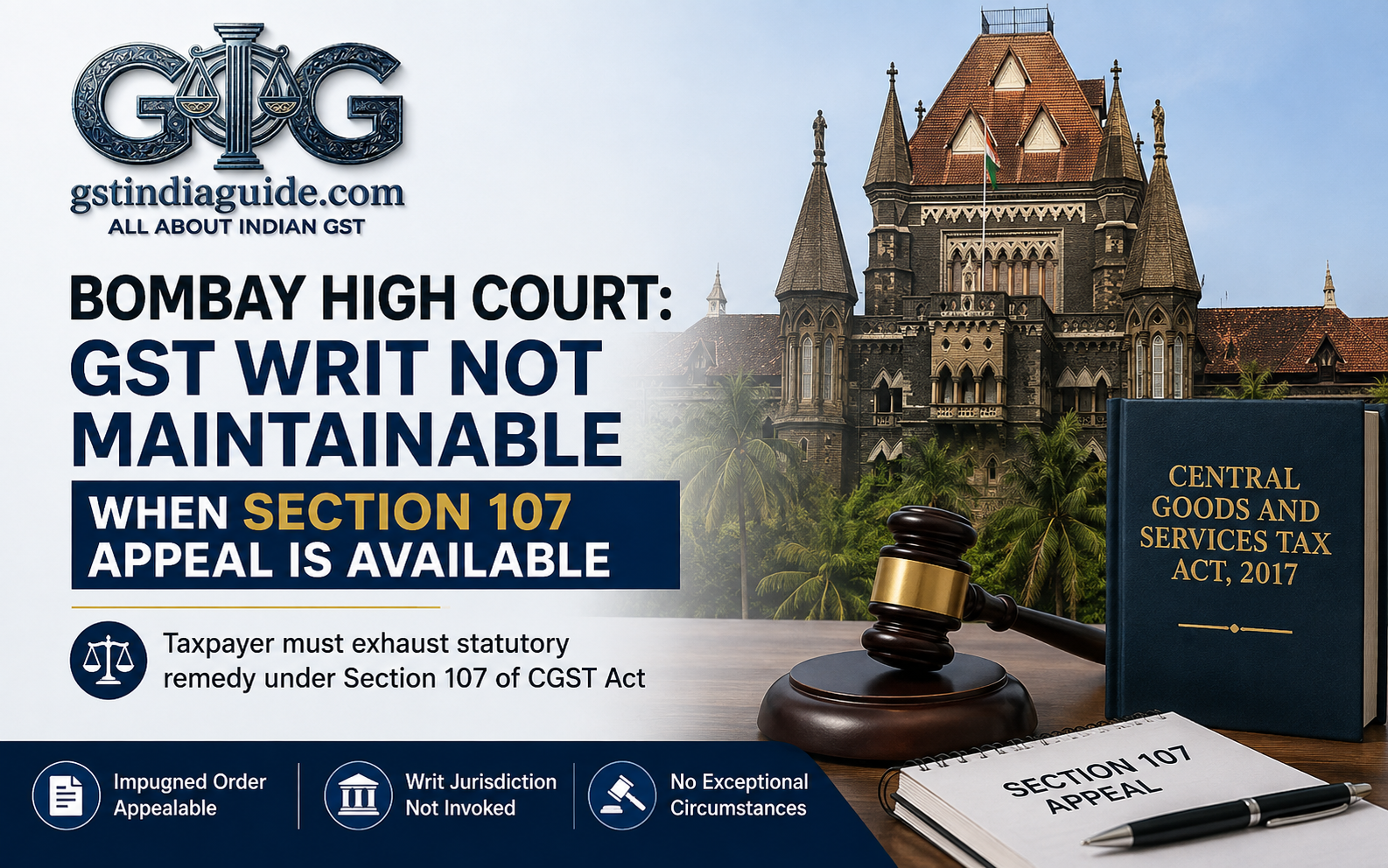
The Bombay High Court, in Mahapuja Ltd Through Its Director Keyur Jaswant Shah v. The Office of the Commissioner of CGST and Central Excise, Mumbai Central, has reiterated that the extraordinary writ jurisdiction under Article 226 of the Constitution should ordinarily not be invoked against an adjudication order when an effective statutory appellate remedy is available under the Central Goods and Services Tax Act, 2017.
The judgment was pronounced on 5 August 2026 by a Division Bench comprising Justice Suman Shyam and Justice Advait M. Sethna in Writ Petition (L) No. 15871 of 2026.
Background of the Dispute
Mahapuja Ltd challenged an Order-in-Original dated 17 March 2026 issued by the Additional Commissioner of CGST and Central Excise, Mumbai. The order, issued in Form GST DRC-07, arose from proceedings in which the Department had proposed, among other matters, disallowance of Input Tax Credit under Section 16 of the CGST Act and tax and penalty liabilities stated to be approximately ₹6.50 crore.
The petitioner contended that search and seizure proceedings had earlier been conducted under Section 67 of the CGST Act and that certain books of account, business records, electronic devices and laptops had been seized. According to the petitioner, documents in the Department’s custody had not been furnished before adjudication, thereby prejudicing its defence and violating the principles of natural justice.
On that basis, the petitioner sought setting aside of the adjudication order and remand of the proceedings for fresh consideration.
Department Relies on Statutory Appeal Under Section 107
The Revenue raised a preliminary objection to maintainability, contending that the impugned Order-in-Original was appealable before the statutory Appellate Authority under Section 107 of the CGST Act.
It was also submitted that the petitioner had been granted an opportunity of personal hearing and had filed a detailed reply during the adjudication proceedings.
The High Court examined the impugned order and noted that the Show Cause Notice and relied-upon documents had been forwarded to the email address registered by the petitioner on the GST portal and another available email address on 28 June 2025. They were again forwarded on 4 February 2026 to another email address at the petitioner’s request.
Natural Justice Plea Must Be Supported by Particulars
A significant aspect of the judgment is the Court’s treatment of the plea concerning violation of natural justice.
The Court observed that the petitioner had not specifically identified which documents had allegedly not been supplied. Nor was there sufficient pleading or material demonstrating the prejudice allegedly caused by such non-supply.
The Court therefore declined to accept general or bald assertions concerning denial of documents, particularly when the adjudication order itself recorded that the relied-upon documents had been furnished.
The judgment emphasises that invocation of natural justice cannot automatically enable a taxpayer to bypass the statutory appellate mechanism. Where a party relies upon violation of natural justice as an exceptional ground for invoking Article 226, the case must be supported by appropriate pleadings, particulars and material demonstrating the alleged violation and resulting prejudice.
High Court Cautions Against Routine Bypass of GST Appeals
The Bombay High Court also expressed concern regarding what it described as a growing tendency to bypass statutory appellate remedies and directly approach the writ court.
The Court observed that such proceedings may sometimes be adopted to circumvent statutory requirements, including the mandatory pre-deposit applicable to an appeal.
Relying upon recent judicial precedents, the Court reaffirmed that where an efficacious statutory remedy exists, exercise of extraordinary writ jurisdiction should remain confined to exceptional circumstances.
The Bench specifically observed that taking refuge under natural justice in every case cannot serve as a basis for filing a writ petition under Article 226 where the statute expressly provides an appellate remedy.
Section 107 Remedy Must Ordinarily Be Exhausted
The High Court held that no exceptional circumstances had been established which justified interference under Article 226.
Accordingly, the writ petition was held to be not maintainable because the petitioner had an appellate remedy under Section 107 of the CGST Act.
Importantly, the Court did not decide the substantive merits of the GST demand or the rival factual and legal contentions concerning the adjudication proceedings.
Four Weeks Granted to File GST Appeal
While disposing of the writ petition, the High Court granted liberty to Mahapuja Ltd to approach the Appellate Authority under Section 107 of the CGST Act.
The Court directed that if the statutory appeal was filed within four weeks from the date of uploading of the judgment, the Appellate Authority should consider the appeal on its own merits and in accordance with law, subject to compliance with all statutory requirements, including the mandatory pre-deposit.
The Court expressly clarified that it had not gone into the merits of the rival contentions and that those issues remained open to be raised in appropriate appellate proceedings.