, even where the perquisite was taxed in the UK.)
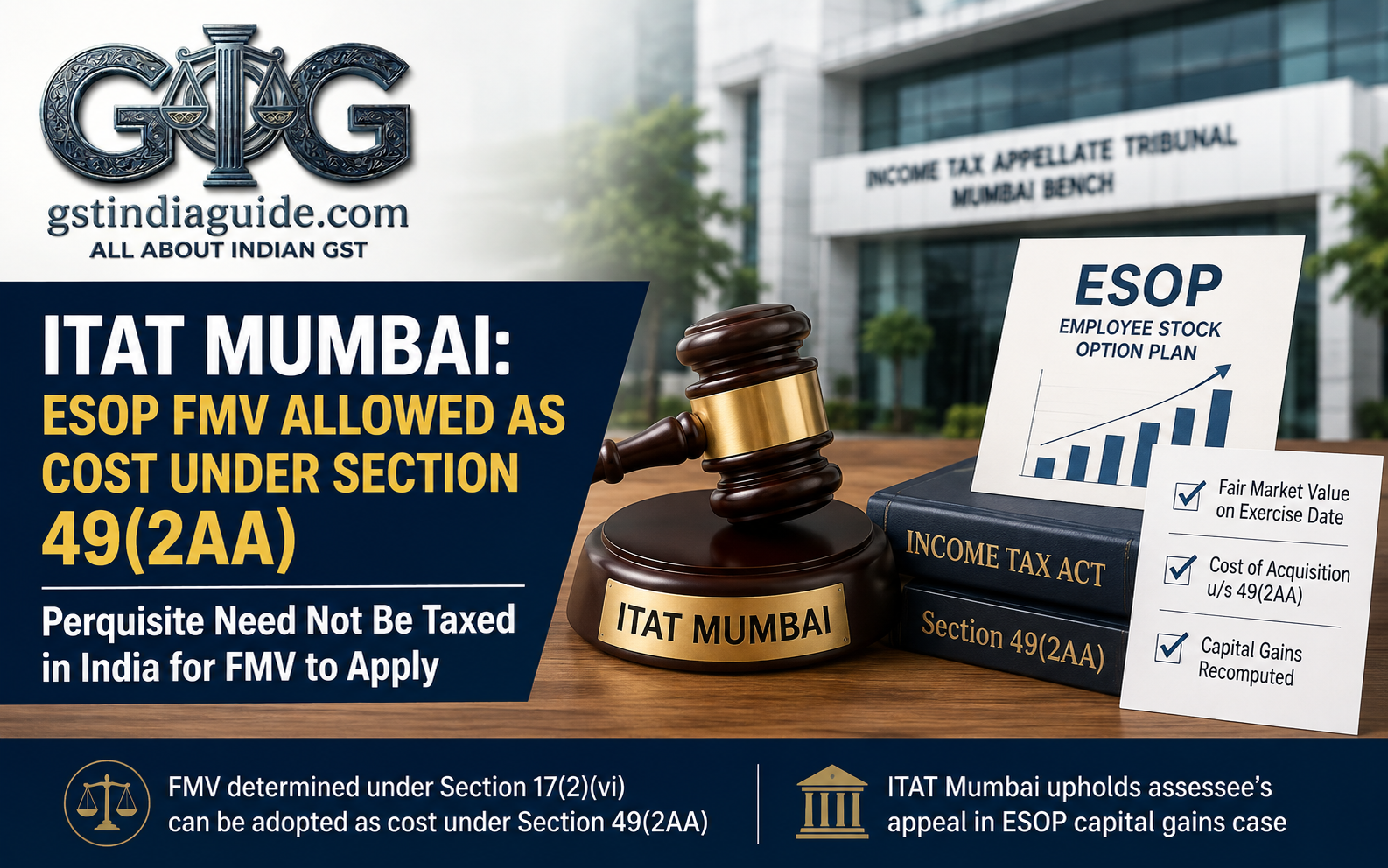
The Income Tax Appellate Tribunal, Mumbai Bench “I”, in Mr. Rajesh R Hemrajani v. ITO Int. Tax Ward 2(2)(1), has held that the fair market value of shares determined on the date of exercise of Employee Stock Options can be adopted as the cost of acquisition under Section 49(2AA) of the Income-tax Act, 1961. Importantly, the Tribunal held that the provision does not require the corresponding ESOP perquisite to have actually been taxed in India.
Background of the Dispute
The assessee was a non-resident individual residing in the United Kingdom and employed with the UK branch of L&T Infotech Ltd. As part of his employment remuneration, he had been granted ESOPs in respect of shares of L&T Infotech Ltd., an Indian listed company.
During the relevant year, the assessee exercised 1,540 stock options at an exercise price of Re.1 per share. The fair market value on the exercise date was determined at approximately Rs.1,753.58 per share. The shares were subsequently sold through a recognised stock exchange for an aggregate consideration of Rs.25,99,863.
While computing capital gains, the assessee treated the fair market value of the shares on the exercise date as the cost of acquisition under Section 49(2AA), resulting in a short-term capital loss of Rs.1,00,650.
The Assessing Officer, however, restricted the cost of acquisition to the actual exercise price of Re.1 per share. The AO reasoned that since the ESOP perquisite relating to services rendered in the UK did not accrue or arise in India and was outside the assessee’s Indian taxable income, the assessee could not use Section 49(2AA) to substitute the FMV as the cost of acquisition.
Key Issue Before the ITAT
The principal controversy was whether, while computing capital gains on the subsequent sale of ESOP shares, the assessee could adopt the fair market value determined for purposes of Section 17(2)(vi) as the cost of acquisition under Section 49(2AA), even though the corresponding perquisite was not taxable in India.
The Tribunal also considered whether Section 49(2AA) requires the ESOP perquisite to have actually suffered tax in India before the FMV can be recognised as the cost of acquisition.
ITAT’s Interpretation of Section 49(2AA)
The Tribunal emphasised that Section 49(2AA) specifically deals with specified securities and sweat equity shares covered by Section 17(2)(vi). It noted that, in the case of ESOP shares, Parliament has consciously departed from the ordinary principle of determining cost by reference to the actual amount paid for acquiring the asset.
Instead, Section 49(2AA) statutorily substitutes the fair market value taken into account for purposes of Section 17(2)(vi) as the cost of acquisition when capital gains are subsequently computed.
The Tribunal particularly examined the expression “fair market value which has been taken into account for the purposes of section 17(2)(vi)”. It held that these words do not stipulate that the perquisite must have actually been included in taxable income or subjected to tax in India.
Computation of Perquisite and Taxability Are Distinct
A significant principle emerging from the judgment is the distinction between the computation of the ESOP perquisite and its ultimate chargeability to tax.
According to the Tribunal, FMV is determined in accordance with Section 17(2)(vi) read with Rule 3 of the Income-tax Rules. Whether the resulting perquisite is actually chargeable to tax in India is a separate question governed by Sections 4, 5 and 9 of the Act and, where applicable, the relevant Double Taxation Avoidance Agreement.
Therefore, the fact that an ESOP perquisite may not be taxable in India does not alter the statutory mechanism prescribed for determining the cost of acquisition under Section 49(2AA).
No Requirement That Perquisite Must Be Taxed in India
The Tribunal rejected the Revenue’s attempt to read an additional condition into Section 49(2AA).
It observed that requiring the perquisite to have been actually taxed in India before allowing FMV as cost would effectively add words to the statute which Parliament had not incorporated.
In the present case, the assessee had stated that the difference between the FMV and exercise price had been taxed as part of his salary/perquisite income in the United Kingdom. The Tribunal also observed that this factual assertion recorded by the AO had not been disputed in the assessment order.
Treatment of Earlier Judicial Precedents
The Revenue had relied on several decisions concerning salary and perquisite taxation of non-residents. The Tribunal distinguished those authorities, observing that they primarily concerned residential status or chargeability of salary and perquisite income under Sections 5 and 9.
According to the ITAT, those rulings did not directly examine the interpretation of Section 49(2AA) for determining the cost of ESOP shares.
The Tribunal also considered the decision in Ramamurthy Sridharan v. ACIT, but held that it could not be treated as laying down an absolute proposition that Section 49(2AA) applies only where the ESOP perquisite has actually suffered tax in India.
ITAT’s Final Ruling
The ITAT held that the assessee was entitled to adopt the fair market value of the shares on the date of exercise, determined in accordance with Section 17(2)(vi) read with Rule 3(8)(ii), as the cost of acquisition under Section 49(2AA).
Accordingly, the approach of the Assessing Officer and the DRP in restricting the cost of acquisition to the exercise price of Re.1 per share was held to be contrary to the plain language of Section 49(2AA).
The Assessing Officer was directed to recompute the capital gains by adopting the fair market value as the cost of acquisition.
The Tribunal did not consider it necessary to conclusively decide the assessee’s alternative argument based on the non-discrimination provision contained in Article 26 of the India-UK DTAA.
The assessee’s challenge concerning the validity of the reassessment proceedings was left academic because the substantive issue had already been decided in his favour. Ultimately, the assessee’s appeal was allowed.