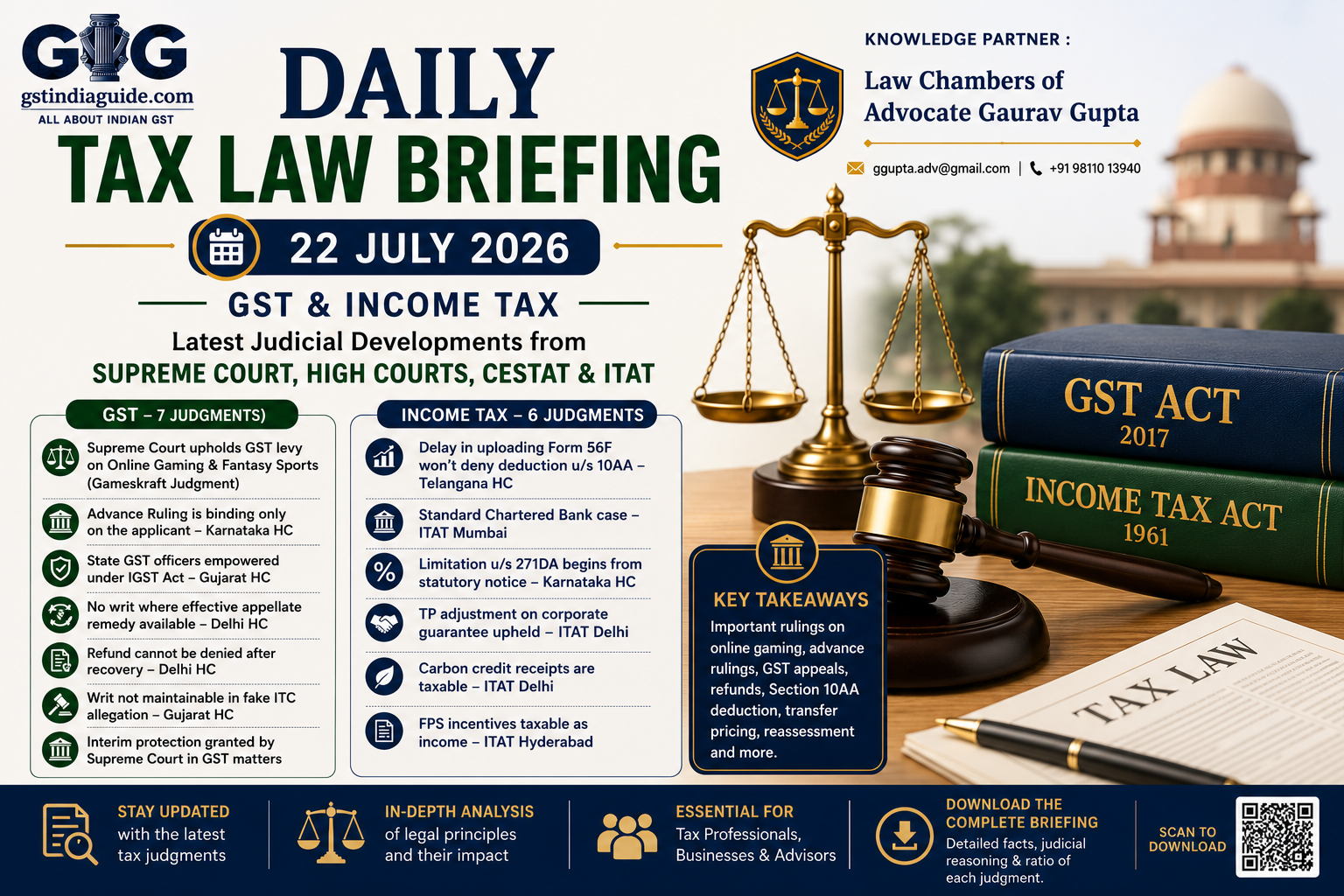
The Daily Tax Law Briefing – 22 July 2026 presents a comprehensive roundup of the latest judicial developments under the Goods and Services Tax (GST) and Income-tax laws. This edition analyses thirteen significant judicial pronouncements, comprising seven GST judgments and six Income Tax decisions, delivered by the Supreme Court of India, Karnataka High Court, Gujarat High Court, Delhi High Court, Telangana High Court, Bombay High Court and various Benches of the Income Tax Appellate Tribunal. The decisions address important issues relating to online gaming, advance rulings, confiscation of goods, GST refunds, appellate remedies, reassessment, transfer pricing, Section 10AA deductions and limitation for penalty proceedings.
The GST section is led by the landmark Supreme Court judgment in Gameskraft Technologies Pvt. Ltd., where the Court upheld the constitutional validity of the GST framework governing organised online gaming, fantasy sports and casino transactions. The Court held that organised online gaming played for stakes constitutes taxable actionable claims falling within betting and gambling, upheld the validity of the 2023 amendments and Rules 31A, 31B and 31C, and restored the show cause notices for fresh adjudication in accordance with the principles laid down in the judgment.
The briefing also includes several important High Court decisions on GST procedure and appellate remedies. The Karnataka High Court reaffirmed that an Advance Ruling is binding only upon the applicant and the concerned jurisdictional authorities, holding that a third party cannot challenge an AAR or AAAR ruling merely because it may have contractual financial consequences. The Gujarat High Court recognised the statutory cross-empowerment of State GST officers under the IGST Act and reiterated that challenges to confiscation orders and jurisdictional issues should ordinarily be pursued through the statutory appellate mechanism. The Delhi High Court similarly declined to exercise writ jurisdiction where an effective appeal under Section 107 of the CGST Act was available against rejection of a refund claim.
Further GST decisions examine the availability of refund after recovery proceedings, interim protection granted by the Supreme Court in pending GST litigation, and the maintainability of writ petitions challenging demands involving allegations of fake input tax credit. Collectively, these rulings reinforce the consistent judicial approach that writ jurisdiction under Article 226 will ordinarily not be exercised where effective statutory remedies exist, except in exceptional circumstances.
The Income Tax section analyses six noteworthy judgments covering deductions, transfer pricing, reassessment, limitation and banking taxation. The Telangana High Court held that a procedural delay in uploading Form 56F cannot defeat a genuine deduction under Section 10AA, particularly where the audit report was obtained within the prescribed time. The Mumbai Bench of the ITAT delivered an important ruling in the case of Standard Chartered Bank, allowing several claims relating to permanent establishments, transfer pricing, foreign exchange losses and head office expenditure while remanding certain factual issues for verification. The Karnataka High Court clarified that limitation for imposing penalty under Section 271DA commences only upon issuance of the statutory notice by the competent Joint Commissioner and not from the Assessing Officer’s internal proposal.
The briefing further covers important decisions relating to transfer pricing adjustments on corporate guarantees, taxation of carbon credit receipts, treatment of Focus Product Scheme incentives, computation of book profits under Section 115JB, reassessment proceedings under Section 148, and procedural safeguards requiring tax authorities to consider additional evidence before rejecting objections to reopening of assessments. These rulings provide valuable guidance on procedural fairness, statutory interpretation and computation of taxable income.
The Daily Tax Law Briefing – 22 July 2026 serves as a practical resource for advocates, chartered accountants, company secretaries, tax consultants, businesses and corporate tax teams seeking concise updates on the latest judicial developments under GST and the Income-tax Act. The briefing highlights the key legal principles emerging from recent decisions while enabling professionals to identify judgments relevant to advisory, compliance and litigation matters.