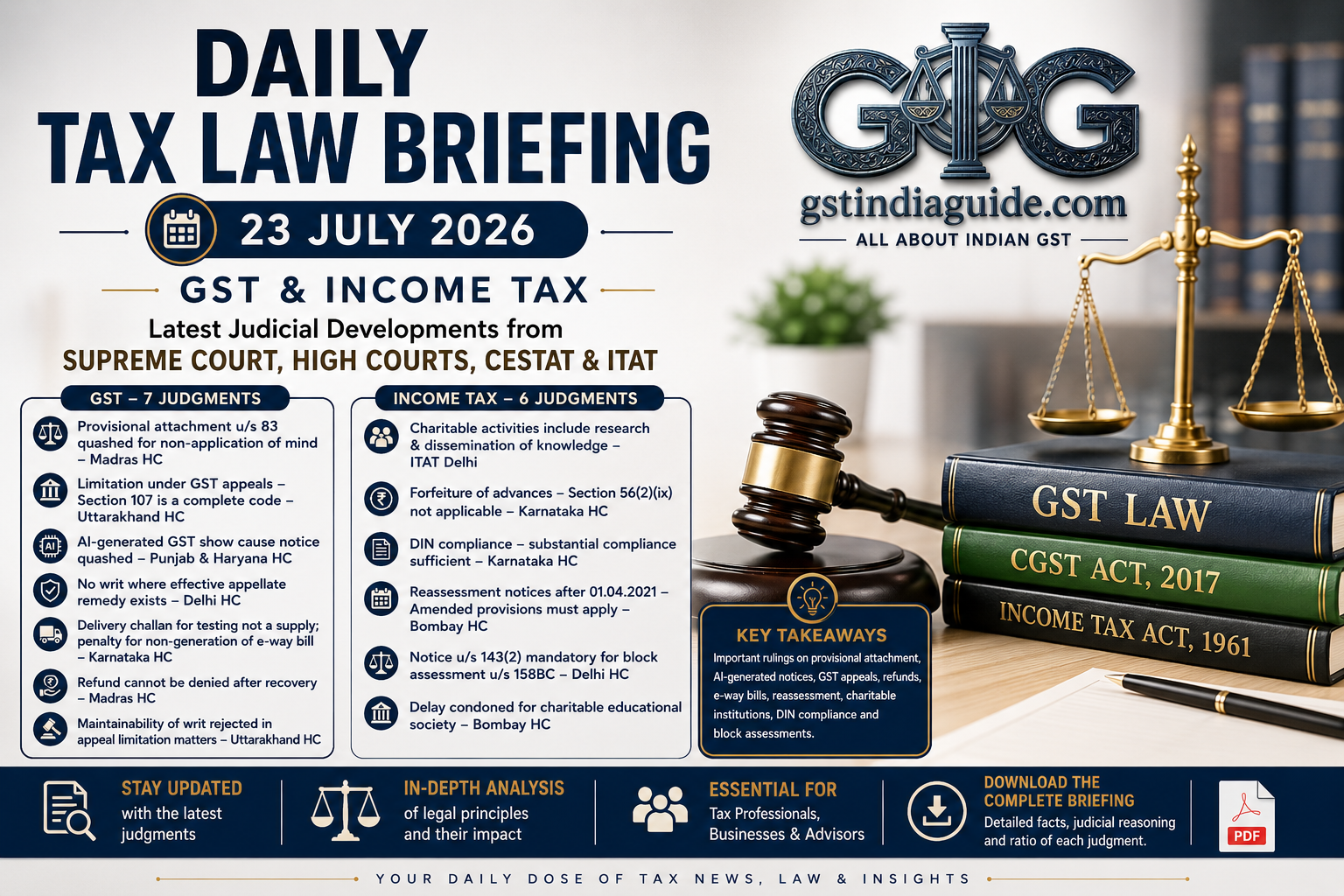
The Daily Tax Law Briefing – 23 July 2026 brings together the latest judicial developments under the Goods and Services Tax (GST) and Income-tax laws. This edition analyses thirteen significant judicial pronouncements, comprising seven GST judgments and six Income Tax decisions, delivered by the Madras High Court, Uttarakhand High Court, Patna High Court, Punjab & Haryana High Court, Delhi High Court, Karnataka High Court, Kerala High Court, Bombay High Court and various Benches of the Income Tax Appellate Tribunal. The rulings deal with important issues relating to provisional attachment of bank accounts, limitation under GST appeals, AI-generated show cause notices, e-way bills, reassessment proceedings, charitable institutions, DIN compliance and block assessments.
The GST section features several landmark rulings on procedural safeguards and statutory interpretation. The Madras High Court reiterated that a valid provisional attachment under Section 83 of the CGST Act requires both the initiation of qualifying proceedings and a reasoned opinion based on tangible material that such attachment is necessary to protect Government revenue. Since the impugned attachment order merely reproduced the statutory language and reflected non-application of mind, the Court quashed the provisional attachment while leaving liberty to the authorities to proceed afresh in accordance with law.
Another significant development comes from the Punjab & Haryana High Court, which quashed a GST show cause notice after finding that it appeared to have been generated primarily through the use of an Artificial Intelligence (AI) tool without independent application of mind by the proper officer. The Court held that the statutory scheme requires the competent authority to independently examine the facts before issuing a notice and that the use of AI cannot substitute the statutory duty of decision-making. Liberty was, however, granted to initiate fresh proceedings in accordance with law.
The briefing also covers important rulings relating to GST appellate remedies and procedural compliance. The Uttarakhand High Court held that the limitation prescribed under Section 107 of the CGST Act constitutes a complete statutory code and excludes the application of Section 5 of the Limitation Act beyond the prescribed condonable period. The Delhi High Court reaffirmed that writ jurisdiction should ordinarily not be exercised where an effective appellate remedy exists under Section 107, while the Patna High Court declined to interfere where the taxpayer had knowledge of the proceedings but failed to pursue the statutory appeal. The Karnataka High Court further clarified that transportation of machinery under a delivery challan for testing does not amount to a supply, although non-generation of an e-way bill may still attract the prescribed statutory penalty. The Kerala High Court also recalled an earlier judgment after finding that it proceeded on an incorrect factual assumption regarding reimbursement of GST under a government contract.
The Income Tax section analyses six important judicial pronouncements covering charitable institutions, reassessment, DIN compliance and block assessments. The Delhi Bench of the ITAT held that activities involving research, dissemination of technical knowledge and professional education continue to qualify as charitable activities, restoring the matter relating to renewal of registration under Sections 12AA/12AB for fresh consideration. The Karnataka High Court ruled that Section 56(2)(ix) concerning forfeiture of advances applies only where statutory conditions are fulfilled and cannot be invoked in relation to business advances received for procuring stock-in-trade.
The briefing further includes significant decisions on reassessment and procedural compliance. The Karnataka High Court held that substantial compliance with the CBDT Circular relating to the Document Identification Number (DIN) is sufficient where the DIN is subsequently communicated through the prescribed electronic process. The Bombay High Court ruled that a reassessment notice dispatched through the ITBA system after 1 April 2021 must comply with the amended provisions introduced by the Finance Act, 2021. The Delhi High Court also reaffirmed that a notice under Section 143(2) is mandatory for completing a block assessment under Section 158BC and that a block assessment cannot be sustained solely on post-search material. Finally, the Bombay High Court adopted a liberal approach in condoning delay for a charitable educational society, emphasising that genuine disputes should ordinarily be decided on merits rather than defeated on technical grounds of limitation.
The Daily Tax Law Briefing – 23 July 2026 serves as a practical resource for advocates, chartered accountants, company secretaries, tax consultants, businesses and corporate tax teams seeking concise updates on the latest judicial developments. It highlights the evolving principles governing GST administration, reassessment proceedings, procedural fairness and charitable taxation while enabling professionals to stay abreast of important judicial trends.