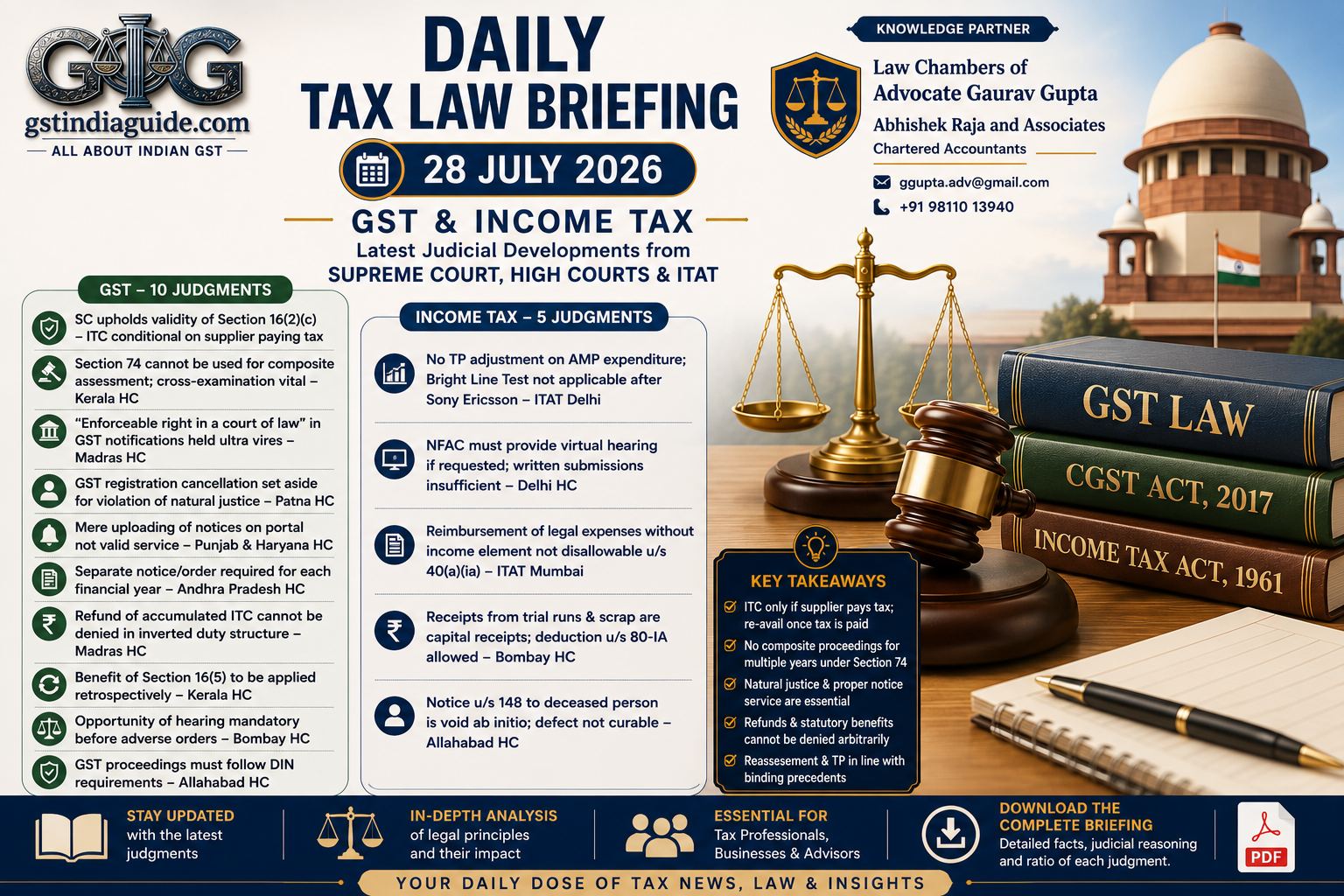
The Daily Tax Law Briefing – 28 July 2026 presents the latest judicial developments under the Goods and Services Tax (GST) and Income-tax laws. This edition analyses fifteen significant judicial pronouncements, comprising ten GST judgments and five Income Tax decisions, delivered by the Supreme Court of India, Kerala High Court, Madras High Court, Patna High Court, Punjab & Haryana High Court, Andhra Pradesh High Court, Delhi High Court, Bombay High Court, Allahabad High Court and various Benches of the Income Tax Appellate Tribunal. The decisions examine important issues relating to Input Tax Credit, Section 74 proceedings, GST registration, service of notices, refund of accumulated ITC, reassessment, transfer pricing, virtual hearings before NFAC and notices issued to deceased assessees.
The GST section is led by the Supreme Court’s decision in Bhandari Scrap Traders v. Union of India, where the Court upheld the constitutional validity of Section 16(2)(c) of the CGST Act. The Supreme Court affirmed that Input Tax Credit remains conditional upon payment of tax by the supplier and held that the scheme under the CGST Act differs materially from the Delhi VAT framework. At the same time, the Court reiterated that a purchasing dealer is entitled to re-avail reversed ITC once the supplier discharges the outstanding tax liability in accordance with the statutory mechanism.
The briefing also includes several landmark High Court rulings strengthening procedural safeguards under the GST regime. The Kerala High Court in EMAS Gold and Diamonds LLP held that proceedings under Section 74 cannot be concluded through a composite assessment covering multiple assessment years and emphasised that requests for cross-examination of witnesses must be considered in accordance with the principles of natural justice. The Madras High Court declared the phrase “enforceable right in a court of law”, inserted through delegated legislation in certain GST rate notifications relating to branded food products, to be ultra vires as it travelled beyond the recommendations of the GST Council.
Further important GST decisions address registration cancellation, assessment procedure and taxpayer rights. The Patna High Court restored GST registration after finding violation of the mandatory requirement of personal hearing and non-compliance with DIN requirements in the cancellation proceedings. It also set aside ex parte assessment proceedings and consequential recovery actions where adequate opportunity of hearing had not been granted. The Punjab & Haryana High Court reiterated that merely uploading notices or orders under the “View Additional Notices and Orders” tab on the GST portal does not constitute valid statutory service. The Andhra Pradesh High Court reaffirmed that a single show cause notice or assessment order cannot cover multiple financial years and directed separate proceedings for each tax period. The Madras High Court further held that refund of accumulated Input Tax Credit under the inverted duty structure cannot be denied merely because the principal input and output attract the same GST rate when other inputs bear a higher rate of tax. The Kerala High Court also directed reconsideration of an Input Tax Credit claim in light of the retrospective benefit granted under Section 16(5) of the CGST Act.
The Income Tax section analyses five significant judicial pronouncements covering transfer pricing, appellate procedure, tax deduction at source, capital receipts and reassessment. The ITAT Delhi deleted the transfer pricing adjustment made on Advertising, Marketing and Promotion (AMP) expenditure in Fujifilm India Private Limited, reiterating that the Bright Line Test cannot be applied following the binding decision of the Delhi High Court in Sony Ericsson. The Delhi High Court in High Vista Buildcon Pvt. Ltd. held that the National Faceless Appeal Centre (NFAC) must provide a virtual hearing whenever requested by the assessee and that written submissions alone cannot substitute an oral hearing in appellate proceedings.
The briefing further covers the ITAT Mumbai’s decision in Maersk India Private Limited, where reimbursement of legal and professional expenses without any income element was held not to attract disallowance under Section 40(a)(ia). The Bombay High Court in Pr. Commissioner of Income Tax-2 v. Tata Power Company Ltd. reaffirmed that receipts from trial runs and sale of scrap before commencement of business are capital receipts reducing the cost of the project, while also allowing deduction under Section 80-IA in accordance with CBDT Circular No. 1/2016. Finally, the Allahabad High Court held that a notice issued under Section 148 in the name of a deceased person is void ab initio and that such a jurisdictional defect cannot be cured by invoking Sections 159, 292B or 292BB of the Income-tax Act.
The Daily Tax Law Briefing – 28 July 2026 serves as an essential resource for advocates, chartered accountants, company secretaries, tax consultants, businesses and corporate tax teams seeking concise updates on the latest judicial developments. It provides practical insights into GST litigation, procedural safeguards, Input Tax Credit, reassessment proceedings and transfer pricing while helping professionals remain informed of emerging judicial trends.