M/s ATR Traders Pvt. Ltd. v. Principal Commissioner, Department of Trade and Taxes, Government of NCT of Delhi
Court: High Court of Delhi at New Delhi
Coram: Justice Anil Kshetrapal and Justice Shail Jain
Case No.: W.P.(C) 10259/2026 and CM APPL. 47543/2026
Date of Decision: 27 July 2026
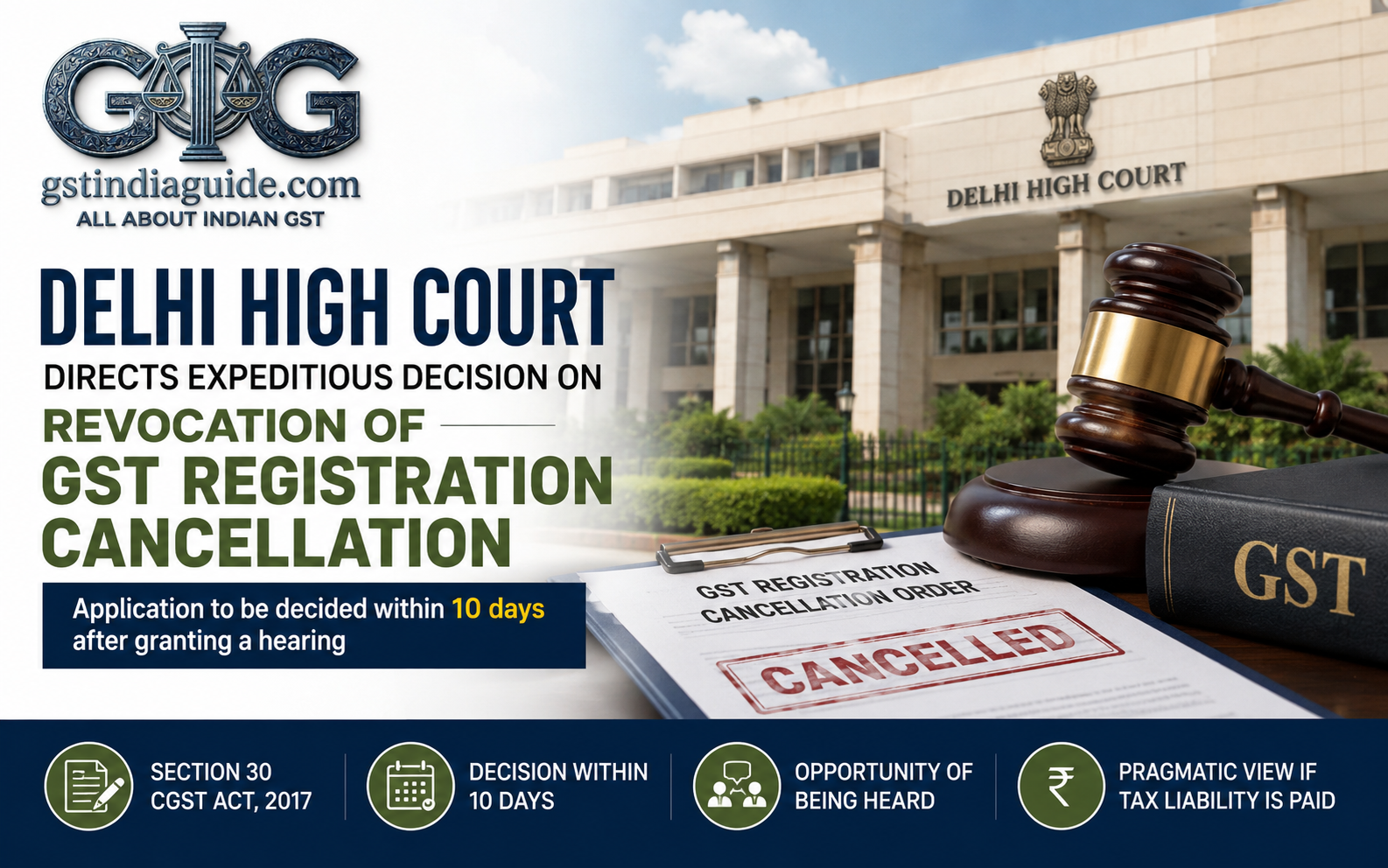
The Delhi High Court has directed the competent GST authority to consider and decide an application for revocation of cancellation of GST registration within ten days, after granting the taxpayer an opportunity of being heard.
The petition was filed by M/s ATR Traders Pvt. Ltd. challenging the show cause notice dated 13 June 2026 and the order dated 9 July 2026 cancelling its GST registration. The cancellation was based on the allegation that, despite reporting substantial turnover, the petitioner had failed to discharge the prescribed portion of its tax liability in cash as required under Rule 86B of the Central Goods and Services Tax Rules, 2017.
According to the Revenue, the petitioner had obtained GST registration in January 2026 and declared turnover of approximately ₹14.14 crore between January and March 2026 and ₹23.80 crore between April and June 2026. The Revenue also alleged that the petitioner had availed fake input tax credit from non-genuine firms to legitimise ineligible credit.
The petitioner submitted that it was willing to deposit the balance tax liability in cash and requested an opportunity to have the cancellation of its GST registration revoked.
Statutory Remedy under Section 30 of the CGST Act
The High Court observed that Section 30 of the Central Goods and Services Tax Act, 2017 provides a statutory remedy by way of an application for revocation of cancellation of GST registration.
In view of the availability of this statutory remedy, the Court declined to examine the challenge to the cancellation order and show cause notice on merits.
The Court, however, granted liberty to the petitioner to file an application seeking revocation of cancellation. It directed that, if such an application is filed, the competent authority must consider and decide it expeditiously within ten days after providing the petitioner an opportunity of being heard.
Pragmatic Consideration upon Payment of Tax Liability
The Court further clarified that, if the petitioner deposits its entire outstanding tax liability, the competent authority should take a pragmatic view while considering the revocation application.
The order therefore does not itself restore the petitioner’s GST registration or decide the allegations concerning fake input tax credit. It provides the petitioner an opportunity to invoke the statutory revocation mechanism and requires the authority to decide the matter promptly and in accordance with law.
Key Legal Takeaway
Where GST registration has been cancelled, the registered person is ordinarily required to invoke the statutory remedy of revocation under Section 30 of the CGST Act before seeking writ relief. Nevertheless, the High Court may protect the taxpayer by prescribing a time-bound decision, ensuring a personal hearing and directing the authority to adopt a pragmatic approach where the outstanding tax liability is discharged.
Decision
The writ petition was disposed of with liberty to the petitioner to apply for revocation of cancellation of GST registration. The competent authority was directed to decide the application within ten days after granting an opportunity of hearing. The pending application was also closed.