(b) CGST Act, parallel Central-State GST proceedings, ITC demand and availability of statutory appellate remedy.)
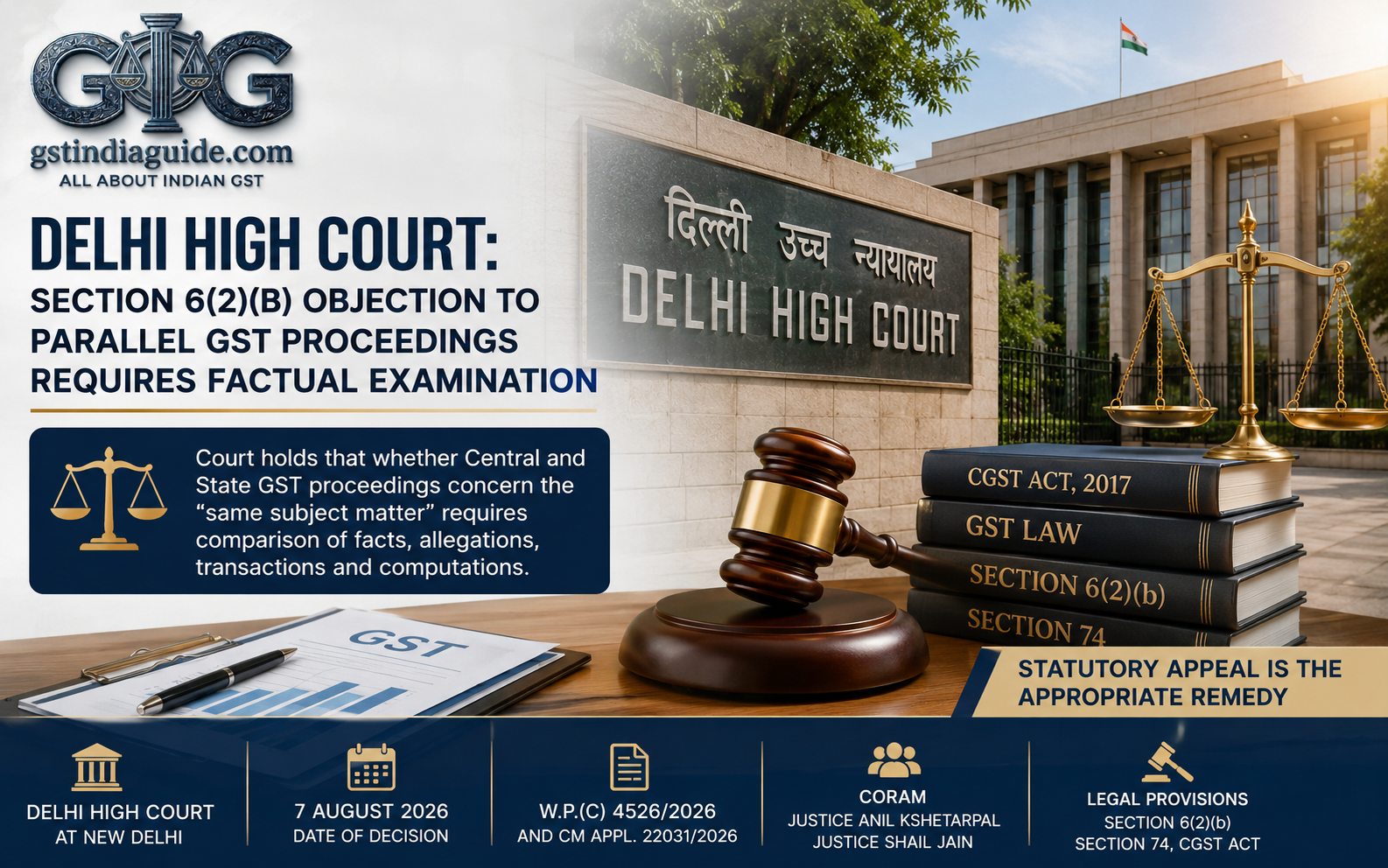
The Delhi High Court in M/s Liberty General Insurance Limited v. The Additional Commissioner of CGST, Delhi South Commissionerate & Anr. examined whether proceedings initiated by Central GST authorities could be challenged directly under Article 226 on the ground that State GST authorities had already initiated proceedings concerning alleged excess availment of Input Tax Credit for the same financial year.
The petitioner challenged the Order-in-Original dated 3 December 2025 passed by the Additional Commissioner of CGST, Delhi South Commissionerate. The principal contention was that, insofar as Financial Year 2020-21 was concerned, the Central proceedings were barred by Section 6(2)(b) of the CGST Act, since the State GST authorities had already initiated proceedings relating to alleged excess ITC and had subsequently dropped the demand.
Background of the Dispute
The Anti-Evasion Branch of the Central GST Department issued summons to the petitioner on 7 November 2023 regarding a discrepancy between ITC reflected in Form GSTR-3B and the corresponding figures in Form GSTR-9.
Subsequently, the State GST authorities issued a show cause notice dated 26 November 2024 for FY 2020-21 alleging excess availment of ITC of Rs. 2,44,97,609. After considering the petitioner’s reply, the State proceedings were dropped by an order dated 22 February 2025.
Meanwhile, the Central GST investigation continued. A show cause notice dated 26 May 2025 was issued under Section 74 of the CGST Act covering FY 2018-19 to FY 2023-24 and alleging fraudulent availment of excess ITC. The proceedings culminated in the Order-in-Original dated 3 December 2025, which created a demand of Rs. 4,80,26,753, along with penalty.
The petitioner approached the Delhi High Court contending principally that continuation of the Central proceedings for FY 2020-21 amounted to duplication prohibited by Section 6(2)(b).
Scope of Section 6(2)(b) of the CGST Act
The High Court observed that Section 6(2)(b) is procedural in nature and is intended to prevent parallel proceedings by Central and State tax authorities in respect of the same subject matter, thereby avoiding multiplicity of proceedings and conflicting determinations.
However, the Court clarified that the mere fact that both proceedings concern GST or involve examination of ITC does not automatically establish that they concern the “same subject matter”.
Determining whether two proceedings concern the same subject matter requires examination of their nature and scope, the relevant periods, allegations, transactions or ITC under scrutiny, liability sought to be determined, computations and the material relied upon by the respective authorities.
In the present case, the State proceedings related specifically to FY 2020-21 and an alleged ITC discrepancy of Rs. 2.44 crore, whereas the Central proceedings extended from FY 2018-19 to FY 2023-24 and involved a substantially larger demand. Therefore, the alleged overlap for FY 2020-21 could not be decided merely by noting that both proceedings related to ITC.
Factual Examination Necessary
The Court held that deciding the applicability of Section 6(2)(b) would require a detailed comparison of the respective show cause notices, allegations, computations, transactions, supporting materials and the order passed by the State GST authorities.
The fact that the Central proceedings covered additional financial years did not by itself establish that there was no overlap for FY 2020-21. Equally, the fact that both authorities examined ITC for FY 2020-21 did not by itself prove that the proceedings related to an identical subject matter.
The Court distinguished its earlier decision in Alliance Polychem Private Limited v. Deputy Commissioner, CGST, Mundka Division, Delhi West & Ors., where the identity of the demand in the two proceedings was apparent from the record. In the present case, such identity required a factual examination.
Objection Should Ordinarily Be Raised at the Earliest Stage
The Court also noted that the petitioner was aware of the earlier State GST proceedings but had not raised an objection under Section 6(2)(b) in its written reply dated 25 July 2025 to the Central show cause notice.
According to the petitioner, the objection was raised during personal hearing. However, no material was placed before the High Court showing that such objection had been recorded by the adjudicating authority or formed part of the adjudication record.
The Court observed that since the statutory prohibition under Section 6(2)(b) operates at the stage of initiation, an assessee seeking to object to parallel proceedings should ordinarily raise the objection at the earliest available opportunity, particularly upon receipt of the show cause notice.
The Court nevertheless expressly clarified that these observations were confined to deciding whether writ jurisdiction should be exercised and were not findings on the merits of the Section 6(2)(b) objection before the appellate authority.
Statutory Appeal Held to Be the Appropriate Remedy
The High Court declined to exercise its extraordinary jurisdiction under Article 226 because the petitioner had an efficacious statutory remedy of appeal and determination of the Section 6(2)(b) issue required examination of the underlying factual record.
The Court held that the appellate authority would be an appropriate forum to compare the State and Central proceedings and determine whether the Central proceedings, insofar as they related to FY 2020-21, concerned the same subject matter as the earlier State proceedings.
Accordingly, the High Court did not express any final opinion on the applicability of Section 6(2)(b).
The Court also declined at this stage to examine the petitioner’s challenge to invocation of the extended period under Section 74, the correctness of the ITC demand, findings relating to fraud, wilful misstatement or suppression, or the consequential interest and penalties. All such issues were left open for consideration in statutory appeal.
Limitation for Filing Appeal
The petitioner expressed concern that the period spent pursuing the writ petition could affect limitation for filing the statutory appeal.
The High Court observed that if the petitioner files an appropriate application under Section 14 of the Limitation Act, 1963, seeking exclusion of the period during which the writ petition remained pending, the appellate authority shall consider the application independently and in accordance with law.
The Court did not express any opinion on whether the requirements of Section 14 were actually satisfied.
Conclusion
The Delhi High Court disposed of the writ petition without adjudicating the merits of the GST demand or finally deciding whether Section 6(2)(b) barred the Central proceedings.
The petitioner was granted liberty to raise all its contentions before the competent appellate authority, including the objection that the Central proceedings relating to FY 2020-21 were barred because State GST authorities had already initiated proceedings on the same subject matter.
The ruling underscores that the expression “same subject matter” under Section 6(2)(b) cannot be determined merely from similarity of tax period or the broad issue involved. The actual scope, allegations, transactions, computations and supporting material in the respective Central and State proceedings must be examined before a conclusion on impermissible parallel proceedings can be reached.