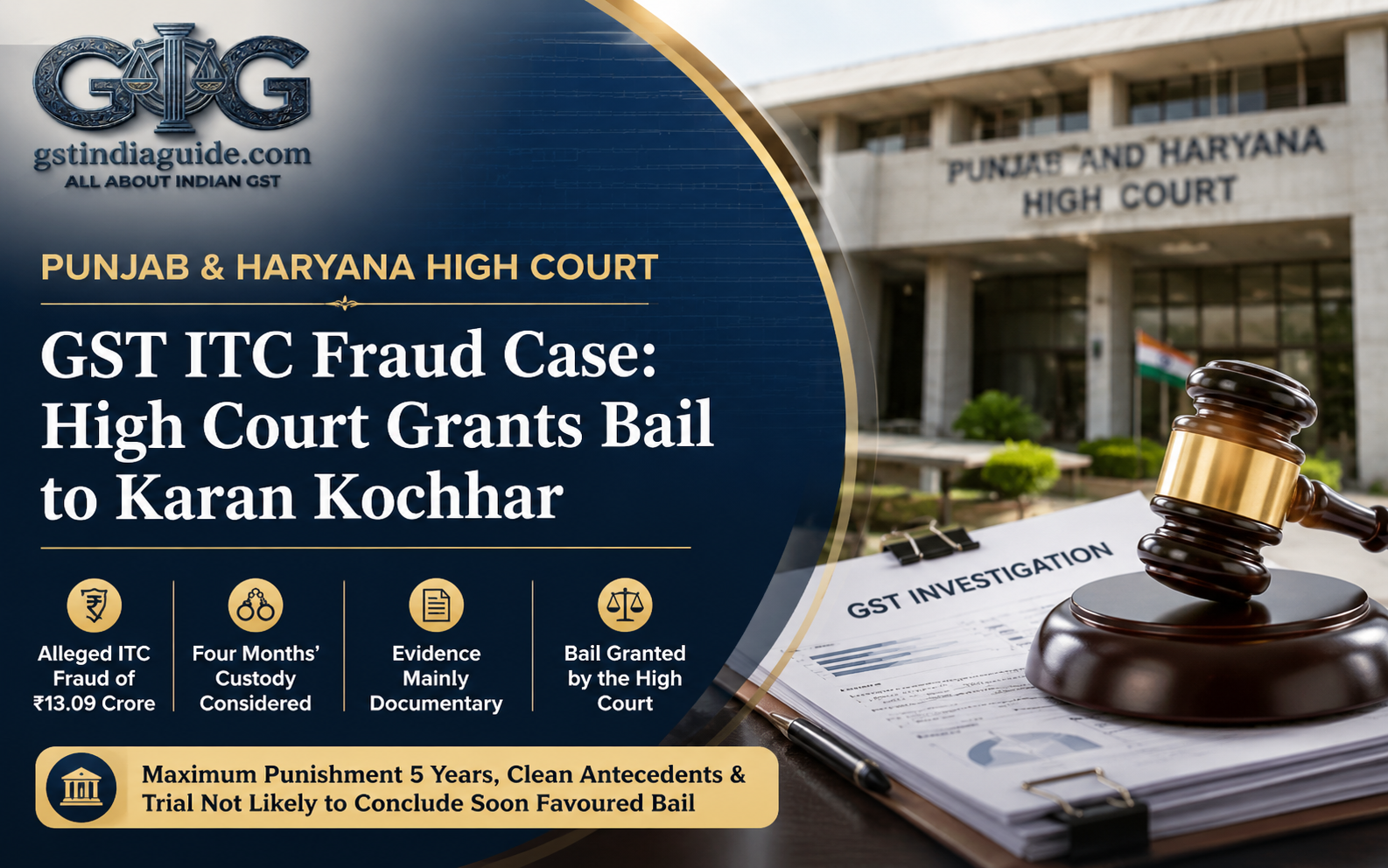
The Punjab and Haryana High Court has granted regular bail to Karan Kochhar in proceedings arising from allegations of fraudulent availment and utilisation of Input Tax Credit under the Central Goods and Services Tax Act, 2017.
The petitioner was being prosecuted for offences punishable under clauses (b), (c) and (i) of Section 132(1) of the CGST Act, read with Section 20 of the IGST Act. The CGST Department alleged that the petitioner had illegally claimed Input Tax Credit of approximately ₹13.09 crore on the basis of alleged fake invoices having taxable value of ₹72.76 crore, without corresponding actual movement or transaction of goods.
Petitioner’s Case
The petitioner contended that his concern, M/s Titan Steels, was carrying on genuine trading activities involving ERW Pipes, HR Coil, MS Billet and other goods. According to him, purchases and supplies were supported by tax invoices and delivery challans, payments were made through banking channels and GST returns were regularly filed.
It was further argued that the petitioner had actually been detained on 28 April 2026, although his formal arrest was shown on 29 April 2026. He also questioned compliance with the statutory requirements governing arrest, including communication of the grounds of arrest and the order passed under Section 69 of the CGST Act.
The petitioner additionally relied upon his period of incarceration of approximately four months, absence of criminal antecedents, the maximum punishment of five years and the predominantly documentary nature of the prosecution evidence.
Department’s Stand
The CGST Department opposed the bail application and maintained that investigation had revealed fraudulent availment and utilisation of ITC without actual transactions of goods.
According to the Department, the proceedings conducted on 28 April 2026 were search and inspection proceedings under Section 67(2) of the CGST Act, followed by recording of the petitioner’s statement under Section 70. An authorisation under Section 69(1) was thereafter issued by the Principal Commissioner and the petitioner was formally arrested on 29 April 2026.
The Department also submitted that substantial documentation remained to be scanned and relied upon the seriousness and magnitude of the alleged economic offence to oppose release on bail.
High Court’s Observations
The High Court examined several decisions of the Supreme Court dealing with the principles governing bail, particularly in GST and economic offences.
The Court referred to Vineet Jain v. Union of India, where the Supreme Court had observed that cases involving offences under Section 132 of the CGST Act, carrying a maximum sentence of five years and based substantially on documentary evidence, would ordinarily warrant bail unless extraordinary circumstances existed.
The High Court also took note of Radhika Agarwal v. Union of India, which emphasised that an arrest under the GST law must be based upon recorded reasons supported by material and cannot be undertaken merely for investigation on suspicion.
Reference was also made to Ratnambar Kaushik v. Union of India, where the Supreme Court considered the documentary and electronic nature of evidence, limited maximum punishment and likely duration of trial while granting bail in a GST prosecution.
The Court further noted the Supreme Court’s observations in Union of India v. Sunil Biyani concerning communication of an order under Section 69 of the CGST Act, observing that such an order is significant in the context of remedies available to a person apprehending arrest.
Four Months’ Custody and Documentary Evidence Favoured Bail
While considering the facts of the case, the High Court specifically recorded that:
The petitioner had already remained in custody for approximately four months and had clean antecedents. The maximum punishment prescribed for the alleged offence was imprisonment extending to five years.
The Court also found that the evidence required by the investigating agency was substantially documentary in nature. Continued judicial custody was therefore not considered necessary merely for collection of evidence.
The Court was not persuaded that release of the petitioner would create a genuine risk of tampering with the evidence, particularly considering the period already available to the Department for investigation.
It was also noted that there was nothing on record demonstrating that the petitioner, if released, would influence witnesses, tamper with evidence, fail to cooperate with the proceedings or avoid participation in the trial.
Significantly, the High Court also observed that the trial was not likely to conclude in the near future.
Bail Granted
Considering the cumulative effect of these circumstances and the principles governing personal liberty and bail, the Punjab and Haryana High Court held that the petitioner was entitled to the benefit of bail.
The Court accordingly allowed the petition and directed that Karan Kochhar be released on bail upon furnishing the requisite personal and surety bonds to the satisfaction of the trial court.
The Court clarified that its observations were confined to deciding the bail application and would have no bearing on the merits of the prosecution.
Conditions Imposed by the High Court
The bail was made subject to conditions that the petitioner would not directly or indirectly induce, threaten or make promises to persons acquainted with the facts of the case so as to interfere with their disclosure before the Court or authorities.
The petitioner was also directed to furnish his address to the concerned Court and intimate any change of address during the pendency of the trial.
Further, the petitioner cannot leave India without prior permission of the trial court.
The High Court made it clear that violation of these conditions could result in cancellation of the concession of bail.
Key Takeaway
The judgment reinforces that the seriousness or monetary magnitude of an alleged GST offence is not, by itself, sufficient to justify continued pre-trial incarceration. Where the maximum punishment is limited to five years, the accused has no criminal antecedents, the evidence is predominantly documentary, substantial custody has already been undergone and the trial is unlikely to conclude shortly, these considerations may weigh significantly in favour of bail.
The decision also reflects the increasing judicial emphasis on compliance with safeguards governing arrest under the CGST Act and on protecting personal liberty while ensuring the accused’s participation in investigation and trial.