Delhi High Court Declines Writ Against Fresh Rejection of GST Refund Claim

0
32

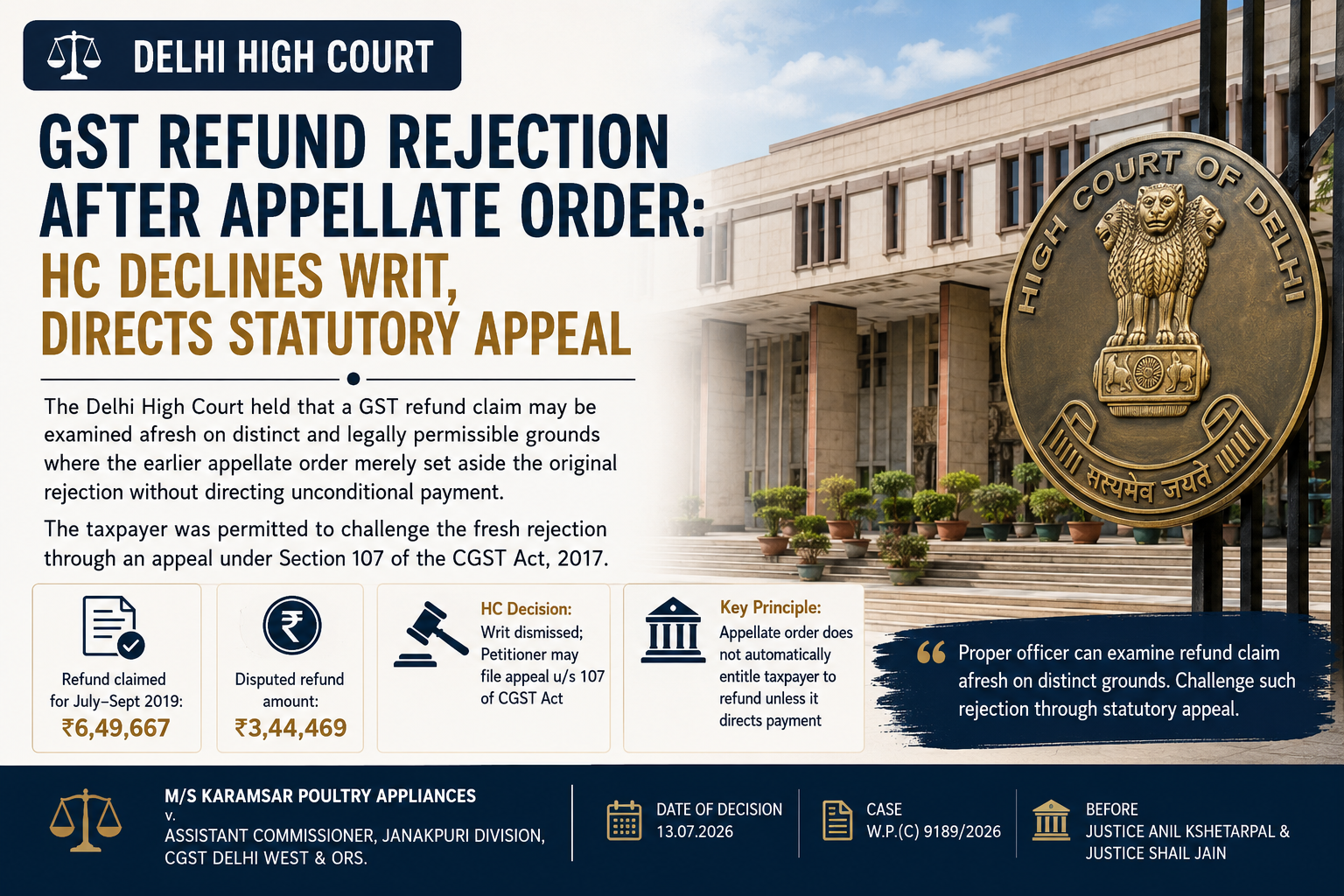
The Delhi High Court, in M/s Karamsar Poultry Appliances v. Assistant Commissioner, Janakpuri Division, CGST Delhi West & Others, examined whether a consequential GST refund could be rejected after the earlier order rejecting the refund had been set aside by the Appellate Authority.

The Division Bench comprising Justice Anil Kshetrapal and Justice Shail Jain held that where the appellate order does not direct the unconditional release of the refund or prohibit examination on other legally permissible grounds, the proper officer may independently examine the taxpayer’s entitlement. The Court consequently declined to exercise writ jurisdiction and permitted the petitioner to pursue the statutory appellate remedy under Section 107 of the Central Goods and Services Tax Act, 2017.

Background of the Dispute

The petitioner had applied for a refund of unutilised input tax credit for the tax period from July 2019 to September 2019. The total refund claimed was ₹6,49,667.

By an Order-in-Original dated 8 October 2021, the Assistant Commissioner sanctioned ₹3,05,198 but rejected the balance amount of ₹3,44,469. The petitioner challenged the partial rejection before the Appellate Authority.

The Joint Commissioner, CGST Appeals-II, Delhi, by an Order-in-Appeal dated 27 September 2025, allowed the appeal and set aside the original order to the extent that the refund had been wrongly rejected.

Following the appellate order, the petitioner filed a consequential refund application for ₹3,44,469. The Assistant Commissioner, however, rejected the application again through an order dated 20 February 2026 after independently examining the statutory returns, turnover reconciliation and refund computation.

Petitioner’s Submissions

The petitioner argued that the Order-in-Appeal had finally decided the issue concerning the disputed refund amount. Since the appellate order had attained finality, the department was required to release ₹3,44,469 along with statutory interest.

It was contended that the proper officer could not reopen or reconsider the refund claim after the original rejection had been set aside. On this basis, the petitioner sought direct interference by the High Court instead of being relegated to another statutory appeal.

Department’s Position

The department submitted that the consequential refund application had been independently examined and rejected through a reasoned order.

The proper officer had reviewed the petitioner’s GSTR-1, GSTR-3B and annual return figures and found inconsistencies in the reporting and reconciliation of turnover. Since the computation of refund under the inverted duty structure depended upon the adjusted total turnover, the officer concluded that the refund amount had not been substantiated through accurate and verifiable figures.

The department therefore maintained that the legality of the fresh rejection order should be examined by the Appellate Authority under Section 107 of the CGST Act.

Scope of the Earlier Appellate Order

The High Court carefully examined the operative portion of the Order-in-Appeal dated 27 September 2025.

It found that the Appellate Authority had set aside the rejection of the refund only on the grounds forming the basis of the original order dated 8 October 2021. The appellate order did not contain a direction requiring the unconditional release of the disputed refund amount.

Importantly, it also did not prevent the proper officer from examining the petitioner’s entitlement on other legally permissible grounds.

The Court therefore held that the Assistant Commissioner was not precluded from reconsidering the refund claim on grounds distinct from those that had already been rejected by the Appellate Authority.

Fresh Examination of Refund Entitlement

The impugned order recorded that the refund claim required verification under Section 54 of the CGST Act read with the applicable refund rules.

The proper officer examined whether the figures reported in GSTR-1, GSTR-3B and the annual returns could be satisfactorily reconciled. The officer found that the petitioner’s explanation regarding the alleged rectification of turnover was not fully supported by the statutory returns and documentary material.

Since adjusted total turnover forms part of the denominator in the refund formula prescribed under Rule 89(4), an incorrect or inconsistent turnover figure could directly affect the amount of refund admissible.

The officer consequently rejected the refund of ₹3,44,469 on the ground that the petitioner had failed to establish a clear and verifiable reconciliation of turnover and had not substantiated the refund computation.

High Court’s Findings

The Delhi High Court held that the impugned order could not prima facie be regarded as wholly without jurisdiction or non-existent in law.

The proper officer had undertaken an independent examination of the refund application and recorded detailed reasons. Whether those reasons were legally sustainable required an examination on merits, including the effect and scope of the earlier appellate order.

Such issues, according to the Court, could be comprehensively considered in a statutory appeal under Section 107 of the CGST Act.

The Court reiterated that writ jurisdiction would ordinarily not be exercised where an effective statutory appellate remedy was available, particularly when the dispute involved scrutiny of returns, reconciliation statements, refund calculations and factual findings recorded by the proper officer.

Decision of the Delhi High Court

The High Court dismissed the writ petition and the pending application.

The petitioner was granted liberty to challenge the refund rejection order before the competent Appellate Authority under Section 107 of the CGST Act.

The Court further clarified that the petitioner could apply for exclusion of the period spent prosecuting the writ petition while calculating the limitation period for filing the statutory appeal.

Key Legal Principle

An appellate order setting aside the rejection of a GST refund claim does not automatically result in an unconditional right to payment unless the order expressly directs the release of the refund or conclusively determines the taxpayer’s entitlement.

Where the appellate order only negates the grounds relied upon in the original order, the proper officer may examine the refund claim on other legally permissible and distinct grounds. The validity of such fresh examination must ordinarily be challenged through the statutory appellate mechanism.

Why This Judgment Matters

The judgment is relevant for taxpayers, advocates, Chartered Accountants, GST practitioners and corporate tax teams handling consequential refund claims after successful appellate proceedings.

It highlights the importance of carefully examining the operative portion of an appellate order. Merely setting aside an earlier rejection may not always amount to a positive direction to release the refund.

The ruling also emphasises that GST refund claims, especially those arising under the inverted duty structure, remain dependent upon accurate statutory returns, verifiable turnover reconciliation and correct application of the refund formula. Where the subsequent rejection is supported by independent reasons, the taxpayer may be required to challenge it through a fresh statutory appeal.

Download

Leave a Reply