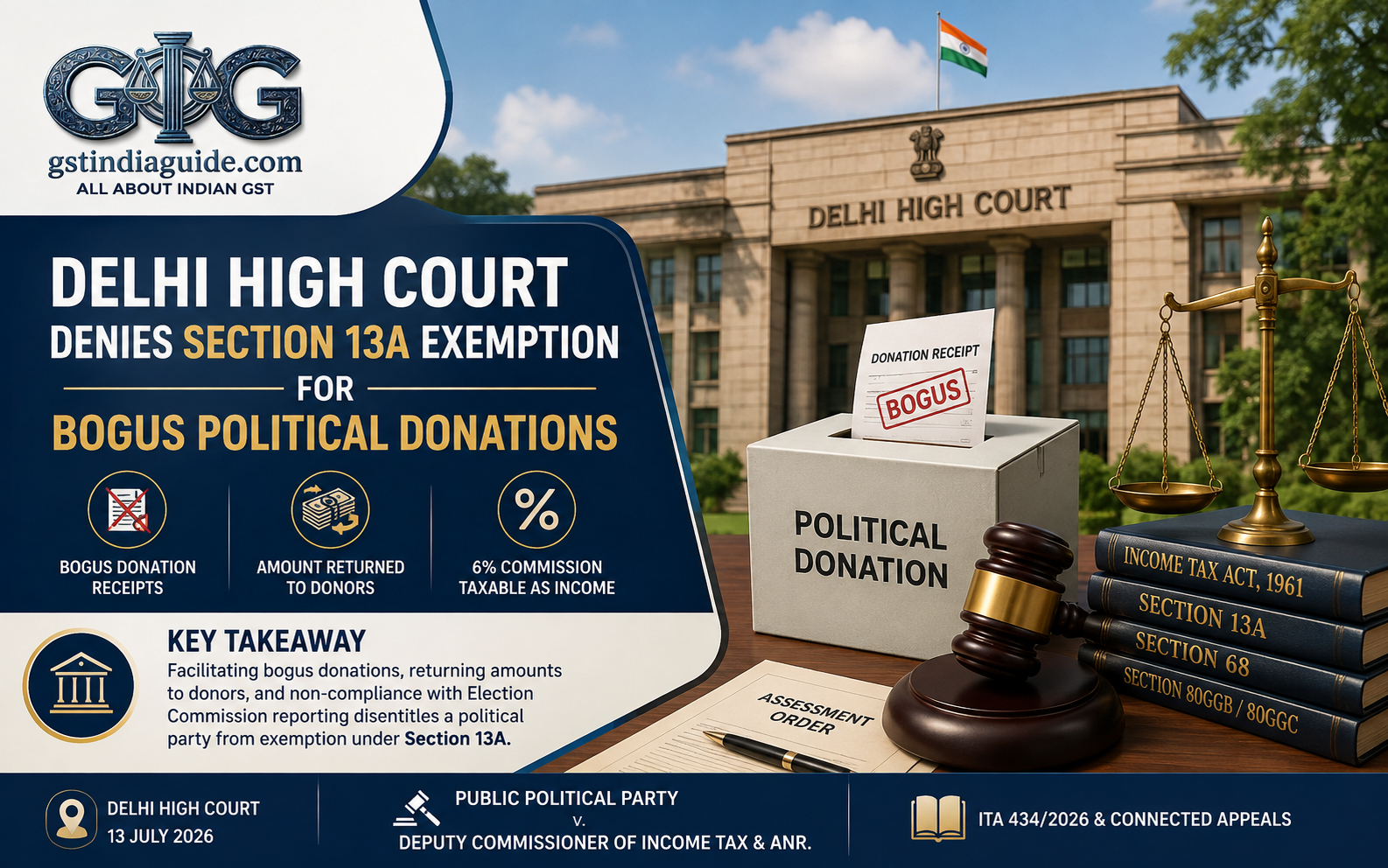
The Delhi High Court, in Public Political Party v. Deputy Commissioner of Income Tax & Anr., examined whether a political party could claim exemption under Section 13A of the Income-tax Act, 1961 after the Income Tax Appellate Tribunal found that it had issued bogus donation receipts and returned the purported donation amounts to the contributors. The judgment addresses important principles concerning political-party taxation, unexplained credits, exemption eligibility and the limited scope of interference with factual findings under Section 260A.
Background of the Dispute
The appeals arose from a common order dated 17 December 2025 passed by the Income Tax Appellate Tribunal, New Delhi. The Assessing Officer had treated the purported donations received by the political party as unexplained cash credits under Section 68. While the Tribunal held that the entire donation amount could not be added under Section 68, it concluded that six per cent of the total amount represented commission income earned by the assessee for facilitating bogus donation receipts.
The political party contended that once the addition under Section 68 was deleted, its income should automatically qualify for exemption under Section 13A. The Revenue maintained that the party had not undertaken genuine political activities, had issued false donation receipts and had returned the amounts to the alleged donors after retaining a commission.
Income Tax: Bogus Donation Receipts and Commission Income
The High Court noted the Tribunal’s categorical factual finding that the assessee had issued bogus donation receipts to enable contributors to claim deductions under Sections 80GGB and 80GGC. The amounts shown as political donations were subsequently returned to the persons from whom they were purportedly received.
On these facts, the Court found no error in the Tribunal’s decision to tax six per cent of the total purported donations as the assessee’s income instead of treating the entire amount as unexplained income. The percentage represented the commission earned by the political party for facilitating the accommodation-entry arrangement.
The Court further held that the Tribunal’s conclusion regarding the issuance of bogus receipts and repayment of donations was a finding of fact. Such a factual determination could not ordinarily be reconsidered by the High Court in an appeal under Section 260A unless it gave rise to a substantial question of law or was shown to be perverse.
Section 13A Exemption Not Available to a Non-Compliant Political Party
The High Court rejected the argument that deletion of the Section 68 addition automatically entitled the political party to exemption under Section 13A. It observed that an entity found to have violated the law and maintained books that did not disclose a true and correct picture could not claim the statutory exemption.
The Court also relied on the failure of the assessee to comply with the second proviso to Section 13A. The record showed that the political party had either filed improper reports with the Election Commission of India in certain assessment years or had not filed the prescribed reports at all in other years.
Compliance with the statutory reporting requirement was treated as a condition for eligibility under Section 13A. Since the assessee had failed to satisfy that condition, it had lost its entitlement to claim exemption for the relevant assessment years.
Key Judicial Principles
The judgment clarifies that deletion of an addition under Section 68 does not, by itself, establish eligibility for exemption under Section 13A. A political party must independently satisfy all statutory conditions, including proper maintenance of accounts and submission of the prescribed report to the Election Commission of India.
The decision also confirms that where a political party merely facilitates bogus donations and returns the funds to the alleged donors, the commission retained from such transactions may be assessed as income. Further, factual findings recorded by the Tribunal regarding sham transactions are generally not open to reassessment by the High Court under Section 260A.
The Court consequently dismissed all the appeals and pending applications, upholding the Tribunal’s treatment of six per cent of the purported donation amount as taxable income and the denial of exemption under Section 13A.
Why Read This Judgment?
The ruling is relevant for advocates, Chartered Accountants, Company Secretaries, tax consultants, political organisations, corporate tax teams and professionals advising donors or political parties. It explains the relationship between Sections 68, 13A, 80GGB and 80GGC and highlights the consequences of bogus donation arrangements, inaccurate books of account and non-compliance with Election Commission reporting requirements.