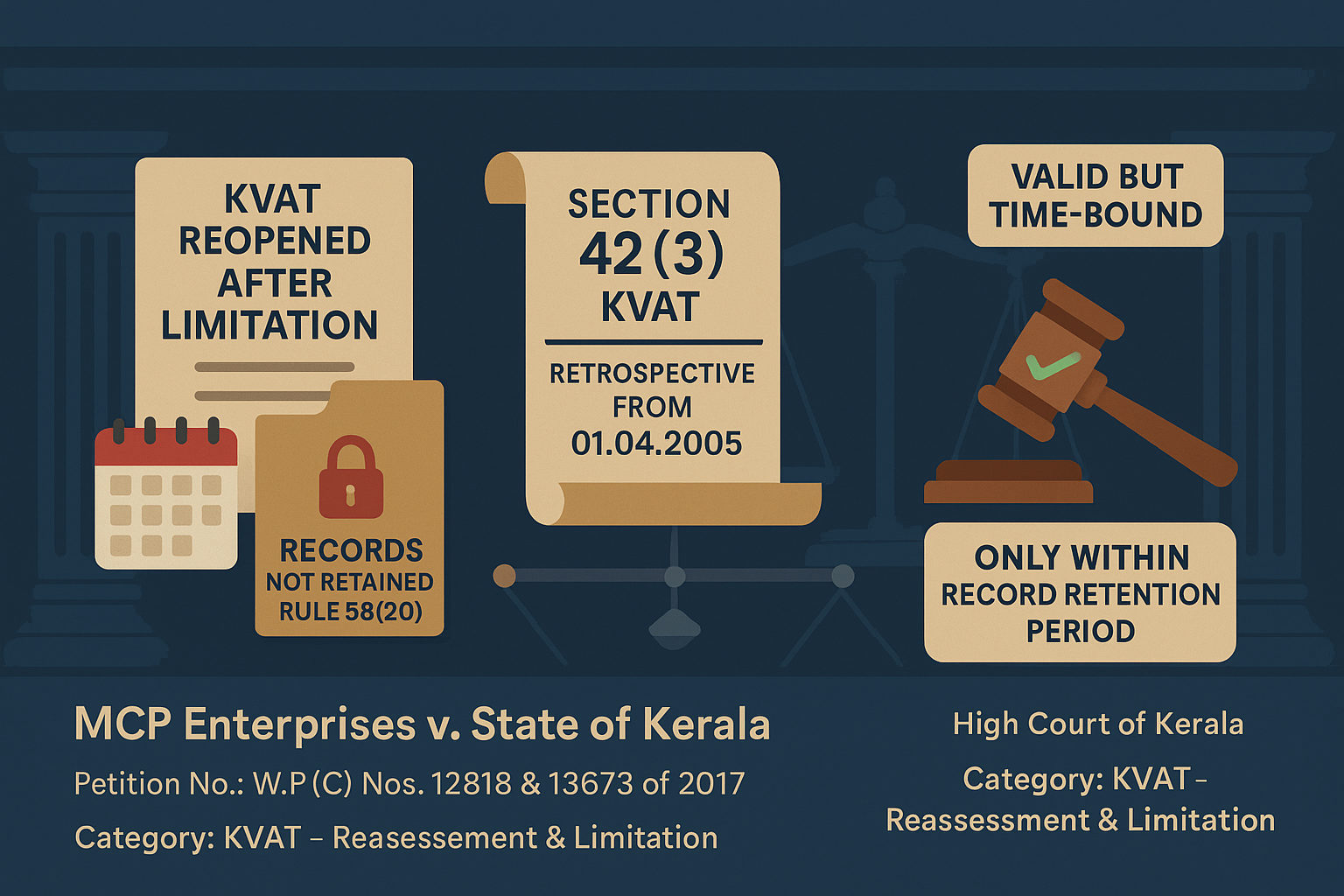
Case Title: MCP Enterprises v. State of Kerala
Court: High Court of Kerala
Petition No.: W.P. (C) Nos. 12818 & 13673 of 2017
Category of Dispute: Reassessment under KVAT – Escaped Turnover
Date of Judgment: 18 December 2019
Relevant Section(s): Section 25 and Section 42(3) of Kerala Value Added Tax Act, 2003; Rule 58(20) of KVAT Rules
Takeaway: When retrospection meets record retention: A statutory race against time
Facts of the Case
[¶1–3, ¶7–9]
- The petitioners challenged pre-assessment notices and assessment orders issued under Section 42(3) of the KVAT Act for alleged escaped turnover.
- These assessments were issued after the expiry of the limitation period prescribed under Section 25 of the KVAT Act.
- Section 42(3) was inserted via notification on 13.11.2016 with retrospective effect from 01.04.2005, allowing assessment of certain dealers without limitation.
- Petitioners argued that this provision, if applied retrospectively, would breach finality of concluded assessments and violate constitutional protections.
Question(s) in Consideration
[¶4–5]
- Whether Section 42(3) of the KVAT Act can validly reopen assessments already deemed final under the Act due to expiry of limitation under Section 25?
- Whether retrospective application of Section 42(3) violates Article 14 of the Constitution and causes undue prejudice due to record retention limits?
Observations of the Court
[¶7–10]
- The Court acknowledged the legislature’s power to amend the Act retrospectively, but noted it must not deprive taxpayers of substantive rights or cause undue hardship.
- The Court upheld the classification under Section 42(3) as constitutionally valid, considering higher turnover dealers may warrant stricter scrutiny [¶8].
- However, the Court accepted that retrospective application without regard to Rule 58(20)—which requires records be retained only for five years—could prejudice assessees unable to defend themselves [¶9].
- It held that assessments could not be reopened under Section 42(3) once the record retention period had expired. The retrospective operation was valid, but subject to a reasonable limitation guided by Rule 58(20) [¶10].
Judgment of the Court
[¶10]
- The writ petitions were disposed of by upholding the validity of Section 42(3) including its retrospective operation.
- However, the Court read in a limitation: such reassessment can only be exercised within the period the assessee is required to retain records under Rule 58(20) of KVAT Rules.
- Any reassessment initiated after this period would be invalid, and legality of such proceedings will be determined accordingly.
Between Fine Lines
- Retrospective tax laws must not override practical limitations like record retention.
- High turnover dealers can be subjected to distinct procedures without breaching equality under Article 14.
- Even when limitation is excluded by statute, courts may read in a reasonable time frame for fairness.
- Legislature’s intent cannot override settled judicial interpretations without clear validation.
- Assessments post-limitation period (even with new laws) require balancing legislative intent with taxpayer protection.
Summary of Referred Cases
| Name of Case | Citation | Summary | Verdict |
| S. Najeem v. CTO | [2017] 80 taxmann.com 350 | Held reopening of assessment after limitation under Section 25 was invalid. | Basis of judgment overruled by legislative amendment. |
| CIT v. Vatika Township (P) Ltd. | [2014] 49 taxmann.com 249 | Retrospective laws should not impair vested rights. | Followed to restrict retrospective application. |
| State of Punjab v. Bhatinda Coop. Milk Union Ltd. | [2007] 11 SCC 363 | Reasonable limitation must be read into tax statutes. | Applied to guide reasonable limit under Section 42(3). |
| Southern Motors v. State of Karnataka | [2017] 77 taxmann.com 251 | Discretionary powers must not result in arbitrary treatment. | Cited in support of Article 14 challenge. |
| Pr. CIT v. Maruti Suzuki India Ltd. | [2019] 107 taxmann.com 375 | Consistency and certainty must be upheld in tax law. | Quoted to justify fair limitation period. |