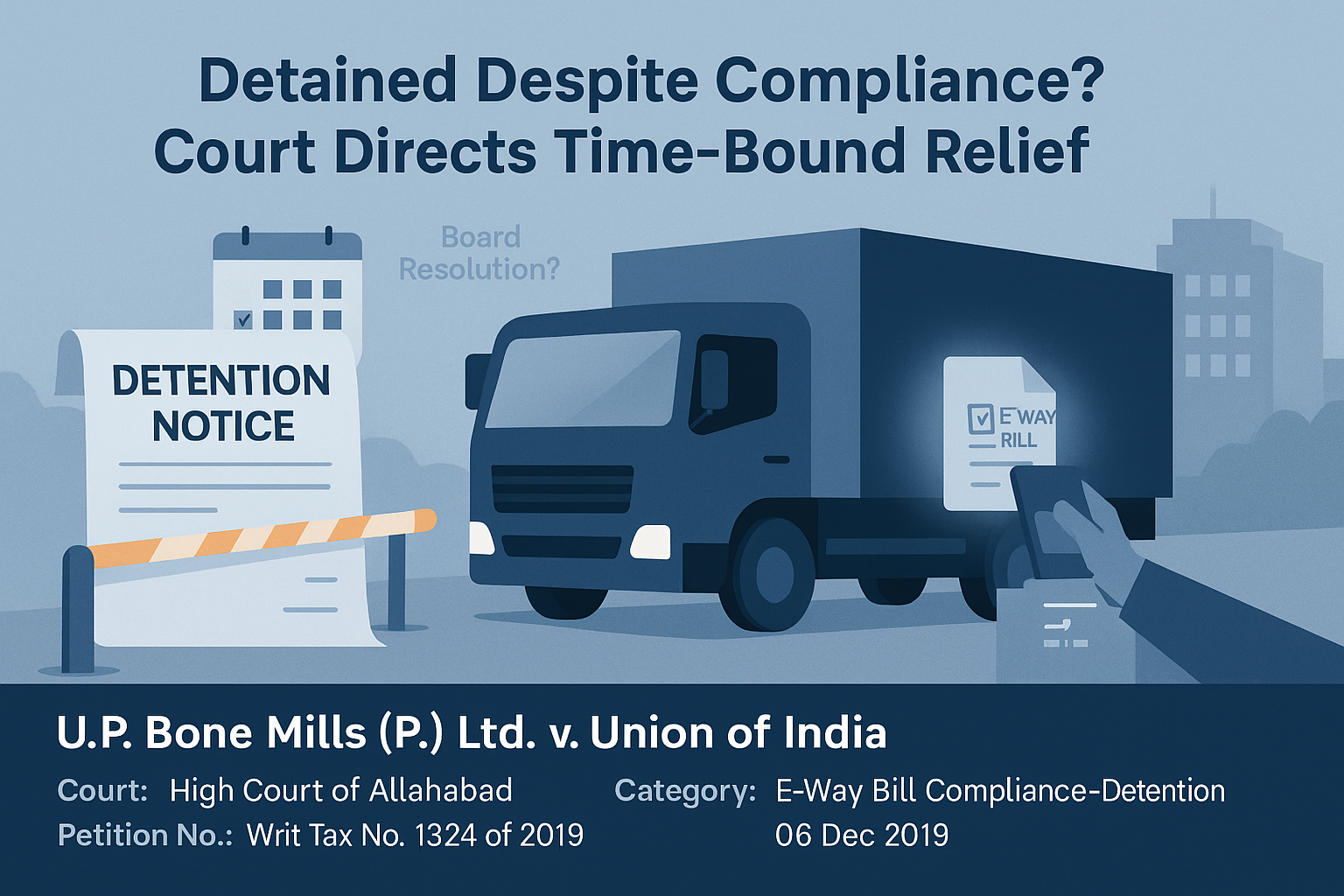
Case Title: U.P. Bone Mills (P.) Ltd. v. Union of India
Court Name: High Court of Allahabad
Petition Number: Writ Tax No. 1324 of 2019
Category of Dispute: Detention of Goods – E-Way Bill Compliance
Date of Judgement: 06 December 2019
Relevant Sections: Section 129 of CGST Act, 2017 (Detention, seizure and release of goods and conveyances in transit)
Facts of the Case [¶1–3]
- U.P. Bone Mills (P.) Ltd. filed a writ petition challenging the detention notices dated 14/15th November 2019 and 18th November 2019 issued by CGST authorities at Muzaffarnagar.
- The seizure was carried out on the ground that the driver/person in charge did not produce valid documents like the e-way bill, although the petitioner claimed that all documents were in fact shown to the officer at the time of interception [¶2].
- The petitioner expressed willingness to pay any excess amount found due after assessment, though the Court noted absence of a Board resolution authorizing such offer by the company [¶3].
Question(s) in Consideration [¶1–2]
- Whether the detention of goods and vehicle by the authorities was justified despite the driver’s submission of valid documents.
- Whether the petitioners were entitled to release of goods upon payment of the dues assessed by the department.
Observation of the Court [¶3–4]
- The Court did not delve into the merits of whether documents were actually produced or not but noted the petitioner’s willingness to pay dues determined upon assessment [¶3].
- The Court took a pragmatic approach and directed the authorities to assess and communicate the excess amount along with applicable penalty to the petitioner within three weeks [¶4].
Judgement of the Court [¶4]
- The writ petition was disposed of with a direction that the respondent authorities calculate and communicate the due amount and penalty to the petitioner within three weeks.
- If the petitioner makes full payment within a week thereafter, the seized goods and vehicle are to be released in accordance with law [¶4].
Between Fine Lines
- The Court prioritized resolution over prolonged litigation by accepting the petitioner’s willingness to pay dues.
- The legality of seizure was not adjudicated upon, implying procedural leniency in commercial matters.
- Payment followed by release was directed to reduce business hardship.
- Lack of Board resolution was noted but not made a ground for rejection.
- Practical relief was preferred over legal formality.
Summary of Referred Cases
(No specific prior cases were cited or relied upon in this judgement.)
| Name of Case | Citation | Summary | Verdict |
| None referred | — | — | — |