
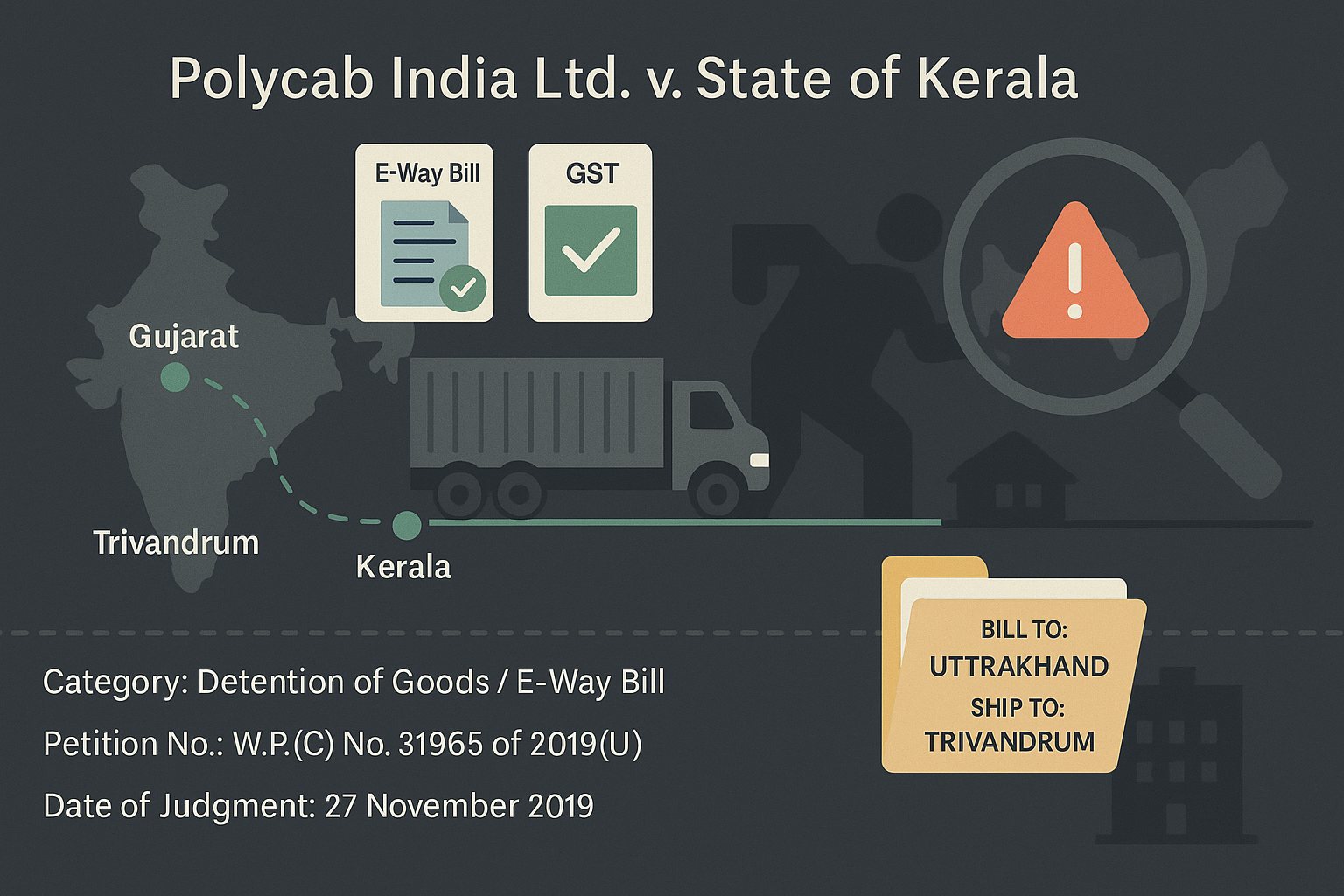
Case Title: Polycab India Ltd. v. State of Kerala
Court: High Court of Kerala
Petition No.: W.P. (C) No. 31965 of 2019(U)
Date of Judgement: 27 November 2019
Section Involved: Section 129 and Section 130 of CGST/SGST Act
Category: Detention of Goods / E-Way Bill / Inter-State Transaction
Facts of the Case
- The petitioner, Polycab India Ltd., challenged the detention of goods and imposition of tax and penalty by the 3rd respondent under Ext.P8 order. The goods were in transit from Gujarat (vendor) to Uttarakhand (purchaser), with delivery directed to Trivandrum on the purchaser’s instructions. [Para 1]
- The consignment was supported by a valid invoice showing a “Bill to (Uttarakhand)/Ship to (Trivandrum)” structure and a corresponding e-way bill reflecting the same. [Para 1]
- Detention was made on the assumption that there was possible evasion of IGST in Kerala and that the consignee in Kerala was an unregistered dealer at the time of detention. [Para 1]
- The petitioner submitted that the grounds for detention were extraneous to Section 129 and that the consignee’s registration details were later provided and acknowledged in the detention order. [Para 2]
Questions in Consideration
- Whether goods can be detained under Section 129 of the CGST/SGST Act based on presumed tax evasion and initial non-verification of consignee’s registration?
- Whether the “Bill to/Ship to” model with a valid e-way bill can justify lawful movement of goods under GST law?
[Para 2]
Observations of the Court
- The High Court held that the reasons for detention, including assumed IGST evasion and lack of immediate registration details of consignee, were irrelevant for invoking Section 129. [Para 3]
- It observed that the documentation was in compliance with the provisions of CGST/SGST, and the “Bill to/Ship to” transaction model was legally permissible. [Para 3]
Judgement of the Court
- The Court directed the 3rd respondent to release the goods and vehicle upon presentation of the judgment by the petitioner. [Para 3]
- It further directed the matter be referred to the adjudicating authority for proceedings, if any, under Section 130 of the Act. [Para 3]
- The writ petition was accordingly disposed. [Para 3]
Between Fine Lines
- Goods moved under a valid “Bill to/Ship to” structure cannot be detained merely due to unfounded suspicion of tax evasion.
- Valid e-way bills and GST invoices, if correctly reflecting the transaction, offer protection against wrongful detention.
- Detention under Section 129 must strictly align with conditions mentioned under the section, not presumptions.
- Lack of immediate registration details, later rectified, is not valid ground for detention.
- Judicial intervention protects genuine trade movements from overreach of departmental powers.
Summary of Referred Cases
No other cases were cited or referred to in the judgment by either side