Monday, April 27, 2026
HomeCase LawsGST demand and show cause notice set aside as denial of reasonable...

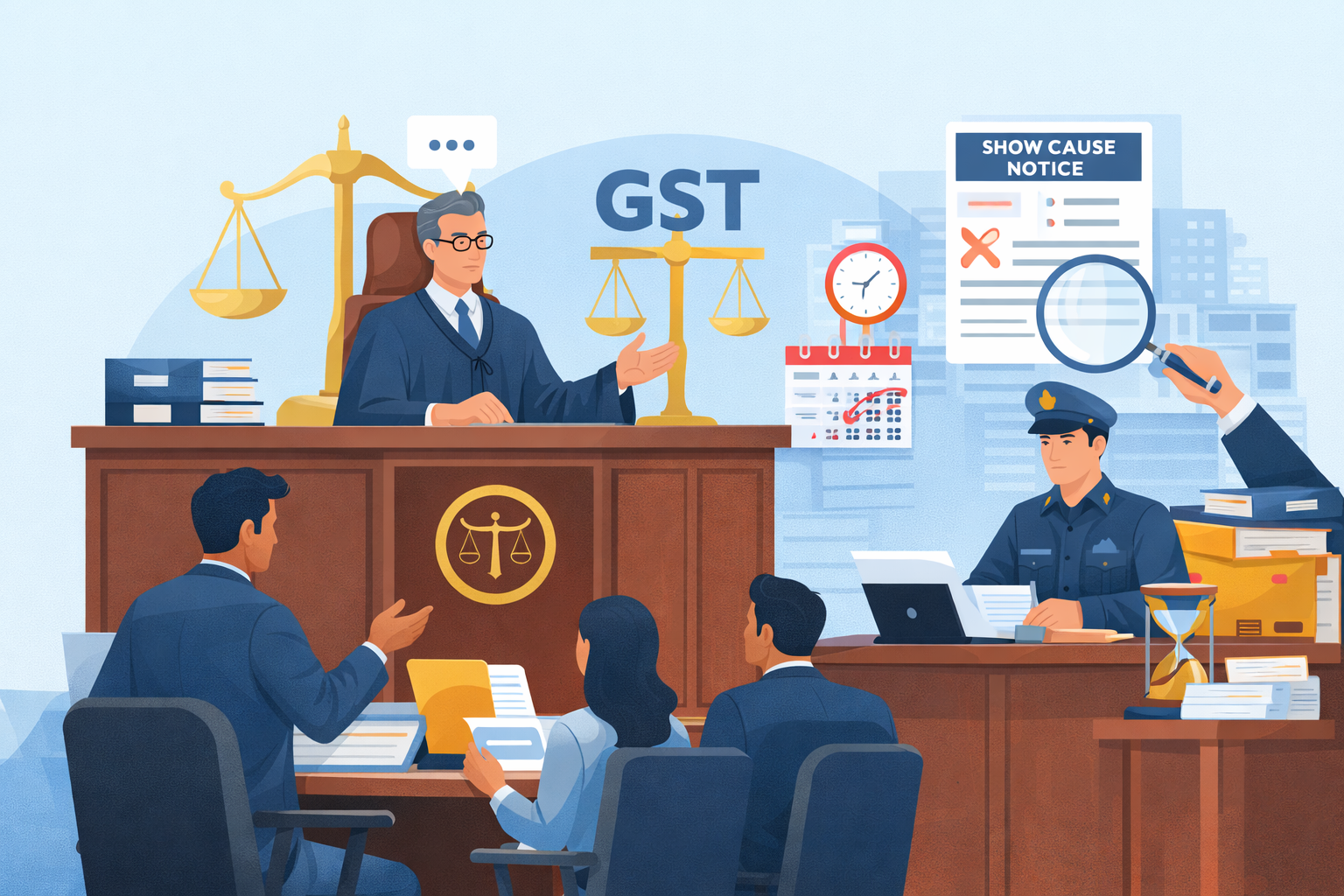
GST demand and show cause notice set aside as denial of reasonable opportunity and cryptic adjudication violated principles of natural justice

Case Reference

Federal Bank Ltd v. Assistant Commissioner, DGST
High Court of Delhi
W.P.(C) 1960 of 2024
Section 73 of the Central Goods and Services Tax Act, 2017
Category of dispute: Input Tax Credit / Output Tax demand – Procedural violation
Date of judgment: 12 February 2024


Facts

The petitioner, a scheduled banking company, was issued a show cause notice dated 23.09.2023 alleging under-declaration of output tax, excess availment of Input Tax Credit, ineligible ITC, and ITC claims from cancelled dealers, return defaulters, and tax non-payers. A detailed reply addressing each allegation head-wise was duly filed on 21.10.2023.

Subsequently, a notice for personal hearing was issued on 24.12.2023 at 8:39 PM, fixing the hearing on 26.12.2023 at 11:30 AM. The intervening date, 25.12.2023, was a gazetted holiday on account of Christmas. Despite the constraints of time and logistics for obtaining instructions from the head office, the adjudicating authority proceeded to pass the impugned order dated 27.12.2023 confirming the proposed demand under Section 73 of the CGST Act, 2017.
(Paras 1–3, 6–7)


Questions

Whether the confirmation of demand under Section 73 of the CGST Act, 2017 was sustainable when the notice of personal hearing was issued at an unreasonably short interval, effectively denying the petitioner an adequate opportunity of being heard, and when the adjudication order failed to record cogent reasons while rejecting a detailed written reply.
(Paras 2, 9–10)


Observations

The Court observed that the show cause notice itself contained detailed allegations, and the petitioner had furnished a comprehensive reply dealing with each issue. However, the impugned order merely recorded that the reply was “not clear and satisfactory” without any analytical discussion or reasoning. Such a cryptic approach, according to the Court, failed to meet the standards of a reasoned quasi-judicial order.

The Bench further noted that if the Proper Officer was of the opinion that the reply was incomplete or required further clarification, the principles of fairness demanded that such deficiencies be specifically communicated to the petitioner. The record did not reflect that any such opportunity was granted.

Importantly, the Court took judicial notice of the fact that the hearing was fixed with virtually no effective notice, having been issued late in the evening of 24.12.2023, followed by a gazetted holiday, thereby rendering the opportunity illusory rather than real. This procedural lapse was held to be a clear violation of the principles of natural justice.
(Paras 6–10)


Judgment

The High Court held that the impugned adjudication order could not be sustained due to denial of adequate opportunity of hearing and absence of reasoned findings. Consequently, both the order dated 27.12.2023 and the underlying show cause notice were set aside.

The matter was remitted to the Proper Officer for fresh adjudication. Specific directions were issued requiring the Proper Officer to intimate, within one week, the precise details or documents required from the petitioner. Upon such intimation, the petitioner was granted one week to furnish explanations and documents. The adjudicating authority was directed to complete re-adjudication within two weeks thereafter, strictly after granting an effective opportunity of personal hearing. The Court clarified that it had not expressed any opinion on the merits of the tax allegations, leaving all contentions open.
(Paras 11–13)


Relevant Statutory Provisions

  • Section 73, Central Goods and Services Tax Act, 2017

  • Principles of natural justice governing quasi-judicial adjudication under the CGST framework


Between the Fine Lines – Practical Takeaway

This ruling reiterates that GST adjudication is not a mere formality. Issuance of hearing notices at impracticable hours, fixation of hearings across holidays, and passing non-speaking orders expose demands to judicial invalidation. For trade and industry, the decision underscores that detailed replies cannot be brushed aside mechanically and that procedural fairness remains a non-negotiable safeguard even in revenue proceedings.

Disclaimer – “The above summary is for academic purpose only; not formal legal opinion. Seek professional opinion before application. Author or publisher or website shall not be responsible for any usage in any form.”

RELATED ARTICLES

Leave a Reply

Most Popular

Recent Comments

Discover more from GST Indiaguide

Subscribe now to keep reading and get access to the full archive.

Continue reading