M/s Delhi MSW Solutions Limited v. Assistant Commissioner of State Tax & Ors.
Delhi High Court – W.P.(C) 5236/2024
Date of judgment: 22 May 2024
Relevant provisions: Sections 73, 75(3) of the Central Goods and Services Tax Act, 2017
Category of dispute: Input Tax Credit – Adjudication under Section 73 / Violation of principles of natural justice
Facts
The petitioner, M/s Delhi MSW Solutions Limited, was issued a Show Cause Notice dated 24 September 2023 proposing a demand of ₹8.79 crore under Section 73 of the CGST Act on multiple allegations, including under-declaration of output tax, excess availment of Input Tax Credit, ineligible ITC, and ITC claimed from cancelled dealers and return defaulters. The petitioner submitted a detailed written reply dated 30 October 2023, supported with documents, which was uploaded on the GST portal in November 2023. Despite this, the Proper Officer passed an order dated 29 December 2023 confirming the demand along with penalty, holding the reply to be “partially not satisfactory” without engaging with the explanations furnished under various heads
Questions before the Court
Whether an adjudication order passed under Section 73 of the CGST Act can be sustained when the Proper Officer fails to meaningfully consider the taxpayer’s detailed reply and supporting documents, and merely records a summary conclusion of partial dissatisfaction without reasoned analysis
Observations
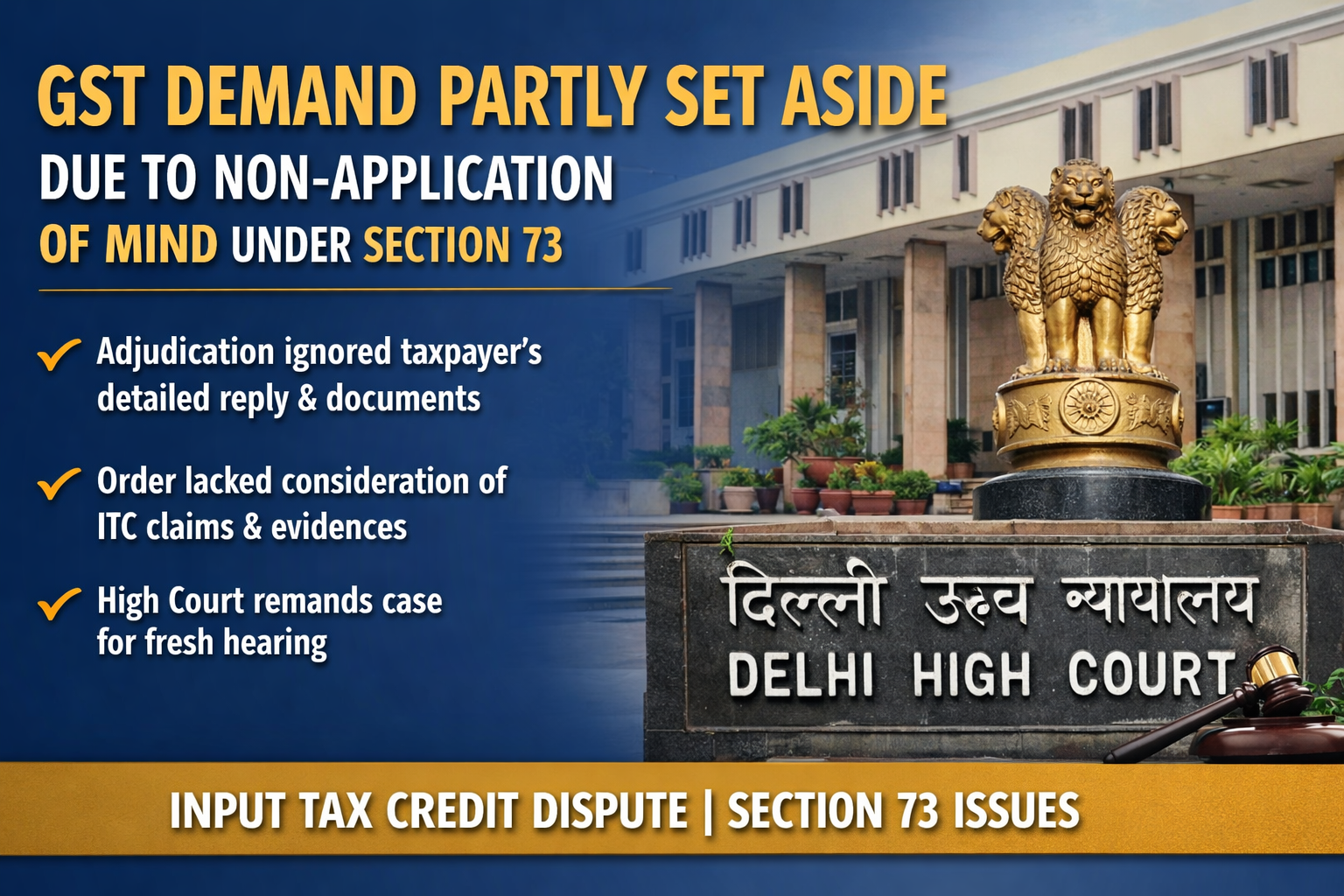
The High Court observed that the Show Cause Notice raised multiple distinct issues under separate heads, and the petitioner had responded to each allegation with detailed explanations and documentary evidence. However, the impugned order merely recorded that the reply was “partially found not satisfactory” and selectively accepted certain points while rejecting others on the bald ground that supporting documents were not provided, without discussing the reply in substance. The Court held that such an approach ex facie demonstrates non-application of mind, as the Proper Officer is duty-bound to examine the entire reply, evaluate the material placed on record, and pass a reasoned and speaking order. An adjudication order cannot be sustained if it fails to reflect consideration of the taxpayer’s defence in a meaningful manner
Judgment
The Delhi High Court set aside the impugned order dated 29 December 2023 only to the extent it rejected the petitioner’s reply on issues relating to (i) excess ITC claimed due to non-reconciliation, (ii) under-declaration of ineligible ITC, and (iii) ITC claimed from cancelled dealers, return defaulters, and tax non-payers. These issues were remanded to the Proper Officer for fresh adjudication. The Court directed that the petitioner be permitted to file a supplementary reply within two weeks, followed by a personal hearing, and mandated that a fresh speaking order be passed within the statutory time limit under Section 75(3). The portions of the order dropping demand on outward tax reconciliation and ITC on non-business/exempt supplies were left undisturbed. The Court clarified that it expressed no opinion on merits and left all rights and contentions open
Between Fine Lines – Practical Takeaway for Trade & Industry
This judgment reinforces that GST adjudication is not a mechanical exercise. Where a taxpayer files a detailed, issue-wise reply with supporting documents, the Proper Officer must engage with the defence and record clear reasons for acceptance or rejection. Cryptic orders confirming large ITC demands without proper reasoning are vulnerable to being set aside on grounds of violation of natural justice, even without examining the merits of tax liability.
Cases referred – Summary Table
| Case | Court | Core Issue | Verdict |
|---|---|---|---|
| M/s Delhi MSW Solutions Limited v. AC State Tax | Delhi High Court | Non-consideration of reply in Section 73 adjudication | Demand partly set aside; matter remanded for fresh adjudication |
Disclaimer – “The above summary is for academic purpose only; not formal legal opinion. Seek professional opinion before application. Author or publisher or website shall not be responsible for any usage in any form.”