Case Details
-
Case Title: NHPC Ltd. v. Principal Commissioner, CGST and Ors.
-
Court: High Court of Himachal Pradesh
-
Petition No.: CWP No. 10471 of 2024
-
Date of Judgment / Order: 20.09.2024
-
Category of Dispute: Classification of free power supply – whether “compensation” or “consideration” under GST
-
Relevant Sections: Section 74(9) CGST Act, 2017; Section 74(9) SGST Acts; Section 21 UTGST Act; Section 73(1) Finance Act, 1994
Facts (Paras 2–13)
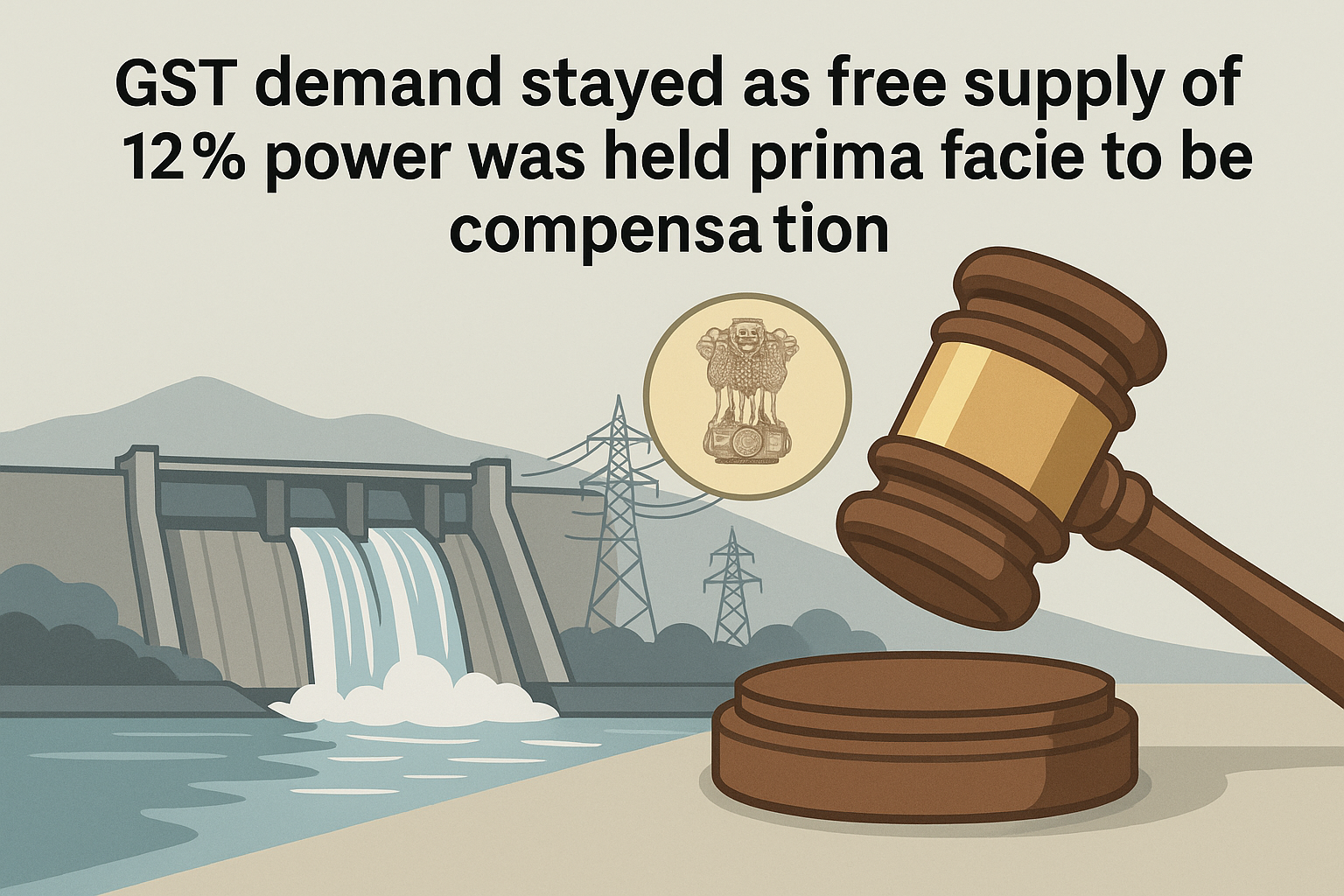
NHPC Ltd., a government company engaged in hydropower generation, entered into agreements with various State Governments including Himachal Pradesh. Under these agreements, it provided 12% free power to the State and 1% to local area development funds as compensation for displacement, environmental impact, and distress caused by the projects. The impugned order dated 14.06.2024 (Annexure P-1) demanded GST of over ₹1,000 crores, holding such free power as “consideration” for licensing services by States.
Earlier, service tax proceedings under the Finance Act, 1994 on the same issue were dropped by the Additional Director General (Adjudication) vide order dated 19.06.2024 (Annexure P-9), holding that free power is “compensation” and not “royalty”. Reliance was placed on CESTAT rulings in South Eastern Coalfields Ltd. and Mahanadi Coalfields Ltd.
Questions for Determination (Paras 7–9, 17–20)
-
Whether free supply of 12% electricity by NHPC to States is “consideration” for services or “compensation” for environmental distress?
-
Whether GST authorities can take a view contrary to service tax adjudication under the same Ministry of Finance?
-
Whether Himachal Pradesh High Court has jurisdiction when part of the liability relates to its territorial jurisdiction?
Observations (Paras 14–24)
The Court noted that:
-
The Service Tax authority had already held the supply of free power to be “compensation” and not taxable (para 13).
-
Prima facie, different departments of the same Ministry cannot take conflicting views unless the earlier order is appealed and overturned (para 15–16).
-
The impugned GST order directly contradicted the service tax adjudication, creating legal uncertainty (para 16–17).
-
The Court prima facie agreed that GST applies only on supply made for “consideration” (Section 2(31), CGST Act). Free power seems more akin to compensation than a contractual quid pro quo (para 24).
-
Jurisdiction was confirmed since NHPC has GSTIN in Himachal Pradesh and part liability exceeding ₹100 crores related to the State (para 22).
Judgment (Paras 25–26)
The Court held that there was prima facie merit in NHPC’s contention that free power supply is compensation, not consideration. Given the conflicting departmental views and the enormous financial stakes (over ₹1,000 crores), the Court ordered an interim stay on all proceedings pursuant to the impugned order dated 14.06.2024, pending final adjudication. The matter was listed for further hearing on 18.11.2024.
Case Law Table
| Case Referred | Forum | Verdict |
|---|---|---|
| South Eastern Coalfields Ltd. v. Principal Commissioner, CGST & CE, Indore (Service Tax Appeal No. 54988/2023) | CESTAT, New Delhi | Compensation is not consideration; no service tax leviable |
| Mahanadi Coalfields Ltd. v. Commissioner of CGST & CE, Rourkela (Service Tax Appeal No. 75432/2022) | CESTAT, Kolkata | Payments like NPV/CAMPA charges are compensation, not consideration |
| Navinchandra N. Majithia v. State of Maharashtra (2000) 7 SCC 640 | Supreme Court | Part cause of action sufficient to confer High Court jurisdiction |
Between Fine Lines
For hydropower companies, this order signals that free power supply under State agreements may not be treated as taxable consideration but as compensation for environmental and social costs. Until the final verdict, GST demands on this issue are vulnerable to challenge, especially where service tax authorities have already ruled in favor of “compensation.”
Disclaimer – “The above summary is for academic purpose only; not formal legal opinion. Seek professional opinion before application. Author or publisher or website shall not be responsible for any usage in any form.”