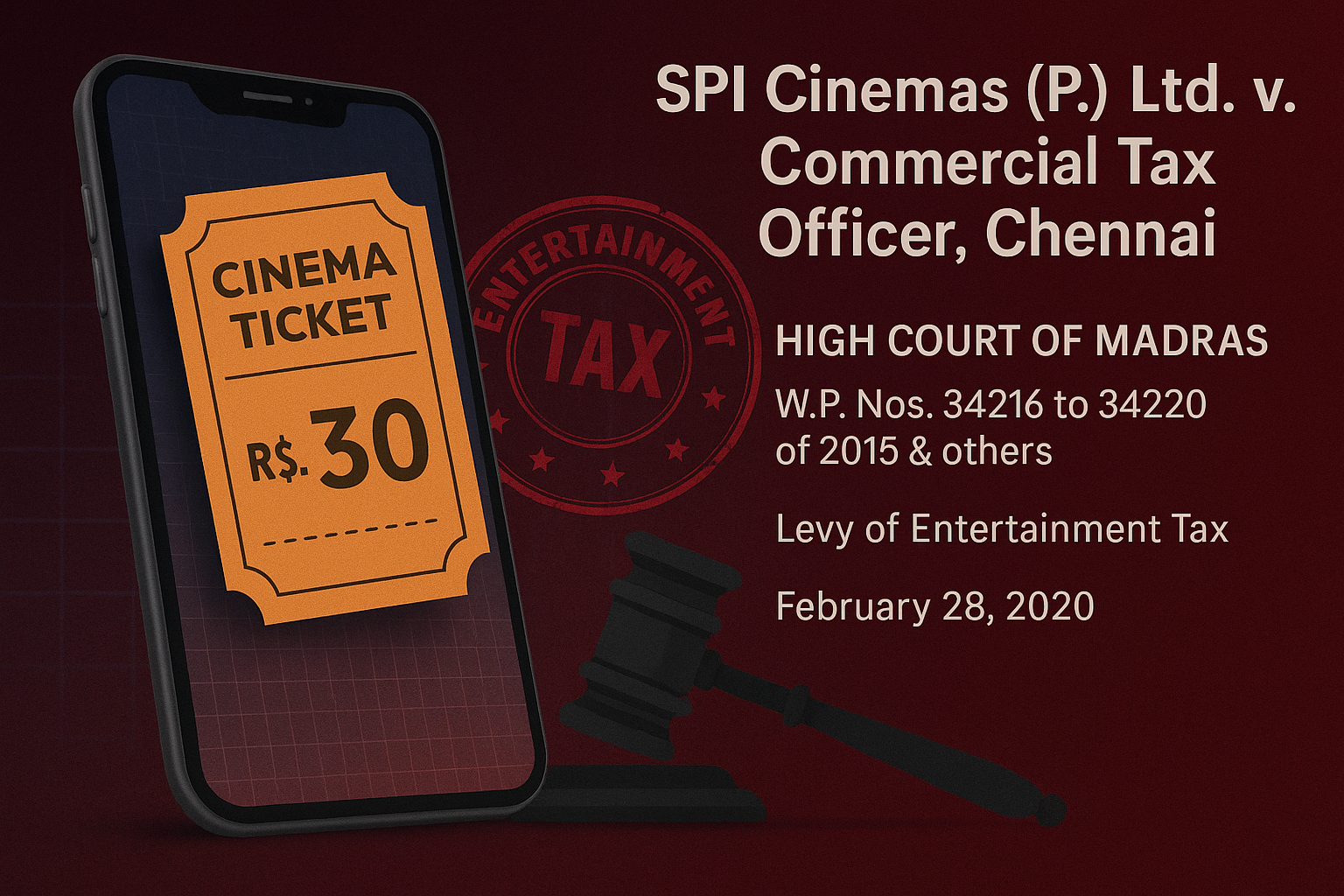
Case Title: SPI Cinemas (P.) Ltd. v. Commercial Tax Officer, Chennai
Court: High Court of Madras
Petition Number: W.P. Nos. 34216 to 34220 of 2015 & others
Category: Levy of Entertainment Tax
Date of Judgment: February 28, 2020
Relevant Law: Section 3(7)(c) of the Tamil Nadu Entertainment Tax Act, 1939; Rule 4 and 20 of Tamil Nadu Entertainment Tax Rules, 1939; Rule 83(1A)(a) of the Tamil Nadu Cinema Regulation Rules, 1957
Facts of the Case
- The petitioner operates multiplexes in Tamil Nadu, offering facilities including online booking of movie tickets with home delivery options, charging ₹30 per ticket for online bookings besides ticket cost (Para 1–2).
- The Commercial Taxes Department conducted an inspection and issued pre-assessment proposals seeking to levy entertainment tax on the ₹30 online booking charges under Section 3(7)(c) of the TNET Act (Para 3–4).
- Petitioners contended that online booking charges are not for entertainment but for service convenience and are paid to third-party portals like Book My Show (Para 5, 15).
- The assessing officer passed orders confirming the levy of entertainment tax on online booking charges; these were challenged in writ petitions (Para 7).
Question(s) in Consideration
Whether online booking charges levied by multiplexes form part of “payment for admission” under Section 3(7)(c) of the Tamil Nadu Entertainment Tax Act, 1939, and are thus exigible to entertainment tax? (Para 14)
Observations of the Court
- Section 3(7)(c) of the TNET Act includes within “payment for admission” any amount paid as a condition for attending or continuing to attend entertainment. Hence, booking charges form part of admission fee (Para 11–14, 27).
- The argument that booking is distinct from admission was rejected; both are integral to accessing the entertainment (Para 25).
- Supreme Court decisions in Sunrise Associates and Doypack Systems were relied on to conclude that distinctions between connected services and the main act are legally unsustainable (Para 22–26).
- The analogy of Drive-in Enterprises case was used to show that charges improving the entertainment experience (like taking a car inside) are part of the entertainment and taxable (Para 28–34).
- The court rejected the argument that the Act, being old, cannot include modern means like online booking; statutory interpretation must evolve with technological changes (Para 36–37).
Judgment of the Court
The Court upheld the levy of entertainment tax on online booking charges, dismissed all writ petitions, and granted petitioners two weeks to file statutory appeals from the date of receipt of the order (Para 38–39).
Between Fine Lines
- Online booking charges are part of the cost for accessing entertainment, not a separate service.
- The TNET Act includes all payments connected with attending entertainment, even if charged separately.
- Charges for enhanced convenience or comfort (like online booking) are taxable.
- Legislative language must evolve with modern practices, like online systems.
- Writ petitions were dismissed; statutory remedy was kept open.
Summary of Referred Cases
| Case Name | Citation | Summary | Verdict/Use in Judgment |
| T.N.K. Govindarajulu Chetty | [1951] 2 STC 26 (Mad.) | Willful default must be proven before levying penalty | Cited to support argument against penalty without intention (Para 6) |
| Dy. Commissioner v. Adam & Co. | [1970] 43 STC 508 (Mad.) | Similar principle regarding willful default | Supportive of petitioner’s stance (Para 6) |
| R. Abdul Aziz v. State of Tamil Nadu | (1987) 67 STC 273 | Willfulness necessary for penalty | Supportive of petitioner’s contention (Para 6) |
| Funworld & Tourism Development Ltd. | [2013] 40 taxmann.com 677 / 59 VST 306 (Guj HC) | Amusement park entry vs. ride charges treated distinctly | Distinguished by Madras HC; not applicable to theatre scenario (Para 18–21) |
| Sunrise Associates v. Govt. of NCT | [2006] 4 STT 105 (SC) | Actionable claim principle; composite right concept | Applied to show inseparability of booking and admission (Para 22–25) |
| Doypack Systems Pvt. Ltd. | [1988] 2 SCC 299 | “Connected with” and “in relation to” are synonymous | Used to counter petitioner’s semantic argument (Para 26) |
| State of Karnataka v. Drive-in Enterprises | 2002 taxmann.com 2347 | Tax on cars entering drive-in theatre upheld as enhancing entertainment | Applied as precedent for taxing ancillary facilities (Para 28–34) |
| Senior Electric Inspector v. Laxminarayan Chopra | [1962] 3 SCR 146 | Law must be interpreted dynamically in light of technological evolution | Used to reject argument that 1939 Act cannot include online booking (Para 36) |