
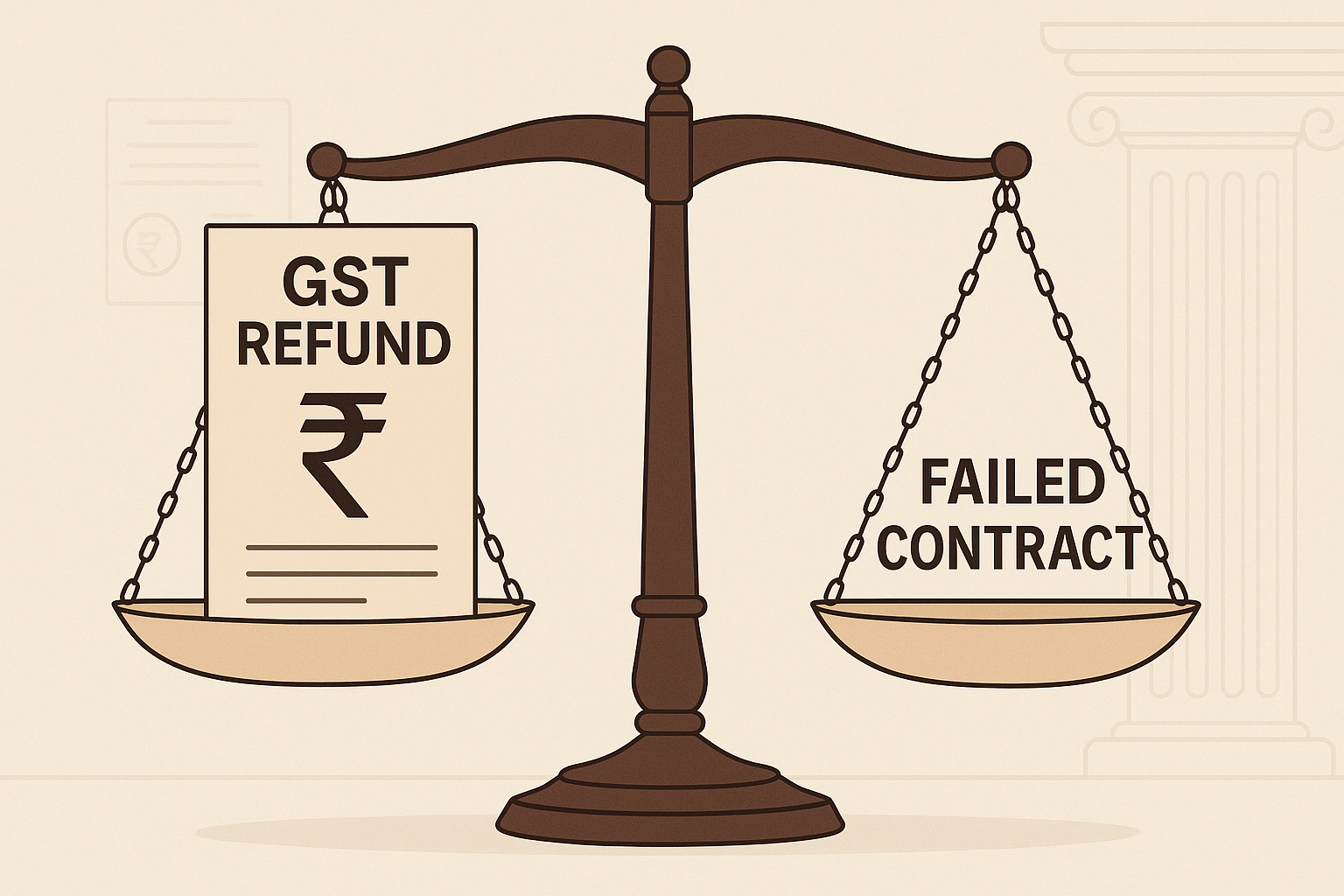
Case Title: Joint Commissioner of Commercial Taxes (Appeals-1) & Anr. v. M/s NAM Estates Pvt. Ltd.
Court: High Court of Karnataka, Bengaluru
Petition No.: Writ Appeal No. 1195 of 2024 (T-RES)
Category: Refund of GST (Failure of Contract – Tax paid on Advance)
Date of Judgment: 9 January 2025
Relevant Sections: Section 54 of CGST/SGST Act, 2017; Article 265 of the Constitution of India; reference to Section 11B of Central Excise Act, 1944 (by analogy).
Facts (Paras 2.1–2.5)
M/s NAM Estates Pvt. Ltd. had entered into a contract with M/s Mavin Switch Gears and Control Pvt. Ltd. for the supply and installation of high-voltage sub-stations. An advance of ₹14.08 crore was paid, and the supplier issued a tax invoice dated 01.08.2017 charging GST of ₹2.53 crore, which was duly reflected in GSTR-1 and GSTR-3B. However, the supplier failed to deliver the goods, leading to contract cancellation in March 2021 and recovery of the advance through encashment of the bank guarantee. NAM Estates applied for a refund of ₹2.53 crore GST under Section 54 on 05.07.2021. The Assistant Commissioner rejected the claim on 06.09.2021 for want of eligibility proof, and the appellate authority on 30.09.2023 upheld the rejection, holding that refund could not be claimed by the buyer as the supplier was responsible for issuing credit notes.
Questions (Para 3–4)
Whether the recipient of supply (buyer) is entitled to claim refund of GST paid on advance when the contract fails and no supply is made, and whether the refund mechanism under Section 54 can be invoked by such a claimant in absence of a credit note from supplier.
Observations (Paras 5.1–5.4)
The Division Bench noted that since the contract stood rescinded and the advance amount was recovered, the tax component remitted to the government could not be retained by the State. Tax attaches to a transaction; if the transaction fails, the levy collapses. Retaining such tax would amount to unconstitutional appropriation of private property without authority of law, offending Article 265.
The Court endorsed the Single Judge’s finding (para 7) that neither the buyer nor the vendor had any GST liability once the contract was cancelled, invoking the doctrines of restitution and unjust enrichment. The Court relied on Oswal Chemicals & Fertilizers Ltd. v. CCE, Bolpur (2015) 14 SCC 431 and Mafatlal Industries Ltd. v. Union of India (1997) 5 SCC 536, affirming that even a purchaser can claim refund if tax payment was without corresponding supply.
Judgment (Paras 5.1–5.4, concluding)
The Division Bench dismissed the Revenue’s appeal, holding that the refund of ₹2.53 crore was rightly directed by the Single Judge. The Court reiterated that “Caesar cannot retain monies of citizens without statutory justification.” The appellants were ordered to refund the amount within eight weeks, failing which contempt and interest recovery from erring officials could ensue.
Summary of Cases Referred
| Case | Citation | Ratio / Verdict |
|---|---|---|
| Oswal Chemicals & Fertilizers Ltd. v. CCE, Bolpur | (2015) 14 SCC 431 | Term “any person” in Section 11B of Central Excise Act includes purchaser; refund can be sought even by buyer. |
| Mafatlal Industries Ltd. v. Union of India | (1997) 5 SCC 536 | Tax collected without authority of law must be refunded; unjust enrichment applies only where burden passed on. |
Between Fine Lines
For trade and industry, this ruling clarifies that GST paid on advances for contracts that are later cancelled—without supply or service—cannot be retained by the government. Even the recipient of supply (buyer) can claim a refund directly under Section 54, without waiting for the supplier to issue a credit note. Businesses should document cancellation, refund of advances, and absence of supply clearly to establish refund entitlement and avoid double taxation.
Disclaimer – “The above summary is for academic purpose only; not formal legal opinion. Seek professional opinion before application. Author or publisher or website shall not be responsible for any usage in any form.”