


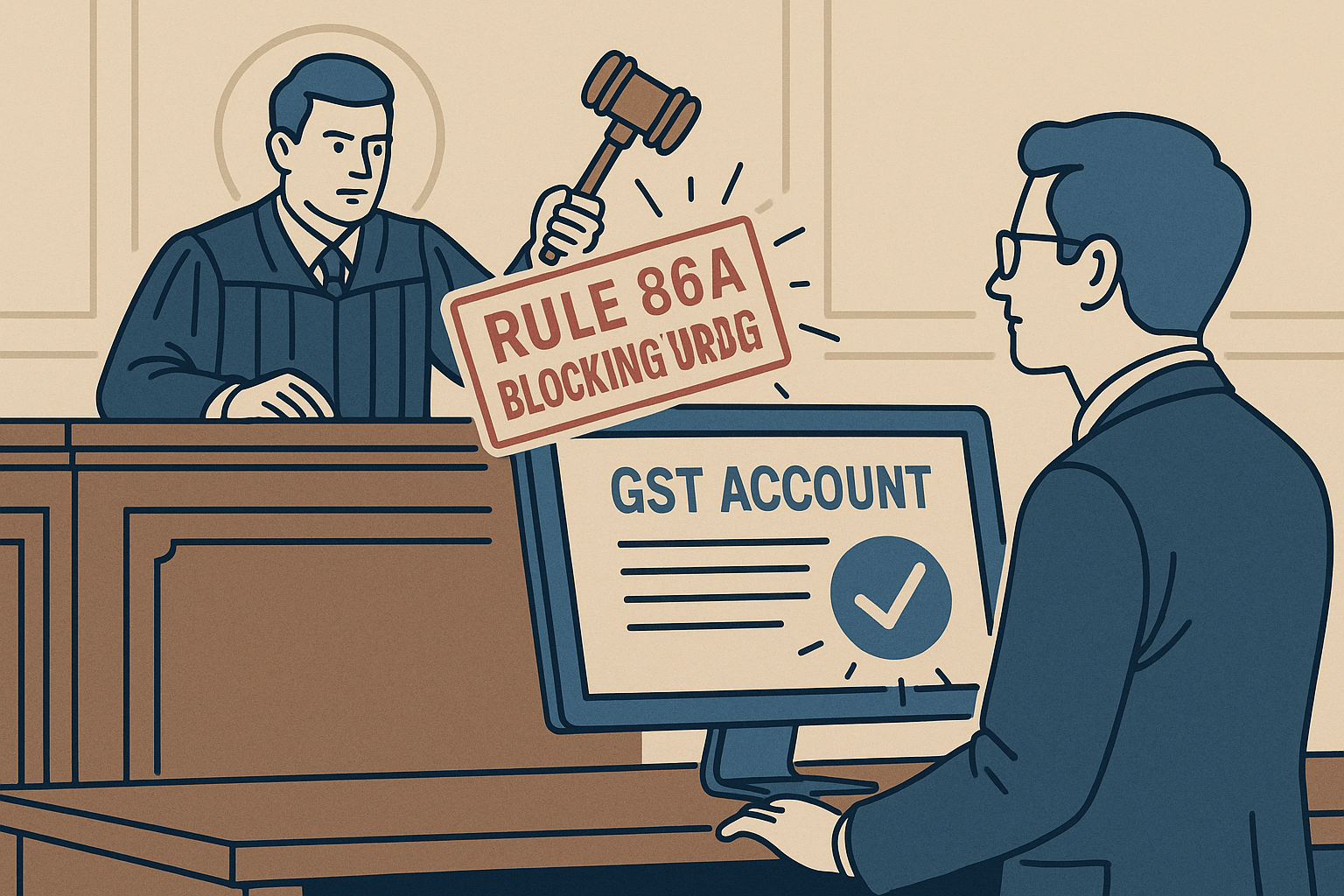
Case Summary: The Lead Factory v. Assistant Commissioner of Commercial Taxes, High Court of Karnataka, W.P. No. 7301 of 2025, decided on 14.03.2025 – Category: Input Tax Credit (Rule 86A blocking of ledger)
Relevant Provisions: Rule 86A of the CGST/SGST Rules, 2017; Articles 14 and 19(1)(g) of the Constitution of India
Facts (Para 1–3):
The petitioner, The Lead Factory, challenged the order dated 27.09.2024 passed by the Assistant Commissioner of Commercial Taxes under Rule 86A of the CGST Rules, blocking its electronic credit ledger (ECL). The petitioner contended that the blocking was done without prior notice, without any “reasons to believe,” and based solely on borrowed satisfaction from enforcement reports alleging that certain suppliers were involved in fake invoicing. The petitioner also questioned the constitutional validity of Rule 86A as arbitrary and violative of Articles 14 and 19(1)(g).
Questions / Issues (Para 2–3):
-
Whether blocking of ITC under Rule 86A without pre-decisional hearing and independent “reasons to believe” violates natural justice.
-
Whether reliance on borrowed satisfaction or investigation reports satisfies the requirements of Rule 86A.
Court’s Observations (Para 5–9):
The Court relied extensively on the Division Bench ruling in K-9 Enterprises v. State of Karnataka (W.A. No. 100425/2023), which had held that:
-
Rule 86A is draconian and extraordinary, requiring strict compliance with its conditions.
-
“Reasons to believe” must be formed independently by the jurisdictional officer based on tangible material, not borrowed from other authorities.
-
The CBIC Circular dated 02.11.2021 mandates a careful and reasoned application of mind before blocking the ledger.
-
Blocking ITC mechanically defeats the value-added tax chain and causes unjust hardship to bona fide taxpayers.
Applying these principles, the Court observed that in the petitioner’s case, no pre-decisional hearing was given, and the impugned order merely stated that the supplier was a “bill trader” without any reasoning or evidence. The authority had relied solely on external enforcement reports without forming its own satisfaction, which is impermissible in law.
Judgement (Para 6–7):
The Court quashed the impugned order dated 27.09.2024 blocking the ECL under Rule 86A. It directed the respondents to immediately unblock the petitioner’s electronic credit ledger to enable filing of returns. However, liberty was granted to the department to proceed in accordance with law and in terms of the K-9 Enterprises judgment.
Summary of Cases Referred:
| Case | Court | Principle / Verdict |
|---|---|---|
| K-9 Enterprises v. State of Karnataka (W.A. No.100425/2023) | Karnataka HC (DB) | Pre-decisional hearing mandatory; independent “reasons to believe” required; Rule 86A power to be used with utmost care. |
| Radha Krishan Industries v. State of H.P. | Supreme Court | “Reasons to believe” and proportionality required before provisional attachment. |
| Xiaomi Technology India v. Union of India | Karnataka HC | Provisional attachment invalid if based on borrowed satisfaction; independent opinion necessary. |
| Indian Minerals v. Income Tax Department | Karnataka HC | Mere apprehension of revenue loss insufficient; tangible material required for attachment. |
Between Fine Lines (Practical Takeaway):
The judgment reiterates that blocking of ITC under Rule 86A cannot be mechanical or based on borrowed satisfaction. Officers must record specific reasons supported by evidence and offer a fair hearing before restricting credit. This ensures that genuine taxpayers are not penalised for suppliers’ defaults, preserving the value-added credit chain that is fundamental to GST.
Disclaimer – “The above summary is for academic purpose only; not formal legal opinion. Seek professional opinion before application. Author or publisher or website shall not be responsible for any usage in any form.”

