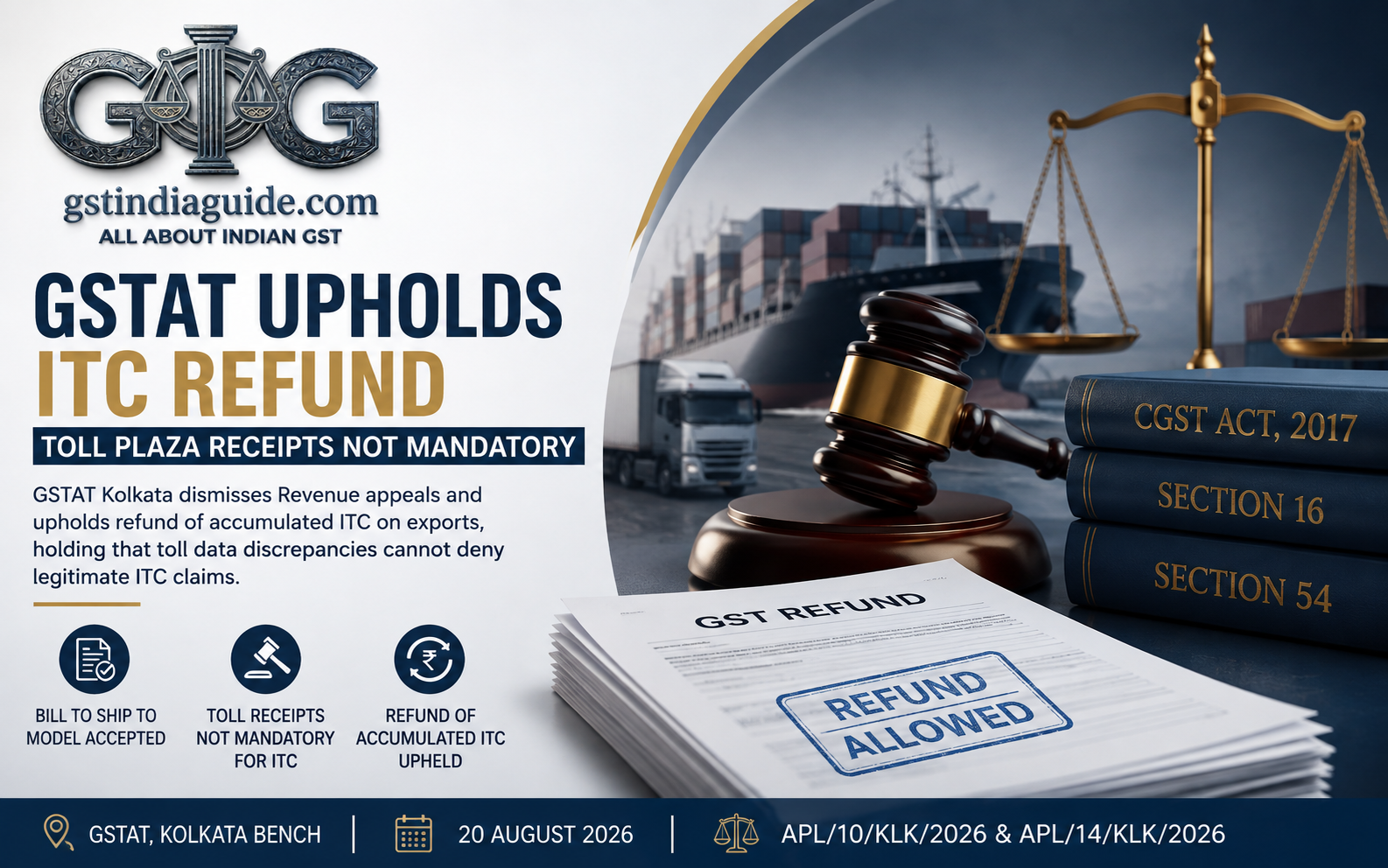
The Goods and Services Tax Appellate Tribunal (GSTAT), Kolkata Bench has dismissed two appeals filed by the Revenue against M/s Agarwala’s Bitumex Private Limited, upholding the orders of the First Appellate Authority which had allowed refund of accumulated Input Tax Credit (ITC) arising from export transactions. The Tribunal held that discrepancies in toll plaza movement, by themselves, could not justify denial of ITC and refund when the taxpayer had produced undisputed statutory and commercial documents establishing receipt, transportation and export of the goods.
Case Details
Case: The Pr. Commissioner, CGST & CX, Siliguri Commissionerate v. M/s Agarwala’s Bitumex Private Limited
Forum: Goods and Services Tax Appellate Tribunal, Kolkata Bench, Court No. 1
Appeal Nos.: APL/10/KLK/2026 & APL/14/KLK/2026
Coram: Hon’ble Shri Sunil Kumar Singh, Judicial Member and Hon’ble Shri Bijoy Kumar Kar, Technical Member
Date of Order: 20 August 2026
Result: Revenue appeals dismissed; Orders-in-Appeal upheld.
Background
M/s Agarwala’s Bitumex Private Limited was engaged, inter alia, in supply and export of goods including iron/non-alloy steel products and bitumen. It claimed refund of accumulated ITC under Section 54 of the CGST Act amounting to ₹11,41,828 for January 2025 and ₹27,65,697 for February 2025. The jurisdictional adjudicating authority rejected both refund claims after issuing separate show cause notices.
On appeal, the Joint Commissioner (Appeals), CGST & CX, Siliguri allowed the refund claims and set aside the original orders. The Revenue consequently approached the GSTAT under Section 112(1) of the CGST Act.
Revenue’s Objections
The principal objection of the Revenue was that the toll movement associated with the consignments did not indicate movement from West Bengal, although the supplier was based in Kolkata. According to the Revenue, the vehicles were reflected as moving through Bihar and Uttar Pradesh, creating doubt regarding the declared origin and genuineness of the inward supplies.
The Revenue also relied upon the fact that the respondent’s immediate supplier, M/s KS Metals Private Limited, had allegedly procured goods from two upstream suppliers whose GST registrations had been cancelled ab initio. It was therefore argued that the respondent had not satisfied the conditions for ITC under Section 16 and consequently could not obtain refund of accumulated ITC under Section 54(3).
GSTAT on Bill-to Ship-to Transactions and Toll Data
The Tribunal noted that the Department itself did not dispute that the goods had reached the “ship-to” location and had subsequently been exported. Export through the Land Customs Station was confirmed, and the Bank Realisation Statement had also been received in the office of the DGFT.
The GSTAT found that the transactions were structured under the “Bill To–Ship To” model, under which the exporter instructed its supplier to deliver the goods directly at the place of export. The Tribunal held that there is no provision under GST law requiring goods to necessarily commence their movement from the registered premises of the supplier.
The taxpayer had produced E-way Bills, bilty copies, shipping bills, Export General Manifest details, transporter certificates and relevant bank statements. These documents collectively established transportation, delivery and subsequent export of the goods, and importantly, the Revenue had not disputed their authenticity.
Toll Plaza Receipts Are Not Mandatory for ITC
Relying upon Raghuvansh Agro Farms Ltd. v. State of U.P., (2026) 38 Centax 53 (All), Writ Tax No. 3829 of 2025, the GSTAT held that toll plaza receipts are not statutory documents required for establishing transportation of goods.
The Tribunal observed that where transactions are supported by tax invoices, E-way Bills, bilty/transport documents and payments through banking channels, absence or discrepancy in toll plaza records cannot by itself be treated as sufficient to negate the physical movement of goods.
Accordingly, the Tribunal held that toll plaza receipts are not a mandatory requirement for availing ITC.
Cancellation of Registration of Upstream Suppliers
The Revenue also sought to deny the refund because two suppliers in the second level of the supply chain had registrations cancelled ab initio.
The GSTAT found that the respondent’s direct supplier, M/s KS Metals Private Limited, had a valid GST registration and continued to exist on the GST portal. There was no direct connection between the respondent and the second-line suppliers.
The Tribunal therefore held that the respondent could not be made liable for irregularities allegedly committed by suppliers further upstream in the supply chain, particularly when no irregularity in the respondent’s own export transactions had been established. Consequently, refund of ITC could not be denied on this ground.
Revenue Cannot Introduce New Grounds at the Tribunal Stage
The GSTAT further observed that certain allegations—relating to Customs/DGGI concerns, licensing requirements for bitumen and the conduct of another entity—were sought to be raised by the Revenue for the first time before the Tribunal.
The Tribunal noted that these issues were not part of the original show cause notices. It referred to Rule 45(1) of the GSTAT (Procedure) Rules, 2025 and Rule 112(1) of the CGST Rules, 2017, which restrict production of additional evidence before the Tribunal except in permissible circumstances.
Since no supporting investigation documents or appropriate application for bringing additional evidence on record had been produced, and the licensing issue had not formed part of the show cause notice, the Tribunal declined to entertain those grounds at the appellate stage.
Decision
The GSTAT concluded that the respondent had complied with the conditions contained in Section 16(2) of the CGST Act and had adequately established the movement, receipt and export of the goods through undisputed documentary evidence.
It therefore upheld the Orders-in-Appeal allowing the refund and dismissed Revenue Appeal Nos. APL/14/KLK/2026 and APL/10/KLK/2026. The summary order expressly records that the impugned appellate orders were upheld and the Revenue’s appeals were dismissed.
Key Takeaway
The ruling reinforces that toll plaza movement data is not an independent statutory condition for claiming ITC under Section 16 of the CGST Act. Where genuine movement and export are established through tax invoices, E-way Bills, transport documents, banking records, shipping bills and EGM records, ITC and consequential refund cannot be denied merely because toll data does not correspond with the supplier’s registered location.
The decision also recognises that a bona fide purchaser dealing with a validly registered immediate supplier cannot automatically be deprived of ITC merely because irregularities are alleged against suppliers further upstream. Further, grounds and evidence outside the show cause notice cannot ordinarily be introduced for the first time at the GSTAT stage contrary to the applicable procedural rules.